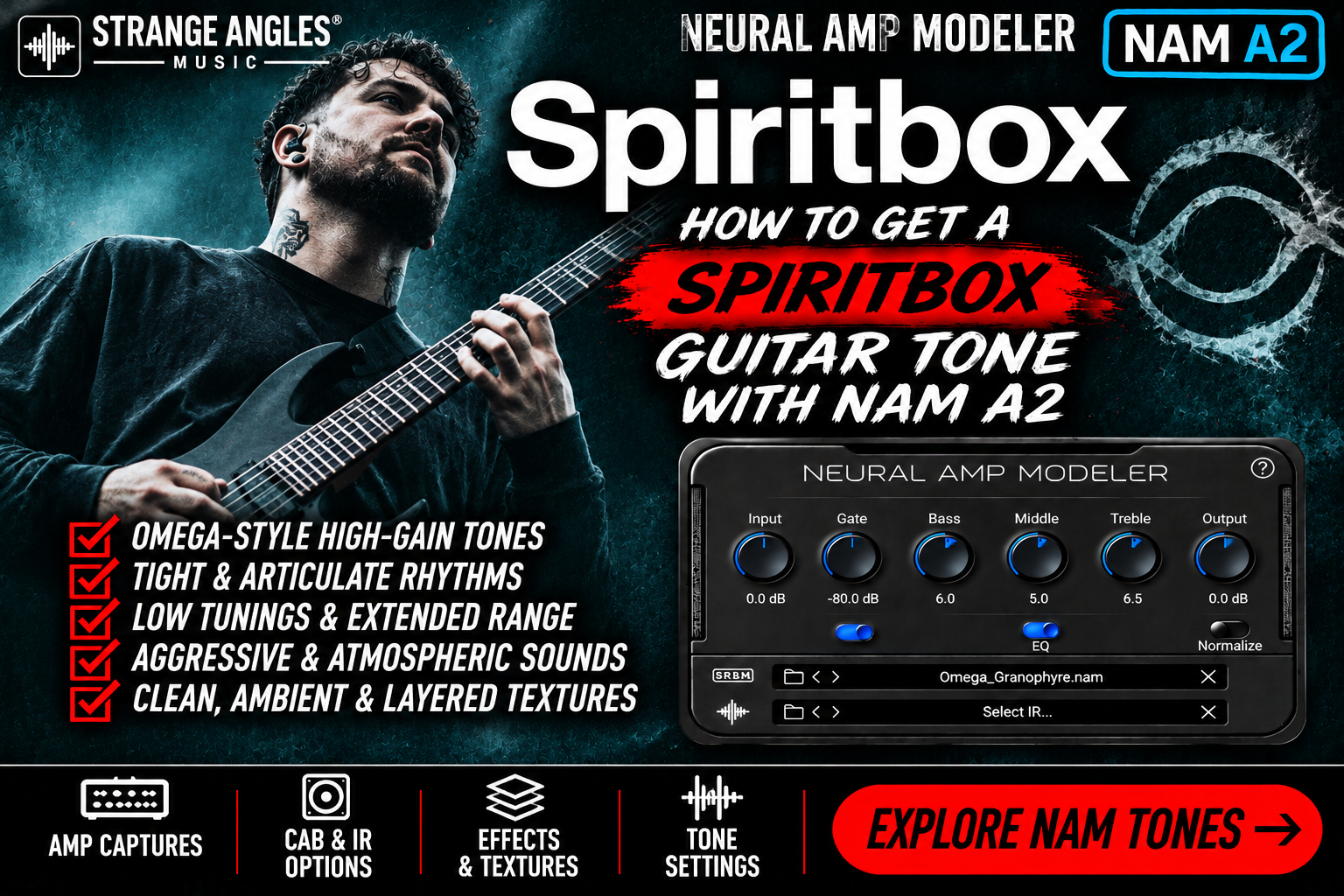
How to Get a Spiritbox Guitar Tone with NAM A2
Want to recreate the crushing, atmospheric, and modern guitar tones of Spiritbox using Neural Amp Modeler (NAM)?
Spiritbox has become one of the most recognizable bands in modern metalcore, combining extremely low-tuned guitars, aggressive distortion, intricate rhythms, atmospheric cleans, and massive production.
Guitarist Mike Stringer has developed a distinctive sound that moves between crushing riffs and spacious, melodic guitar textures.
From Eternal Blue and The Fear of Fear to Tsunami Sea, Spiritbox demonstrates how modern metal guitar tones can be incredibly heavy while remaining clear, dynamic, and expressive.
One of the interesting things about Mike Stringer's approach is his use of digital amp modeling. He has used Neural DSP's Archetype: Nolly for recording, and his famous Quad Cortex playthrough of "Circle With Me" used a capture of an Omega Granophyre amplifier.
That makes this a particularly interesting sound to explore using NAM.
In this guide, we'll look at Mike Stringer's guitar setup, the amplifiers associated with his sound, how to build a Spiritbox-inspired NAM A2 signal chain, and which Strange Angles Music products are worth exploring.
Looking for Great NAM A2 Tones?
Spend less time searching for the right amplifier and more time creating.
Explore professionally captured amplifiers, preamps, and overdrives designed for modern metal, metalcore, progressive metal, and aggressive rhythm guitar.
What Makes the Spiritbox Guitar Tone So Distinctive?
Spiritbox combines several different guitar sounds.
The heavy sections feature aggressive, low-tuned distortion and tight rhythmic playing. The cleaner sections use atmospheric effects, spacious arrangements, and layered textures.
Some of the defining characteristics include:
Extremely low guitar tunings
Extended-range guitars
Tight, aggressive palm mutes
Strong midrange presence
Articulate high-gain distortion
Clear note separation
Pick scrapes and harmonics
Atmospheric clean guitar sounds
Pitch shifting and modulation
Layered guitar arrangements
One of the most important aspects of Mike Stringer's sound is maintaining clarity at extremely low tunings.
Simply adding more bass or gain won't achieve that.
The guitar, pickups, string gauges, amplifier response, cabinet, and playing technique all contribute to keeping the sound tight.
What Amplifiers Does Mike Stringer Use?
Mike Stringer has experimented with different amplifier and modeling setups throughout Spiritbox's career.
His approach has evolved from software-based recording tones to sophisticated digital live rigs.
1. Omega Granophyre
The Omega Granophyre is one of the most interesting amplifiers associated with Mike Stringer's sound.
His official "Circle With Me" Quad Cortex playthrough used a capture of an Omega Granophyre 100-watt amplifier head.
This is especially relevant because the Omega Granophyre is available in the Strange Angles Music NAM catalog.
The Granophyre is known for its aggressive high-gain character, powerful midrange, and tight response.
It is an excellent starting point for exploring Spiritbox-inspired rhythm guitar.
2. EVH 5150 Stealth
Mike's more recent live rig, documented in Premier Guitar's February 2026 Rig Rundown, uses a Fractal Audio Axe-Fx III with a PVH 6160 model based on the EVH 5150 Stealth.
This is another interesting amplifier direction for players looking to create modern metalcore tones.
The 5150 family is known for aggressive high-gain distortion, strong attack, and a tight response.
3. Neural DSP Archetype: Nolly
For the recording of Eternal Blue, Mike Stringer used Neural DSP's Archetype: Nolly plugin for the distorted guitar tones.
This is an important detail because it demonstrates that his studio sound isn't dependent on one physical amplifier.
Digital modeling and processing have been part of his recording workflow for years.
4. Friedman Amplifiers
Mike has also discussed using a boosted Friedman amplifier as an alternative to his Omega capture.
This is another example of how he experiments with different amplifier characters rather than relying on one sound for everything.
5. Neural DSP Quad Cortex
Mike has used the Quad Cortex for live performances and recording playthroughs.
His "Circle With Me" playthrough used an Omega Granophyre capture, demonstrating how a captured amplifier can deliver a powerful, consistent guitar sound.
His more recent live setup has evolved, so it is worth distinguishing that earlier Quad Cortex setup from his 2026 Fractal rig.
What Guitar Does Mike Stringer Use?
Mike Stringer is closely associated with Aristides guitars.
His signature Aristides STX is available in six-, seven-, and eight-string configurations.
His guitars are designed around extended-range playing and extremely low tunings.
The seven-string models are particularly important to his sound.
His more recent setup includes:
Aristides STX seven-string guitars
Aristides eight-string guitars
Bare Knuckle Halcyon signature pickups
EverTune bridges
Multi-scale options
His seven-string guitars are tuned down to F-sharp.
That's extremely low for a seven-string guitar, but the right guitar construction, pickups, scale length, and string setup help maintain clarity.
Why Does Mike Use Such Low Tunings?
Low tunings are an important part of Spiritbox's sound.
They allow Mike to create massive riffs and unusual chord voicings while maintaining the band's modern metalcore character.
However, tuning extremely low introduces challenges.
If the strings are too loose, the guitar can sound muddy and lose definition.
For low-tuned guitar playing, consider:
Appropriate string gauges
Longer scale lengths
Multi-scale guitars
High-quality pickups
Proper intonation
A stable bridge system
Mike has specifically discussed how his guitar setup helps keep extremely low tunings clear and controlled.
Best NAM Amplifiers for Spiritbox-Inspired Guitar Tones
You don't need Mike Stringer's exact rig to experiment with this sound.
Several Strange Angles Music NAM captures provide excellent starting points.
1. Omega Granophyre
Best starting point for the classic Spiritbox-inspired sound
This is my first recommendation because of Mike Stringer's documented use of an Omega Granophyre capture in his "Circle With Me" Quad Cortex playthrough.
The Granophyre offers an aggressive modern high-gain character with strong midrange and tight low-end response.
Try it for:
Low-tuned rhythm guitar
Modern metalcore
Aggressive palm mutes
Tight djent-style riffs
Powerful lead tones
Heavy progressive metal
If you want to explore the amplifier character behind that famous Quad Cortex playthrough, this is the logical place to start.
2. Fortin Evil Pumpkin
The Fortin Evil Pumpkin is another excellent option for aggressive modern metal.
It offers a different high-gain character from the Granophyre and is worth experimenting with when building tight, articulate rhythm tones.
Try it for:
Aggressive metalcore
Tight rhythm guitar
Low-tuned riffs
Heavy modern distortion
3. Driftwood Purple Nightmare
The Driftwood Purple Nightmare is another option for players looking for a powerful modern high-gain sound.
Its aggressive character makes it worth exploring for heavier rhythm guitar and progressive metal.
4. RedSeven Leviathan
The RedSeven Leviathan is another useful amplifier to experiment with.
It offers a different tonal character from the Omega and Fortin designs and can provide another direction for modern metalcore tones.
5. Dover DA 50
The Dover DA 50 is worth exploring if you want another high-gain amplifier option.
Experiment with different cabinet IRs and gain settings to find the right balance of thickness, attack, and clarity.
These are alternative amplifier options for building your own Spiritbox-inspired tone. They are not claims that Mike Stringer used these particular Strange Angles captures.
How to Get a Spiritbox Guitar Tone Using NAM A2
Let's build a practical signal chain.
Step 1: Start With the Omega Granophyre Capture
Begin with the Omega Granophyre NAM capture.
Start with the amplifier by itself before adding additional processing.
Listen for:
Tight low-end response
Strong midrange
Clear palm mutes
Aggressive distortion
Good note separation
Responsive picking dynamics
The goal is a powerful, modern rhythm tone that remains clear at low tunings.
Step 2: Add a Noise Gate
A noise gate is useful for controlling unwanted noise during aggressive rhythm playing.
Place it before the amplifier capture as a starting point.
Adjust the threshold so that it controls noise without cutting off sustained notes.
This is particularly important when playing extremely low-tuned riffs.
Step 3: Experiment With an Overdrive
A Tube Screamer-style overdrive can help tighten the low end and improve picking response.
Try these general starting settings:
Drive: Low
Tone: Adjust to your pickups and cabinet
Level: Moderately high
The purpose is to tighten the signal entering the amplifier rather than simply add more distortion.
Step 4: Choose the Right Cabinet IR
The cabinet is a major part of the final sound.
A 4x12 cabinet is a useful starting point for modern metalcore.
Experiment with:
Vintage 30-style speakers
Mesa-style 4x12 cabinets
Marshall-style 4x12 cabinets
Creamback speakers
SM57 microphone positions
Different microphone blends
If you're using a D.I. capture, add an appropriate cabinet IR.
If you're using a full-rig capture, check whether the cabinet and microphone coloration are already included.
Step 5: Keep the Low End Controlled
This is one of the most important parts of a Spiritbox-inspired sound.
Extremely low tunings can quickly become muddy if the guitar has too much bass or gain.
Try:
Reducing unnecessary low frequencies before the amplifier
Using a suitable overdrive
Adjusting the cabinet IR
Reducing excessive gain
Applying subtle post-capture EQ
The goal is a guitar tone that sounds massive without becoming loose.
Step 6: Preserve the Midrange
Don't automatically scoop the mids.
A strong midrange helps the guitar remain present alongside the bass, drums, and vocals.
Experiment with:
Upper mids for pick attack
Lower mids for body
Controlled bass
Smooth high frequencies
The guitar needs to remain aggressive without becoming harsh.
Step 7: Experiment With Different Amplifier Characters
Try recording different performances through different NAM captures.
For example:
Guitar A: Omega Granophyre for an aggressive, focused rhythm sound.
Guitar B: Fortin Evil Pumpkin for a different high-gain character.
Record separate performances and pan them left and right.
This creates natural stereo width and allows each guitar to contribute a different character.
How to Get Spiritbox-Style Atmospheric Guitar Sounds
Spiritbox isn't just about heavy rhythm guitar.
Mike Stringer uses a variety of effects and textures to create contrast between aggressive riffs and atmospheric sections.
NAM handles the amplifier capture, while separate effects plugins can provide the additional processing.
1. Chorus
Chorus is useful for creating wider, more spacious clean guitar sounds.
Try subtle settings for atmospheric passages and more pronounced modulation for experimental sections.
2. Delay
Delay is an important part of creating spacious guitar textures.
Experiment with:
Short delay times for thickness
Quarter-note delay
Longer atmospheric repeats
Modulated delay
Different wet/dry balances
3. Reverb
Reverb helps create the atmospheric clean sounds that contrast with Spiritbox's heavy riffs.
Try combining a clean or lower-gain amplifier capture with delay and reverb.
4. Pitch Shifting
Mike Stringer uses pitch-shifting tools to create unusual guitar textures.
Try:
Octave-up effects
Octave-down effects
Whammy-style pitch shifting
Expression pedal control
Pitch shifting can also be useful for creating layered harmonies and unusual transitions.
5. Freeze Effects
A freeze effect can sustain a chord or note while you play additional guitar parts.
This is useful for atmospheric arrangements and evolving textures.
6. Pick Scrapes and Harmonics
Mike has discussed his appreciation for pick scrapes and harmonics, including influences from bands such as Gojira.
These techniques can add aggression and character to otherwise conventional riffs.
Experiment with:
Pick scrapes
Natural harmonics
Pinch harmonics
Artificial harmonics
Feedback and sustained notes
Sometimes the most distinctive part of a guitar tone comes from how the instrument is played rather than the amplifier.
Recommended NAM Signal Chains for Spiritbox-Inspired Tones
Here are three practical starting points.
Modern Spiritbox Rhythm
Noise Gate
Optional Overdrive
Omega Granophyre NAM Capture
4x12 Cabinet IR
Subtle Post-EQ
Output
Aggressive Metalcore Rhythm
Noise Gate
Fortin Evil Pumpkin NAM Capture
Cabinet IR
Post-EQ
Output
Atmospheric Spiritbox Guitar
Clean or Crunch NAM Capture
Chorus or Modulation
Delay
Reverb
Output
These are suggested starting points, not exact recreations of Mike Stringer's original recording chains.
Best NAM Packs for Spiritbox-Inspired Guitar Tones
Here are the Strange Angles Music products I would explore for this particular sound.
1. NAM Everything Pack
Best overall choice for amplifier variety
The NAM Everything Pack gives you a broad selection of amplifier captures for experimenting with modern metal tones.
Featured amplifiers include:
Fortin Evil Pumpkin
Fortin Meshuggah 2.0
Omega Granophyre
Omega Obsidian 1.5
Driftwood Purple Nightmare
Dover DA 50
RedSeven Leviathan
Dimebag Darrell Warhead Mini
MLC S_ZERO 93 Silenoz
MLC S_ZERO 100
It also includes cabinet captures, preamps, and overdrives.
The Omega Granophyre makes this collection particularly interesting for players looking to explore the amplifier character associated with Mike Stringer's "Circle With Me" Quad Cortex playthrough.
Best for: Modern metalcore, progressive metal, djent, and guitarists who want a wide selection of high-gain NAM captures.
2. The Chuggernaut – NAM Pack
Best for tight, aggressive modern rhythm tones
The Chuggernaut NAM Pack offers another direction for modern metal guitar.
It includes:
EVH 5150 III Mod
KSR Orthos
ENGL Savage
4 D.I. amplifier captures
9 full-rig captures
8 custom IRs
The custom IRs feature Celestion Creamback and Vintage 30 speakers.
This is a useful collection if you're looking for tight, aggressive amplifier tones and multiple cabinet options.
Best for: Modern metalcore, aggressive rhythm guitar, djent, and low-tuned guitar playing.
Explore The Chuggernaut – NAM Pack →
3. Euge Valovirta – Hard Hitters Vol. 2 NAM
Best for additional high-gain amplifier options
This collection includes:
24 A2 D.I. amplifier captures
24 A2 full-rig studio captures
3 A2 D.I. overdrive captures
Featured amplifiers include:
Soldano SLO-100
Marshall 1959HW Jose Mod Plexi
Marshall JCM800 2203 The Bad Boy
Marshall JCM800 2203 The Little Brother
Peavey 5150 II
Peavey 5150 Block Letter
ADA MP-1 preamp into Fryette PS-100 power amp
It also includes Maxon OD808, BOSS SD-1, and MXR Custom Badass Modified overdrive captures.
This is a good option if you want more amplifier variety beyond modern boutique high-gain designs.
Best for: Modern metal, classic high-gain tones, metalcore, and players who enjoy experimenting with different amplifier characters.
Explore Euge Valovirta – Hard Hitters Vol. 2 NAM →
4. Individual NAM Amplifier Packs
If you prefer to purchase a specific amplifier rather than a larger collection, explore the individual NAM amplifier packs.
The Omega, Fortin, RedSeven, and Driftwood amplifier families are all worth exploring for different modern metal tones.
Best for: Guitarists who already know which amplifier character they want.
Browse Individual NAM Amplifier Packs →
How to Make Your Spiritbox Guitar Tone Sound Better in a Mix
Double-Track Your Rhythm Guitars
Record two separate performances of the same guitar part.
Pan one left and the other right.
This creates natural stereo width and helps the guitars sound much larger.
Don't Overdo the Gain
A clear, articulate guitar tone will usually sound heavier in a mix than one with excessive distortion.
Keep the Low End Controlled
Let the bass guitar provide much of the deepest low-frequency weight.
The guitars should focus on attack, aggression, and midrange definition.
Use Different Guitar Textures
Don't make every track sound identical.
Combine aggressive rhythm tones, clean atmospheric parts, and different effects to create contrast.
Leave Space for the Vocals
Spiritbox's arrangements often combine dense guitar production with melodic vocals.
Avoid excessive midrange buildup that makes the guitars compete with the vocal.
Frequently Asked Questions
What amplifier does Mike Stringer use?
Mike Stringer has used different amplifier and modeling setups. His "Circle With Me" Quad Cortex playthrough used an Omega Granophyre capture. His more recent live setup, documented in February 2026, uses a Fractal Axe-Fx III with a PVH 6160 model based on the EVH 5150 Stealth.
What is the best NAM capture for Spiritbox?
The Omega Granophyre is my first recommendation because Mike Stringer used an Omega Granophyre capture for his "Circle With Me" Quad Cortex playthrough.
What guitar does Mike Stringer use?
Mike is closely associated with Aristides STX guitars, including seven- and eight-string models.
His signature guitars feature Bare Knuckle Halcyon pickups and EverTune bridges.
What tuning does Spiritbox use?
Mike Stringer's seven-string guitars are tuned down to F-sharp. Spiritbox also uses different tunings depending on the song and arrangement.
Can I get a Spiritbox guitar tone with NAM A2?
Yes. You can use high-gain NAM captures, cabinet IRs, overdrives, EQ, and additional effects to create your own Spiritbox-inspired guitar tones.
Did Spiritbox use Neural DSP for recording?
Yes. Mike Stringer used Neural DSP's Archetype: Nolly plugin for the distorted guitar tones on Eternal Blue.
Does Mike Stringer use Quad Cortex?
Yes. He has used the Quad Cortex, including his "Circle With Me" playthrough with an Omega Granophyre capture. His more recent live setup has evolved to a Fractal Axe-Fx III.
Do I need a seven-string guitar?
A seven-string is useful for recreating Mike's extremely low-tuned guitar parts. However, you can still explore many Spiritbox-inspired tones using a properly set up six-string or another extended-range guitar.
Do I need a cabinet IR with NAM?
It depends on the capture.
D.I. amplifier captures generally need a cabinet IR or another cabinet stage. Full-rig captures may already include the cabinet and microphone response.
Final Thoughts
Spiritbox's guitar sound is built around extremely low tunings, tight amplifier response, aggressive rhythm playing, and atmospheric textures.
Mike Stringer's use of the Omega Granophyre capture on his "Circle With Me" Quad Cortex playthrough makes that amplifier a particularly interesting starting point for this style.
The NAM Everything Pack gives you access to the Omega Granophyre alongside a broad selection of other high-gain amplifiers.
The Chuggernaut and Euge Valovirta Hard Hitters Vol. 2 collections offer additional amplifier and cabinet options.
Experiment with different captures, cabinet IRs, overdrives, and effects.
Keep the low end controlled, preserve the midrange, and don't be afraid to combine aggressive rhythm tones with atmospheric clean sounds.
With the right captures and signal chain, you can build your own Spiritbox-inspired guitar setup using Neural Amp Modeler.
Find Your Next NAM Guitar Tone
Explore the Strange Angles Music NAM collection and discover professionally captured amplifiers, preamps, and overdrives for metalcore, progressive metal, modern metal, and more.