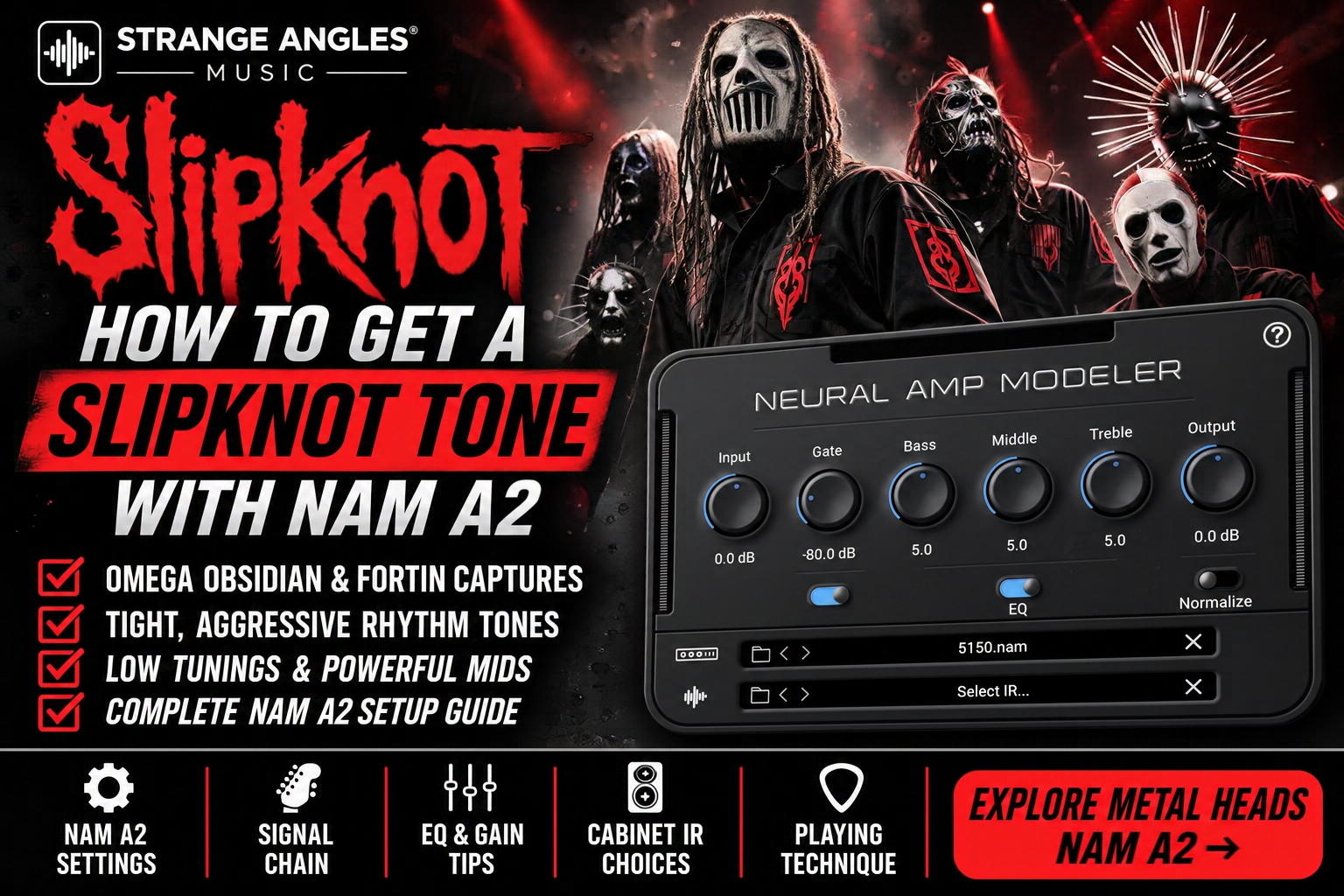
How to Get a Slipknot Guitar Tone with NAM A2
Want to get the crushing, aggressive guitar tones of Slipknot using Neural Amp Modeler (NAM)?
Slipknot helped define modern heavy music with a guitar sound built around massive low-end, aggressive distortion, tight palm-muted riffs, and powerful rhythmic attacks.
Mick Thomson and Jim Root have developed distinctive guitar sounds using different amplifiers, guitars, and recording techniques throughout the band's career.
From the raw aggression of Slipknot and Iowa to the massive production of All Hope Is Gone and We Are Not Your Kind, the band's guitar tones have continued to evolve.
One particularly interesting amplifier connection is Mick Thomson's use of the Omega Obsidian, which is also available as a capture in the Strange Angles Music Metal Heads NAM A2 collection.
In this guide, we'll explore the amplifiers behind Slipknot's sound, how to build your own Slipknot-inspired NAM A2 signal chain, and which Strange Angles Music captures are worth trying.
Looking for Great NAM A2 Tones?
Spend less time searching for the right amplifier and more time playing.
Explore professionally captured boutique amplifiers, preamps, and overdrives designed for modern metal, nu metal, groove metal, and aggressive rhythm guitar.
🎸 Browse Premium NAM Profiles and Captures →
What Makes the Slipknot Guitar Tone So Distinctive?
Slipknot's guitar sound combines aggression, weight, and precision.
The guitars need to sound enormous while maintaining enough clarity for fast riffs, dissonant chords, palm-muted patterns, and complex rhythmic arrangements.
Some of the defining characteristics include:
Aggressive high-gain distortion
Tight, powerful palm mutes
Strong midrange presence
Thick low-frequency response
Clear pick attack
Low-tuned guitars
Wide, layered rhythm guitar production
Different amplifier tones blended together
One important thing to understand is that Slipknot hasn't relied on one amplifier or one guitar tone throughout its career.
Mick Thomson and Jim Root have experimented with different amplifier combinations, cabinets, and processing approaches across different albums.
That gives you several interesting directions to explore using NAM.
What Amplifiers Have Slipknot Used?
Slipknot's guitarists have used a variety of amplifiers throughout their careers.
Some documented examples include:
Omega Obsidian
Omega Iridium
Rivera amplifiers
VHT/Fryette amplifiers
Mesa/Boogie amplifiers
Diezel Herbert
Marshall JCM800
Rocktron Piranha preamp
The band's early recording setups were quite different from the more elaborate amplifier combinations used on later albums.
Mick Thomson and the Omega Obsidian
One of the strongest connections between Slipknot and Strange Angles Music is Mick Thomson's use of the Omega Ampworks Obsidian.
In a 2019 Thomann rig rundown, Mick demonstrated the Obsidian as part of his live amplifier setup.
He also discussed the development of his relationship with Omega and the amplifier's tonal characteristics.
In an interview with Guitar World, Mick explained that he used both the Omega Obsidian and an Omega Iridium prototype while recording We Are Not Your Kind.
He experimented with blending different amplifiers to create the guitar sounds on that record.
This makes the Obsidian a particularly interesting amplifier to explore for Slipknot-inspired tones.
Mick Thomson's Earlier Recording Setup
The original Slipknot album used a much different amplifier arrangement.
Mick has discussed recording the album with a Rocktron Piranha preamp into a Mesa/Boogie 295 power amplifier.
He also used an equalizer in the effects loop to shape the sound.
This is a good reminder that the band's early guitar tone wasn't simply the result of plugging into a modern high-gain amplifier.
Jim Root's Amplifier History
Jim Root has used several different amplifiers throughout his career.
Some documented examples include:
Mesa/Boogie .50 Caliber Plus
Mesa/Boogie DC-10
Rivera Knucklehead Reverb
Diezel Herbert
Peavey 5150
Orange Rockerverb
His approach has changed considerably over the years, and he has discussed how important it is for the guitar tone to work within the overall sound of the band.
Best NAM A2 Amplifiers for a Slipknot-Inspired Guitar Tone
You don't need to duplicate every part of the original rigs to get a similar tonal character.
Several high-gain amplifier captures in the Strange Angles Music NAM collection are worth exploring.
1. Omega Obsidian 1.5
<badge color="success">Best direct artist connection</badge>
The Omega Obsidian is my first recommendation for this article because of its documented connection to Mick Thomson.
Its aggressive high-gain character makes it a great option for:
Heavy rhythm guitar
Aggressive palm mutes
Modern metal
Down-tuned riffs
Powerful lead tones
Start with the Obsidian capture and experiment with different cabinet IRs and EQ settings.
The goal is to create a powerful, aggressive rhythm sound without excessive distortion.
2. Fortin Evil Pumpkin
The Fortin Evil Pumpkin is another excellent option for aggressive modern metal.
It offers a saturated high-gain character that works well for heavy rhythm guitar and aggressive lead sounds.
Try it when you want a different tonal direction from the Omega Obsidian.
3. Omega Granophyre
The Omega Granophyre is worth exploring for tight, aggressive modern metal tones.
It offers a different character from the Obsidian and can be useful for fast rhythm guitar and low-tuned riffs.
4. Driftwood Purple Nightmare
The Driftwood Purple Nightmare is another interesting option for modern high-gain tones.
Experiment with it when you want a different distortion character and more tonal variety.
5. Dover DA 50
The Dover DA 50 provides another amplifier option for players looking to experiment with aggressive high-gain guitar sounds.
These are recommended alternatives for building your own Slipknot-inspired tones, not a claim that every amplifier was used on a particular Slipknot recording.
How to Get a Slipknot Guitar Tone Using NAM A2
Once you've selected your amplifier capture, you can build the rest of your signal chain around it.
Step 1: Load an Omega Obsidian Capture
Start with an Omega Obsidian NAM A2 capture from the Strange Angles Music Metal Heads collection.
Begin with the capture before adding additional processing.
Listen for:
Aggressive pick attack
Tight palm mutes
Strong midrange
Defined low notes
Enough gain for your playing style
The goal is to establish the amplifier's character before making major EQ adjustments.
Step 2: Add an Overdrive or Boost
A boost can help tighten the low end and improve the attack of a high-gain amplifier.
A Tube Screamer-style overdrive is a useful starting point.
Try these general settings:
Drive: Low
Tone: Adjust to your pickups and cabinet
Level: Moderately high
You can experiment with the Maxon 808, Fortin Grind, Fortin Hexdrive, or other overdrive captures included in the Metal Heads NAM A2 collection.
Don't automatically add more gain.
The purpose of the boost is to tighten the response rather than simply make the signal more distorted.
Step 3: Choose the Right Cabinet IR
The cabinet has a major influence on the final guitar tone.
A 4x12 cabinet with aggressive, mid-forward speakers is a good starting point for Slipknot-inspired sounds.
Experiment with:
Mesa-style 4x12 cabinets
Vintage 30-style speakers
SM57-style microphone positions
Different microphone blends
If you're using a D.I. amplifier capture, you'll generally need a cabinet IR to complete the guitar tone.
If you're using a full-rig capture, it may already include cabinet and microphone coloration. Avoid adding another cabinet stage unless you're deliberately changing the sound.
Step 4: Keep the Low End Tight
Slipknot's guitar sound has plenty of weight, but excessive bass can quickly make the guitar muddy.
If your palm mutes sound loose, try:
Reducing excessive bass before the amplifier
Adjusting your cabinet IR
Using a suitable overdrive
Reducing unnecessary gain
Applying subtle post-capture EQ
Don't try to make the guitar handle all the low-frequency weight in the mix.
The bass guitar and kick drum should provide much of the foundation.
Step 5: Preserve the Midrange
A strong midrange helps aggressive rhythm guitars remain audible in a dense metal mix.
Avoid scooping too much of the midrange.
If the tone sounds harsh, experiment with small adjustments to the upper mids rather than removing too much of the entire frequency range.
Step 6: Use a Noise Gate
A noise gate helps control unwanted noise between riffs and during rhythmic stops.
Start with a moderate threshold and adjust it until unwanted noise is controlled without cutting off sustained notes.
Too much gating can make the guitar sound unnatural.
How to Create a Bigger Slipknot Rhythm Guitar Sound
A major part of Slipknot's recorded guitar sound is the way different amplifiers and guitar layers are combined.
Mick Thomson has discussed using multiple amplifier combinations on individual songs, including combinations that wouldn't necessarily be the obvious choice for metal.
You can experiment with a similar approach using NAM.
Try Different Amplifiers on Separate Guitar Tracks
For recording, try using different amplifier captures for separate guitar performances.
For example:
Left guitar: Omega Obsidian
Right guitar: Fortin Evil Pumpkin
This can create a wider and more interesting stereo image.
Record two separate performances rather than simply duplicating one guitar track.
Experiment With Different Cabinet IRs
Different speakers and microphone positions can produce very different results.
Try comparing a Mesa-style cabinet against a Marshall-style cabinet.
Sometimes changing the cabinet makes a bigger difference than changing the amplifier.
Use Less Gain Than You Think
Too much gain can reduce note separation and make the guitar sound smaller in a mix.
Try lowering the gain until the individual notes and rhythmic details become easier to hear.
Keep the Low End Controlled
Let the bass guitar provide additional low-frequency weight.
The guitars should focus on aggression, attack, and midrange definition.
Recommended NAM A2 Signal Chains for Slipknot-Inspired Tones
Here are two practical starting points.
Heavy Rhythm Chain
Noise Gate
Overdrive / Boost
Omega Obsidian NAM A2 Capture
Cabinet IR
Post-EQ
Output
Alternative Modern Metal Chain
Noise Gate
Fortin Grind or Maxon 808-Style Boost
Fortin Evil Pumpkin NAM A2 Capture
Cabinet IR
Post-EQ
Output
These are suggested starting points. Adjust the settings to suit your guitar, pickups, tuning, and recording setup.
How to Record Slipknot-Inspired Guitar Tones With NAM A2
One of the biggest advantages of NAM is that you can record your guitar using a clean D.I. signal and process it through an amplifier capture afterward.
This is particularly useful for recording complex metal riffs.
A basic recording setup looks like this:
Connect your guitar to an audio interface.
Record a clean D.I. guitar signal.
Load a NAM-compatible plugin into your DAW.
Load your Omega Obsidian or Fortin Evil Pumpkin capture.
Add a suitable cabinet IR if required.
Adjust your gain and EQ.
Record or reamp your final guitar tone.
Recording a clean D.I. signal gives you the flexibility to experiment with different amplifier captures without having to replay the entire guitar part.
You can compare the Omega Obsidian against the Fortin Evil Pumpkin, Omega Granophyre, and other NAM A2 captures while keeping the original performance identical.
Best NAM Packs for Slipknot-Inspired Guitar Tones
If you're looking for professionally captured amplifiers to create this style of guitar tone, these Strange Angles Music products are worth exploring.
1. Metal Heads – NAM A2 Collection
<badge color="success">Best overall recommendation</badge>
The Metal Heads NAM A2 Collection is our top recommendation for Slipknot-inspired tones.
It includes:
54 D.I. captures
3 full-rig captures
Featured amplifiers include:
Fortin Evil Pumpkin
Fortin Meshuggah 2.0
Omega Granophyre
Omega Obsidian 1.5
Driftwood Purple Nightmare
Dover DA 50
RedSeven Leviathan
MLC S_ZERO 93 Silenoz
It also includes Fortin and Airis preamp captures and a large collection of overdrive captures.
The overdrive selection includes:
Fortin Hexdrive
Fortin Tempest
Fortin Grind
Fortin Blade
Maxon 808
Maxon OD-808 40th Anniversary
Maxon SSD9 Custom Shop
Protone Misha Mansoor Attack Drive
KHDK Gary Holt Paranormal Drive
Abasi Pathos
Airis Effects Liverkick
This gives you a huge range of amplifier and boost combinations to experiment with.
Best for: Slipknot-inspired tones, modern metal, nu metal, groove metal, and aggressive rhythm guitar.
Explore Metal Heads – NAM A2 →
2. NAM Everything Pack
If you want a broader selection of amplifier captures, the NAM Everything Pack includes a collection of Strange Angles Music NAM products.
It's a useful option for guitarists who want to experiment with different amplifier characters and build tones for multiple genres.
Best for: Guitarists who want a larger selection of NAM amplifier captures.
3. Sonic Assault Atlas – NAM A2
The Sonic Assault Atlas NAM A2 Pack is another option for guitarists looking for aggressive modern metal tones.
It includes:
30 D.I. captures
30 full-rig captures
The pack features the Driftwood Nightmare Atlas 180 amplifier, along with a Creamback 75 cabinet and a blend of Shure SM57 and Austrian Audio OC16 microphones.
It also includes several overdrive captures.
Best for: Modern metal, aggressive rhythm guitar, and players looking for another high-gain amplifier character.
Explore Sonic Assault Atlas – NAM A2 →
Frequently Asked Questions
What amplifier does Mick Thomson from Slipknot use?
Mick Thomson has used different amplifiers throughout his career. His documented setups include the Omega Obsidian, Omega Iridium, Rivera, VHT/Fryette, and other amplifier combinations.
What amplifier did Slipknot use on its first album?
Mick Thomson has discussed recording the original album using a Rocktron Piranha preamp into a Mesa/Boogie 295 power amplifier. Jim Root used a Mesa/Boogie DC-10.
Is the Omega Obsidian associated with Slipknot?
Yes. Mick Thomson's documented live setup included the Omega Obsidian. He also discussed using the Obsidian and an Omega Iridium prototype while recording We Are Not Your Kind.
Can I get a Slipknot guitar tone with NAM A2?
Yes. You can use NAM A2 amplifier captures, cabinet IRs, overdrives, and EQ to build your own Slipknot-inspired tones.
What is the best NAM capture for Slipknot?
The Omega Obsidian is an excellent starting point because of its documented connection to Mick Thomson.
The Fortin Evil Pumpkin and Omega Granophyre are also worth exploring for alternative aggressive modern metal tones.
What tuning does Slipknot use?
Slipknot has used different tunings throughout its career. Mick Thomson has used seven-string guitars and guitars tuned to Drop B, among other setups. Always check the tuning of the specific song you're learning.
Do I need a cabinet IR with NAM?
It depends on the capture.
D.I. amplifier captures generally need a cabinet IR or another cabinet stage. Full-rig captures may already include the cabinet and microphone response.
Can I use NAM A2 in my DAW?
Yes, provided you're using a NAM-compatible plugin or playback application that supports A2 models. Check your plugin version before loading A2 captures.
Can I use these captures for other nu metal and modern metal bands?
Absolutely. The Omega Obsidian, Fortin Evil Pumpkin, and other high-gain captures can also be useful for exploring tones inspired by Korn, Deftones, Mudvayne, and other heavy alternative metal bands.
Final Thoughts
Slipknot's guitar sound is built around aggression, weight, and precision.
The Omega Obsidian is a particularly interesting amplifier to explore because of its documented association with Mick Thomson.
Start with an Obsidian capture, experiment with different cabinet choices, keep the low end controlled, and focus on aggressive but articulate playing.
If you want a larger selection of high-gain amplifiers, the Strange Angles Music Metal Heads NAM A2 collection gives you plenty of options to experiment with.
You don't need an expensive amplifier rig to start exploring these tones. You need a good capture, compatible playback software, and a guitar setup that can handle the tuning.
Find Your Next NAM A2 Guitar Tone
Explore the Strange Angles Music NAM collection and discover professionally captured amplifiers, preamps, and overdrives for modern metal, nu metal, groove metal, and more.