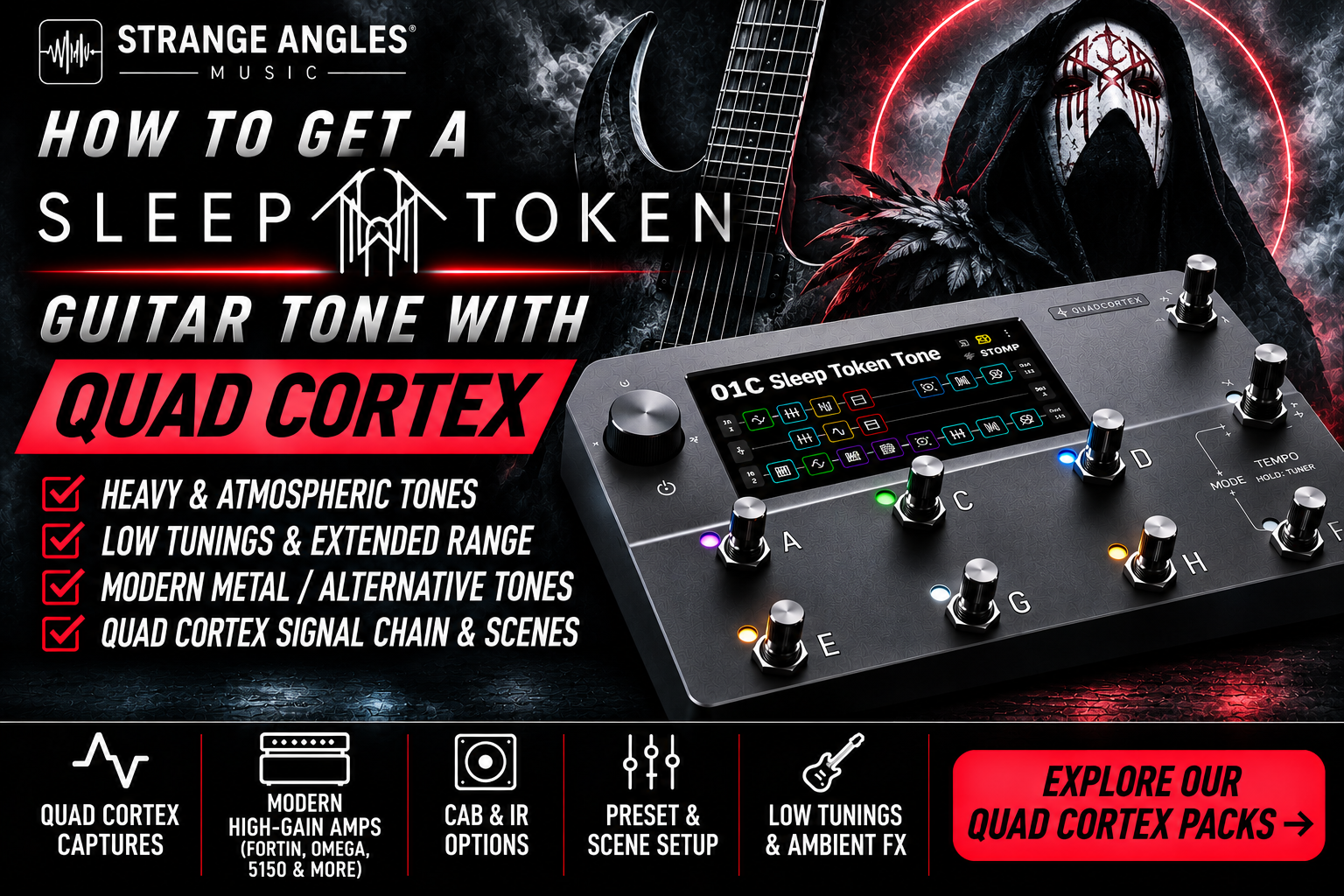
How to Get a Sleep Token Guitar Tone with Quad Cortex
Want to get the atmospheric, crushing guitar tones of Sleep Token using the Neural DSP Quad Cortex?
Sleep Token has developed one of the most distinctive sounds in modern heavy music, combining low-tuned guitars, aggressive metal riffs, atmospheric cleans, electronic textures, and massive production.
Guitarist IV's sound is particularly interesting because it moves between extremely low guitar tunings and spacious, melodic passages.
The Quad Cortex is an important part of his documented live setup, making it a particularly relevant platform for guitarists looking to explore this style of tone.
In this guide, we'll look at the gear behind the sound, how to build a Sleep Token-inspired signal chain, and which Strange Angles Music amplifier captures are worth exploring.
Looking for Great Quad Cortex Tones?
Explore professionally captured high-gain amplifiers designed for modern metal, alternative metal, progressive metal, and aggressive rhythm guitar.
From Fortin and Omega to EVH, ENGL, and more, Strange Angles Music offers professionally captured tones for your Quad Cortex.
🎸 Browse Quad Cortex Captures →
What Makes the Sleep Token Guitar Tone So Distinctive?
Sleep Token's guitar sound is built around contrast.
Some sections feature extremely heavy, low-tuned guitar riffs, while others use clean tones, ambient effects, and spacious production.
The defining characteristics include:
Extremely low guitar tunings
Aggressive, tight high-gain rhythm tones
Extended-range and baritone guitars
Strong low-frequency response
Clear note definition
Atmospheric clean guitar sounds
Delay and reverb effects
Wide stereo guitar production
The goal isn't simply to create the heaviest possible distortion.
You need a guitar tone that can deliver powerful low-end riffs while remaining clear and articulate. You also need a completely different sound for the atmospheric sections.
That's why building separate Quad Cortex scenes for heavy and clean sounds is a great approach.
What Gear Does Sleep Token Guitarist IV Use?
One of the most interesting aspects of Sleep Token's guitar setup is the way IV combines extended-range guitars with digital modeling.
In a December 2024 Guitar World rig rundown, IV's guitar technician revealed several details about the live setup.
Some of the key details included:
Neural DSP Quad Cortex processors
Revv Generator amplifier captures
Mesa cabinet captures
Two amplifier tones running left and right
MIDI control of the processors
The Quad Cortex Doubler feature for additional stereo width
The technician explained that IV's main tones came from a Revv Generator amplifier and Mesa cabinet captured into the Quad Cortex.
This is a particularly interesting approach because it combines the character of a real amplifier and cabinet with the flexibility of digital modeling.
Important: The Revv Generator is part of IV's documented setup, but it isn't included in the Strange Angles Music packs featured below. We'll explore alternative high-gain captures that you can use to build your own version of this sound.
The Sleep Token Guitar: Low Tunings and Extended Scale Lengths
Another important part of the band's sound is the guitar itself.
IV has used extended-range guitars, including an unusual 30-inch-scale baritone guitar.
This allows for extremely low tunings while maintaining better string tension than a conventional guitar.
For example, the tuning used for the 8-string parts in "The Summoning" is an unusually low tuning:
Low to high: E – A – E – A – D – G – B – E
The arrangement also uses digital pitch shifting, so the recorded and performed pitch relationship is more involved than simply tuning an ordinary 8-string down.
You don't necessarily need a 30-inch baritone to experiment with this sound, but guitar setup becomes increasingly important as you go lower.
Consider:
Appropriate string gauges
Sufficient scale length
Proper intonation
Pickup clarity
Consistent picking technique
A guitar with insufficient string tension can make low notes sound loose and difficult to control.
How to Get a Sleep Token-Inspired Tone Using Quad Cortex
You don't need the exact Revv Generator setup to build a similar tonal character.
The Quad Cortex gives you plenty of flexibility to experiment with different high-gain amplifier captures, cabinet IRs, and effects.
Here is how I'd approach the setup.
1. Start With a High-Gain Amplifier Capture
For the heavy sections, start with an aggressive high-gain capture.
Some good options available through Strange Angles Music include:
Omega Granophyre
Fortin Evil Pumpkin
EVH 5150 III
Omega Obsidian 1.5
Driftwood Purple Nightmare
The Omega Granophyre is a particularly interesting starting point for modern metal because of its aggressive character and tight response.
The Fortin Evil Pumpkin is another great option if you want a saturated, aggressive rhythm tone.
These aren't Revv Generator recreations. They're alternative amplifier tones that you can use to build your own Sleep Token-inspired sound.
2. Add an Overdrive or Boost
A boost can help tighten the low end and improve the attack of a high-gain amplifier.
A Tube Screamer-style overdrive or Precision Drive-style boost is a good starting point.
Try these general settings:
Gain: Low
Level: Moderately high
Tone: Adjust to your pickups and cabinet
Bass: Avoid excessive low frequencies
Don't automatically add an overdrive to every capture. Some amplifiers already have the tight response you're looking for.
3. Choose the Right Cabinet
The cabinet has a major influence on the final guitar tone.
A 4x12 cabinet with Celestion Vintage 30-style speakers is a useful starting point for modern metal.
Experiment with different microphone positions and blends.
If you're using a D.I. capture, add a cabinet IR or cabinet block to complete the sound.
If you're using a full-rig capture, it may already include cabinet and microphone coloration. Avoid adding another cabinet stage unless you're deliberately changing the sound.
4. Keep the Low End Controlled
Low-tuned guitars can quickly become muddy if there's too much bass going into the amplifier.
If your palm mutes sound loose, try:
Reducing excessive bass before the amp
Using a suitable boost
Adjusting your cabinet IR
Reducing unnecessary gain
Applying subtle post-capture EQ
Let the bass guitar provide much of the low-frequency weight in the mix.
Your guitar needs to remain tight and articulate.
5. Use Stereo Processing for Wider Guitar Sounds
One interesting detail about IV's documented Quad Cortex setup is the use of two amplifier tones running left and right.
You can experiment with a similar concept in your own recordings.
Try using:
Two different amplifier captures
Different cabinet combinations
Separate left and right guitar recordings
Subtle stereo processing
The Quad Cortex Doubler feature where appropriate
For recorded rhythm guitars, two separate performances panned left and right are still an excellent starting point.
Avoid simply duplicating one mono recording and expecting it to create the same width.
How to Create Sleep Token-Style Clean and Atmospheric Tones
The atmospheric side of Sleep Token is just as important as the heavy guitar sound.
Rather than trying to use one high-gain preset for everything, create a separate clean scene.
1. Start With a Clean Amplifier
Choose a clean amp or clean capture with enough headroom to keep the sound clear.
Avoid excessive distortion or compression.
2. Add Chorus or Modulation
Subtle modulation can add movement and width to clean guitar sounds.
Start with a moderate chorus setting and adjust the depth and rate until the sound feels natural.
3. Add Delay
Delay is useful for creating spacious guitar textures.
Experiment with:
Quarter-note delay
Dotted-eighth delay
Longer ambient delays
Increased feedback for atmospheric sections
Keep the effect level appropriate for the part you're playing.
4. Add Reverb
Reverb is essential for creating large, atmospheric guitar sounds.
Try:
Hall reverb
Plate reverb
Ambient reverb
Longer decay times
For atmospheric sections, longer decay times can help create a much larger sense of space.
5. Create Separate Quad Cortex Scenes
Organize your sounds into separate scenes so you can switch between them during a performance.
SceneSoundScene 1Heavy rhythmScene 2Boosted rhythmScene 3Lead guitarScene 4Clean chorusScene 5Ambient delay and reverb
This gives you a versatile setup for moving between crushing metal riffs and spacious atmospheric passages.
Recommended Quad Cortex Signal Chains
Here are two practical starting points.
Heavy Rhythm Chain
Noise Gate
Overdrive / Boost
High-Gain Neural Capture
Cabinet IR or Cab Block
Post-EQ
Output
Clean / Ambient Chain
Compressor
Clean Amp or Capture
Chorus / Modulation
Delay
Reverb
Output
For a wider recorded guitar sound, experiment with two different amp and cabinet combinations, or record separate left and right performances.
Best Quad Cortex Packs for Sleep Token-Inspired Tones
If you're looking for high-gain amplifier captures to build your own version of this sound, these Strange Angles Music collections are worth checking out.
1. Grannyphyre – Quad Cortex Pack
The Grannyphyre Quad Cortex Pack features captures of the Omega Ampworks Granophyre.
It includes:
15 D.I. and full-rig studio captures
The Granophyre is an excellent option for aggressive modern metal tones, tight low-tuned riffs, and high-gain rhythm guitar.
Best for: Modern metal, progressive metal, metalcore, and aggressive rhythm guitar.
Explore Grannyphyre – Quad Cortex Pack →
2. Vile Pumpkin – Quad Cortex Pack
The Vile Pumpkin Quad Cortex Pack features captures of the Fortin Evil Pumpkin amplifier.
It includes:
22 D.I. captures
The Fortin Evil Pumpkin is a great option for players looking for aggressive, saturated high-gain tones.
Try it for heavy rhythm guitar, low-tuned riffs, and aggressive modern metal sounds.
Best for: Modern metal, metalcore, aggressive rhythm guitar, and high-gain lead tones.
Explore Vile Pumpkin – Quad Cortex Pack →
3. Quad Cortex – Everything Pack
If you want a much larger selection of amplifiers, the Quad Cortex Everything Pack includes over 150 D.I. and studio captures.
Featured amplifiers include:
Fortin Evil Pumpkin
Fortin Meshuggah 2.0
Omega Ampworks Granophyre
Omega Ampworks Obsidian 1.5
RedSeven Duality
RedSeven Leviathan
Dover DA 50
Driftwood Purple Nightmare
Randall Satan
Science Hellhawk
Science Mother
Fryette Deliverance
EVH 5150 III
ENGL Savage
ENGL Powerball
Marshall JVM
Dimebag Darrell Warhead Mini
It also includes preamp captures, overdrives, and additional amplifier tones.
Best for: Guitarists who want a wide selection of modern and classic high-gain amplifiers in one collection.
Explore Quad Cortex Everything Pack →
How to Make Your Sleep Token-Inspired Tone Sound Better in a Mix
A great guitar tone by itself doesn't always translate into a great recorded guitar tone.
Sleep Token's production combines guitars with bass, drums, vocals, synthesizers, and atmospheric elements.
Here are a few practical tips.
Double-Track Your Rhythm Guitars
Record two separate performances of the same rhythm part.
Pan one performance left and the other right.
This creates natural stereo width and helps the guitars sound much bigger.
Keep the Low End Controlled
Low-tuned guitars already produce substantial low-frequency energy.
Avoid excessive bass in your guitar signal.
Let the bass guitar provide additional low-frequency weight while the guitars focus on attack, definition, and midrange.
Use Different Tones for Different Sections
Don't force one high-gain preset to handle every part of a song.
Use separate scenes for:
Heavy rhythm guitar
Lead guitar
Clean guitar
Atmospheric textures
This gives you much more control over the dynamics of a performance.
Don't Overdo the Gain
Excessive distortion can reduce note separation and make complex riffs sound less precise.
Start with enough gain to get the aggression you want, then adjust based on how the guitar performs alongside the drums and bass.
Leave Space for the Other Instruments
One of the defining characteristics of Sleep Token's production is the contrast between different musical elements.
Avoid filling every available frequency with guitar.
A controlled guitar tone leaves more room for the bass, vocals, synthesizers, and other atmospheric elements.
Frequently Asked Questions
What amplifier does Sleep Token guitarist IV use?
A December 2024 Guitar World rig rundown revealed that IV's main live guitar tones came from a Revv Generator amplifier and Mesa cabinet captured into the Quad Cortex.
The setup also used two amp tones running left and right.
Does Sleep Token use the Quad Cortex?
Yes. IV's documented live setup includes Neural DSP Quad Cortex processors. His guitar technician described using two processors operated via MIDI.
Can I get a Sleep Token guitar tone with Quad Cortex?
Yes. You can use high-gain Neural Captures, cabinet IRs, and effects to build your own Sleep Token-inspired guitar tones.
The Omega Granophyre, Fortin Evil Pumpkin, and other modern high-gain captures are useful starting points.
What tuning does Sleep Token use?
Sleep Token uses different tunings depending on the song and guitar part.
Some of their songs feature extremely low 8-string tunings. For example, the 8-string parts in "The Summoning" use the tuning E–A–E–A–D–G–B–E, with the arrangement digitally pitch-shifted down a half step.
Does IV use an 8-string guitar?
Yes. IV has used extended-range guitars, including 8-string instruments, as well as a 30-inch-scale baritone guitar.
Do I need a baritone guitar to get a Sleep Token tone?
No. A baritone or extended-range guitar can make extremely low tunings easier to manage, but you can experiment with other guitars and pitch-shifting approaches.
Can I create both heavy and clean tones with Quad Cortex?
Absolutely. You can create separate scenes or presets for heavy rhythm, leads, cleans, and atmospheric effects.
Do I need a cabinet IR with a Quad Cortex D.I. capture?
Generally, yes. D.I. amp captures need a cabinet stage to complete the guitar tone. You can use a cabinet IR or a suitable cabinet block.
Full-rig captures may already include cabinet and microphone coloration.
Final Thoughts
Sleep Token's guitar sound combines aggressive modern metal tones with atmospheric textures and melodic dynamics.
The Quad Cortex is particularly well suited to exploring this approach because you can build different amplifier sounds, cabinet combinations, and effects into one versatile setup.
Start with a high-gain capture such as the Omega Granophyre or Fortin Evil Pumpkin, keep the low end controlled, and build separate scenes for heavy and atmospheric sections.
You don't need to duplicate IV's exact equipment to create your own powerful Sleep Token-inspired guitar tone.
Find Your Next Quad Cortex Guitar Tone
Explore the Strange Angles Music Quad Cortex collection and discover professionally captured amplifiers for modern metal, alternative metal, progressive metal, and more.