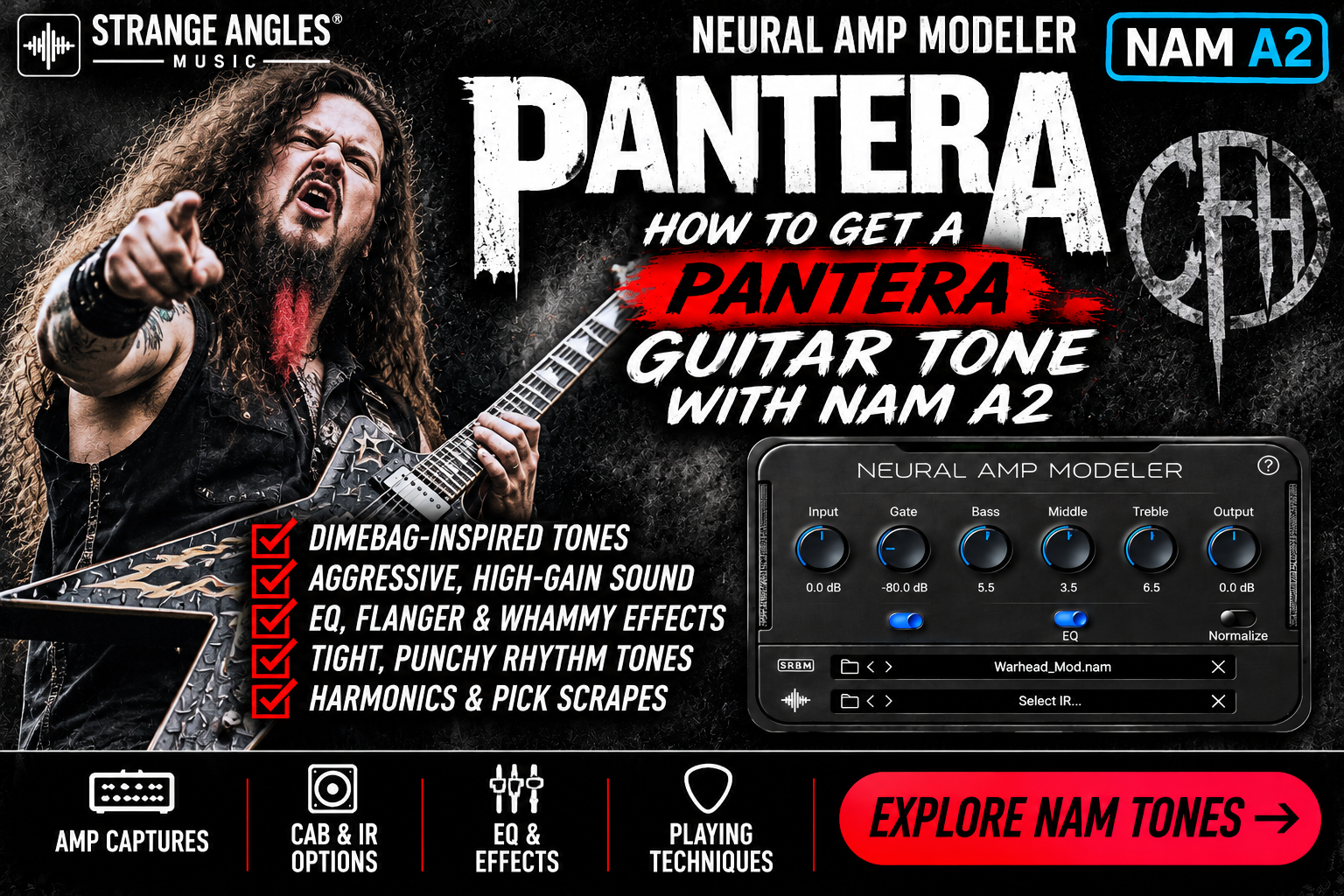
How to Get a Pantera Guitar Tone with NAM A2
Want to recreate the legendary guitar tones of Dimebag Darrell using Neural Amp Modeler (NAM)?
Pantera helped define the sound of 1990s groove metal with crushing riffs, aggressive distortion, powerful palm mutes, and some of the most recognizable guitar solos in metal history.
From Cowboys from Hell and Vulgar Display of Power to Far Beyond Driven and The Great Southern Trendkill, Dimebag Darrell developed a guitar sound that was completely his own.
One of the most interesting things about his tone? He preferred solid-state Randall amplifiers over the traditional tube amplifiers used by many metal guitarists.
His sound was built around aggressive amplification, carefully shaped EQ, a powerful picking attack, and distinctive effects.
With Neural Amp Modeler, you can explore similar amplifier characteristics using professionally captured amplifiers, cabinet IRs, preamps, and effects.
In this guide, we'll look at Dimebag's amplifier history, how to build a Pantera-inspired NAM A2 signal chain, and which Strange Angles Music products are worth exploring.
Looking for Great NAM A2 Tones?
Spend less time searching for the right amplifier and more time playing.
Explore professionally captured amplifiers, preamps, and overdrives designed for groove metal, thrash metal, classic heavy metal, and aggressive rhythm guitar.
What Makes the Pantera Guitar Tone So Distinctive?
Dimebag Darrell's guitar sound is instantly recognizable.
It combines an aggressive, almost grinding distortion character with tight rhythm playing, sharp pick attack, and powerful harmonics.
Some of the defining characteristics include:
Aggressive solid-state amplifier distortion
Powerful midrange and upper-midrange detail
Tight, punchy rhythm guitar
Carefully shaped EQ
Strong pick attack
Pinch harmonics and squeals
Whammy and tremolo effects
Flanger and doubler textures
Precise alternate picking
High-energy guitar solos
Unlike many modern metal tones, Dimebag's sound wasn't built around a typical high-gain tube amplifier.
His Randall amplifiers were a major part of what made his sound different.
What Amplifiers Did Dimebag Darrell Use?
Dimebag experimented with different equipment throughout his career, but two Randall amplifier families were especially important to Pantera's classic sound.
1. Randall RG100ES / RG100H – Cowboys from Hell
The Randall RG100 series is one of the most recognizable amplifiers associated with Dimebag.
The solid-state Randall sound helped create the aggressive, immediate response heard on Cowboys from Hell.
Dimebag loved the amplifier's punch, grind, and attack.
He didn't feel that traditional tube amplifiers gave him exactly what he wanted.
The Randall's solid-state character was an important part of his signature sound.
For this style, focus on:
Aggressive distortion
Strong upper-midrange
Tight low frequencies
Sharp pick attack
Clear note separation
A slightly raw, gritty character
2. Randall Century 200 – Vulgar Display of Power
The Randall Century 200 became an important part of Dimebag's setup during the Vulgar Display of Power and Far Beyond Driven eras.
The Century 200 helped deliver the thick, aggressive rhythm guitar sound heard throughout these albums.
It provided a different character from the RG100 series, while retaining the solid-state aggression Dimebag preferred.
3. Randall RG100 – The Great Southern Trendkill
Interestingly, Dimebag returned to an older Randall RG100 amplifier for the recording of The Great Southern Trendkill.
In a Guitar World interview, he explained that he used the older amplifier along with a Furman PQ-3 parametric EQ, MXR six-band graphic EQ, and a Boss noise gate.
He liked the sound of the setup during the demos and decided not to change it.
This is a great reminder that the most expensive or newest amplifier isn't necessarily the right one for a particular recording.
4. Randall Warhead
Dimebag also worked with Randall to develop his signature Warhead amplifier.
The Warhead brought his aggressive solid-state sound into a dedicated signature amplifier design.
It became another important part of his later equipment history.
Strange Angles Music offers a capture of the Dimebag Darrell Warhead Mini, giving NAM users a direct way to explore this amplifier character.
5. Krank Krankenstein
After Pantera, Dimebag also worked with Krank on the Krankenstein signature amplifier.
This represents a different stage of his amplifier history, but it is worth mentioning when exploring his overall guitar tone.
The classic Pantera sound, however, is most strongly associated with his Randall amplifiers.
Dimebag's Secret: EQ Before the Amplifier
One of the most important parts of Dimebag's signal chain was his use of EQ before the amplifier.
He used equipment including:
Furman PQ-3 parametric EQ
Furman PQ-4 parametric EQ
MXR six-band graphic EQ
These weren't simply used as conventional post-amplifier tone controls.
The EQ was part of how he shaped and pushed the signal entering the amplifier.
This is important when trying to recreate his sound with NAM.
Instead of automatically adding more amplifier gain, experiment with shaping the signal before the capture.
Try:
A graphic or parametric EQ before NAM
Adjusting the low and high frequencies
Experimenting with the midrange
Increasing the level into the capture
Comparing the result with the EQ bypassed
Don't automatically scoop all the mids. Dimebag's EQ settings changed depending on the amplifier and song, and the goal is to recreate the aggressive character rather than apply one fixed EQ curve.
How Dimebag Used Two Amplifier Stacks
Producer Terry Date discussed an interesting part of Dimebag's recording setup.
He explained that Dimebag frequently used two amplifier stacks:
One stack ran straight.
The other ran through an MXR Flanger/Doubler.
The two sounds were combined to create a thicker, wider guitar tone.
This is an important technique to experiment with in your DAW.
You can create a similar effect using parallel processing:
Path A – Main Guitar Tone
NAM amplifier capture
Cabinet IR
Main dry guitar sound
Path B – Widened Guitar Tone
Duplicate or parallel guitar signal
Flanger or doubler
Adjusted wet/dry blend
Blend the two paths to create additional width without losing the attack of the main guitar tone.
You can also record two separate performances and process them differently.
How to Get a Pantera Guitar Tone Using NAM A2
Let's build a practical signal chain.
Step 1: Start With the Dimebag Warhead Mini Capture
The Dimebag Darrell Warhead Mini capture is an obvious starting point for this style.
Load it into a compatible NAM A2 player.
Start with the amplifier by itself.
Listen for:
Aggressive distortion
Strong attack
Tight low end
Defined palm mutes
Powerful upper-midrange
Clear harmonic response
The goal is to get the basic amplifier character right before adding additional processing.
Step 2: Experiment With EQ Before NAM
This is one of the most important steps.
Try placing a graphic or parametric EQ before the NAM capture.
Experiment with:
Low-frequency control
Upper-midrange presence
High-frequency detail
Input level
Dimebag used EQ to shape and push his amplifier signal.
Small changes can have a substantial effect on the resulting distortion character.
Step 3: Add a Noise Gate
Dimebag used noise gates to control unwanted noise in his high-gain setup.
A noise gate is especially useful for:
Tight palm-muted riffs
Sudden stops
Fast rhythmic passages
Controlling noise between notes
Place the gate where it best suits your signal chain and adjust the threshold without cutting off natural note decay.
Step 4: Choose the Right Cabinet IR
A 4x12 cabinet is a useful starting point for a Pantera-inspired sound.
Experiment with:
Randall-style cabinet characteristics
Marshall-style 4x12 cabinets
Vintage 30 speakers
G12T-75 speakers
SM57 microphone positions
Different microphone blends
The original recording chain used Randall cabinets and microphone techniques that contributed to Dimebag's distinctive sound.
If you're using a D.I. capture, add an appropriate cabinet IR.
If you're using a full-rig capture, check whether cabinet and microphone coloration are already included.
Step 5: Add Flanger or Doubler
Experiment with a subtle flanger or doubler to create the thicker sound associated with Dimebag's two-stack setup.
Try:
Subtle modulation
Low wet/dry blend
Different delay or doubling settings
Parallel processing
The goal is to add thickness while preserving the main guitar's attack.
Step 6: Experiment With Whammy and Wah
Dimebag's use of pitch shifting and wah effects is a major part of his signature sound.
Try:
Whammy-style pitch shifting
Octave effects
Expression pedal control
Wah sweeps
Controlled feedback
These effects are particularly useful for solos and dramatic transitions.
Step 7: Practice the Pinch Harmonics
Dimebag's pinch harmonics are among the most recognizable techniques in metal guitar.
The amplifier and effects are important, but technique is essential.
Practice:
Pick the note firmly.
Allow the thumb to lightly contact the string immediately after the pick.
Experiment with different picking positions.
Use vibrato to add character.
Try different pickup positions.
A high-gain amplifier capture can help make the harmonics more responsive, but the technique itself is what creates the sound.
What Guitar and Pickups Did Dimebag Use?
Dimebag Darrell is closely associated with the Dean ML, particularly his famous Dean From Hell guitar.
He also used Washburn signature guitars during part of his career.
His bridge pickup choice was particularly important.
The Bill Lawrence L-500XL became one of his signature pieces of equipment.
It provided a strong output and aggressive response that worked well with his Randall amplifiers.
Other associated equipment includes:
Floyd Rose tremolo systems
High-output humbuckers
Dean ML-style guitars
Washburn Dime signature guitars
Dunlop Dimebag signature wah
You don't need an exact Dean ML to explore this tone. A guitar with a suitable high-output bridge humbucker can be a good starting point.
Recommended NAM Signal Chains for Pantera-Inspired Tones
Here are three practical starting points.
Classic Cowboys from Hell-Inspired Tone
Guitar
Graphic / Parametric EQ
Noise Gate
Dimebag Warhead Mini NAM Capture
Cabinet IR
Output
Vulgar Display of Power-Inspired Tone
Guitar
EQ Boost
Noise Gate
Aggressive High-Gain NAM Capture
Cabinet IR
Subtle Post-EQ
Output
Widened Dimebag-Style Guitar
Main NAM Guitar Path
Parallel Flanger / Doubler Path
Blend the two signals
Adjust stereo width
Output
These are starting points for your own Pantera-inspired tones, not exact recreations of the original recording chains.
Best NAM Packs for Pantera-Inspired Guitar Tones
Here are the Strange Angles Music products I would explore for this particular sound.
1. DimeTime – NAM Pack
Best direct match for Dimebag-inspired tones
This is the most obvious starting point for anyone looking to explore Dimebag's signature amplifier character.
The pack features the Dimebag Darrell Warhead Mini amplifier capture.
It also includes additional preamp captures:
Fortin Natas
Airis Effects Nemesis
Solar Chug
The Warhead Mini gives you a direct connection to Dimebag's signature Randall amplifier family.
The additional preamp captures provide other tonal options to experiment with.
Best for: Pantera-inspired tones, groove metal, aggressive rhythm guitar, and Dimebag-style high-gain sounds.
2. NAM Everything Pack
Best for a broader amplifier collection
The NAM Everything Pack includes nearly 100 D.I. and studio profiles.
Featured amplifiers include:
Dimebag Darrell Warhead Mini
Fortin Evil Pumpkin
Fortin Meshuggah 2.0
Omega Granophyre
Omega Obsidian 1.5
Driftwood Purple Nightmare
Dover DA 50
RedSeven Leviathan
MLC S_ZERO 93 Silenoz
MLC S_ZERO 100
It also includes preamps, overdrives, and cabinet captures.
This is a good option if you want the Dimebag Warhead Mini alongside a much wider selection of modern high-gain amplifier tones.
Best for: Guitarists who want a broad NAM collection covering groove metal, modern metal, thrash, and other heavy styles.
3. Individual NAM Amplifier Captures
If you prefer to experiment with individual amplifier sounds, Strange Angles Music also offers a selection of dedicated NAM amplifier packs.
You can explore options such as:
Randall-style Dimebag Warhead Mini
Fortin Evil Pumpkin
Omega Obsidian
Omega Granophyre
RedSeven Leviathan
Driftwood Purple Nightmare
These provide different high-gain characters for building your own interpretation of classic and modern metal tones.
Best for: Guitarists who prefer focused amplifier packs rather than larger collections.
Browse Individual NAM Captures →
How to Make Your Pantera Guitar Tone Sound Better in a Mix
Double-Track Your Rhythm Guitars
Record two separate performances of the same guitar part.
Pan one left and the other right.
This creates natural stereo width and helps the guitars sound much larger.
Don't Automatically Scoop All the Mids
Dimebag used EQ extensively, but the exact settings varied.
Experiment with different midrange positions rather than assuming one extreme scoop will produce the right sound.
Keep the Pick Attack Clear
The sharp attack is an important part of the Pantera sound.
If your guitar sounds too compressed or saturated, try reducing the gain.
Let the Bass Provide the Foundation
The guitar should deliver aggression, punch, and definition.
Avoid excessive low-frequency buildup that competes with the bass guitar.
Experiment With Flanger and Doubler
A subtle widening effect can add thickness and help recreate the layered character associated with Dimebag's dual-stack approach.
Frequently Asked Questions
What amplifier did Dimebag Darrell use?
Dimebag was most closely associated with Randall solid-state amplifiers, including the RG100 series and Century 200. He also developed his signature Randall Warhead.
Was Dimebag's guitar tone solid-state or tube?
His classic Pantera guitar sound was primarily associated with solid-state Randall amplifiers rather than traditional tube amplifiers.
What amplifier was used on Cowboys from Hell?
The Randall RG100 series was central to the recording setup for Cowboys from Hell.
What amplifier was used on Vulgar Display of Power?
Dimebag used the Randall Century 200 during the Vulgar Display of Power era.
Can I get a Pantera guitar tone with NAM A2?
Yes. You can use the Dimebag Darrell Warhead Mini capture, EQ, cabinet IRs, and effects to build your own Pantera-inspired guitar tone.
What pickup did Dimebag use?
Dimebag was closely associated with the Bill Lawrence L-500XL bridge pickup.
Did Dimebag use a Tube Screamer?
His classic signal chain is particularly associated with EQ units used to shape and push the amplifier input rather than relying on a traditional Tube Screamer setup.
What effects did Dimebag use?
His equipment included MXR flanger/doubler, MXR graphic EQ, Furman parametric EQ, DigiTech Whammy, Dunlop wah, and noise gates.
Can I use these NAM captures for other groove metal bands?
Absolutely. These amplifier captures can also be useful for exploring tones inspired by Machine Head, Sepultura, Lamb of God, and other aggressive metal bands.
Final Thoughts
Dimebag Darrell's guitar tone remains one of the most recognizable sounds in heavy metal.
His preference for solid-state Randall amplifiers, carefully shaped EQ, powerful picking attack, and distinctive effects helped create a sound that continues to influence guitarists today.
The Dimebag Darrell Warhead Mini NAM capture is a particularly interesting starting point because it gives you access to a signature amplifier from his equipment history.
Experiment with EQ before the amplifier, cabinet IRs, noise gating, and flanger/doubler effects.
Most importantly, focus on the playing technique. The amplifier is only one part of what made Dimebag's guitar sound so unique.
With the right captures and signal chain, you can build your own Pantera-inspired guitar setup using Neural Amp Modeler.
Find Your Next NAM Guitar Tone
Explore the Strange Angles Music NAM collection and discover professionally captured amplifiers, preamps, and overdrives for groove metal, thrash metal, classic heavy metal, and more.