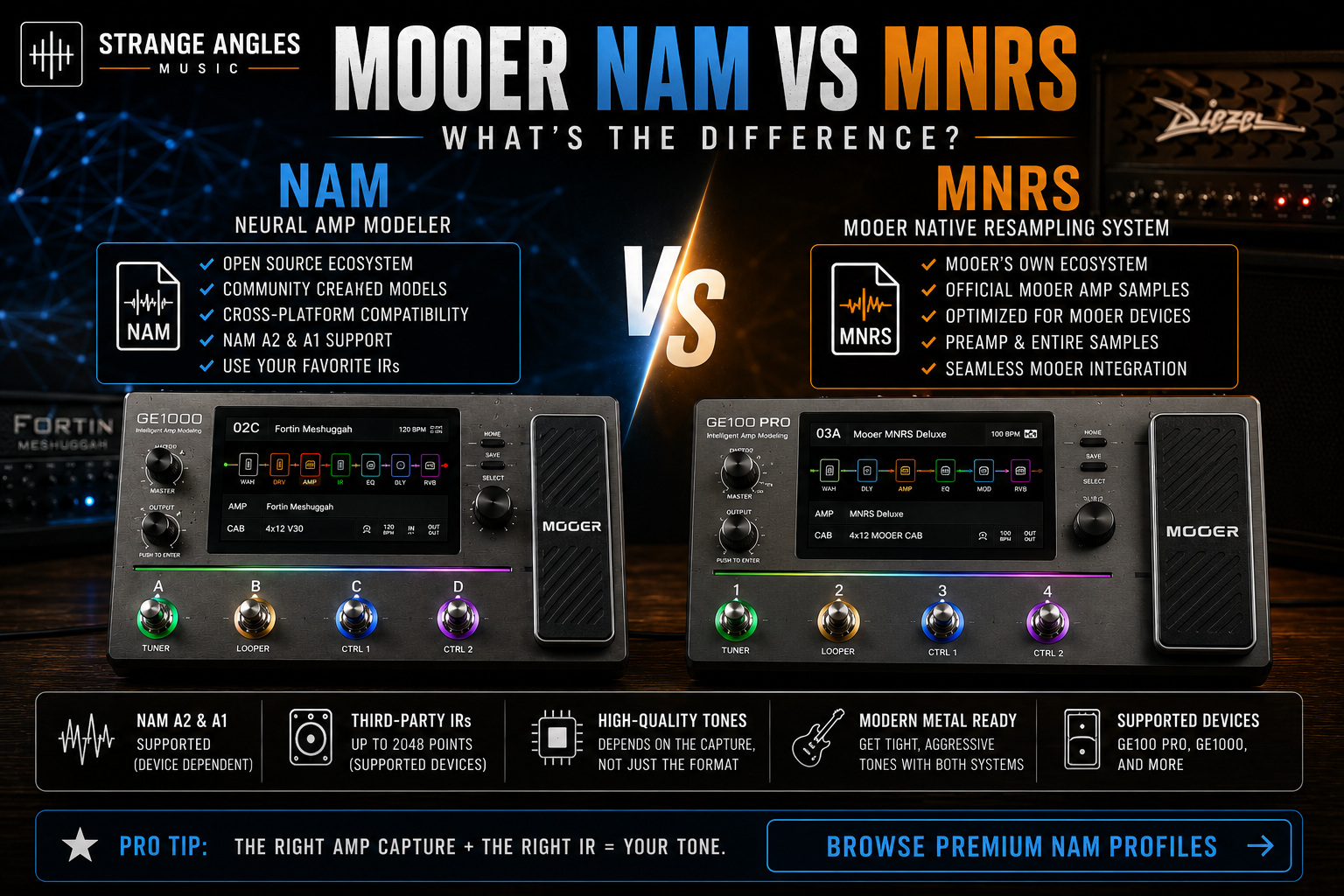
Mooer NAM vs MNRS: What's the Difference?
If you own a modern Mooer modeler, you've probably come across two different types of amp captures: NAM and MNRS.
Both technologies allow you to expand the sounds available in your Mooer, but they aren't the same thing.
NAM stands for Neural Amp Modeler, an open-source modeling platform designed to create highly accurate models of amplifiers and pedals. MNRS is Mooer's own amp-sampling ecosystem, built specifically around Mooer hardware and software.
So which one should you use?
The answer depends on your device, the type of capture you're using, and the tones you're trying to achieve.
Looking for Great Tones?
You don't have to spend hours searching through random amp captures. Start with professionally captured NAM profiles featuring boutique high-gain amps and classic favorites.
What Is NAM?
Neural Amp Modeler (NAM) is an open-source project that uses machine learning to model guitar amplifiers and pedals.
One of NAM's biggest advantages is that it isn't tied to a single hardware manufacturer.
The same NAM ecosystem can be used across compatible software and hardware platforms, giving players more freedom when building their tone library.
NAM has also evolved over time. The original model architectures are now referred to as A1, while the newer architecture is called A2. Existing A1 models remain supported while A2 becomes the newer standard.
What Is Mooer MNRS?
MNRS is Mooer's own amp-sampling system.
Mooer provides MNRS sample files through its ecosystem, and its current hardware supports different types of MNRS captures.
Mooer's own MNRS library includes both:
Preamp Samples
These capture the preamp section and are designed to be used with a cabinet simulation.
Entire Samples
These capture the complete amplifier signal, including the preamp, power amp, and cabinet. Mooer recommends disabling additional preamp, power amp, or cabinet simulation when using an Entire Sample.
NAM vs MNRS: The Biggest Difference
The simplest way to think about it is:
NAM
Open ecosystem
NAM profiles can be created and shared independently of Mooer.
MNRS
Mooer's ecosystem
MNRS files are designed specifically around Mooer's hardware and software environment.
That makes NAM particularly interesting for guitarists who already have a large NAM library or want access to profiles created for other NAM-compatible platforms.
Which Mooer Devices Support NAM?
Mooer's NAM support has expanded considerably.
The GE100 Pro officially supports both MNRS 2.0 amp profiling and NAM capture files, along with third-party IRs.
The GE1000 currently supports native NAM A2 Lite models. Its V3.1.0 firmware added native A2 Lite support, while current V3.1.1 firmware further optimized NAM A2 Lite loading and volume balance.
This is important because NAM compatibility isn't necessarily identical across every Mooer device.
NAM A1 vs NAM A2
This is one area where things can get confusing.
NAM's original architectures are now classified as A1, while the newer architecture is A2. The A1 family includes the older standard, lite, feather, and nano architectures.
Mooer's GE1000 currently handles these differently:
NAM A2 Lite
Loaded natively.
NAM A1
Converted and loaded through the converter.
Mooer's current GE1000 firmware specifically documents this distinction.
So when downloading a NAM profile, always check which architecture it uses.
Which Sounds Better?
There isn't a universal winner.
A great NAM capture can sound incredible.
A great MNRS capture can also sound incredible.
The quality of the capture itself matters enormously.
A poorly captured expensive amplifier won't necessarily sound better than a professionally captured, well-tuned profile of a more affordable amplifier.
That's why the capture process matters so much.
NAM Gives You More Freedom
One of the biggest advantages of NAM is the size of the ecosystem.
Because NAM is open source, creators can build and distribute their own models without being locked into one manufacturer's ecosystem. NAM describes itself as an open-source project for creating highly accurate models of guitar amplifiers and pedals.
That makes NAM particularly appealing if you want to build a large library of amp captures from different creators.
MNRS Has an Advantage on Mooer
MNRS has one major advantage:
It's built specifically for Mooer.
Mooer's software and hardware are designed around the format, and Mooer provides its own sample library and management ecosystem.
For a player who wants a straightforward Mooer-centered experience, MNRS can be extremely convenient.
What About IRs?
NAM and MNRS don't necessarily eliminate the need for impulse responses.
If your capture represents the amplifier without a cabinet, you'll generally want to pair it with an IR.
A typical modern metal setup might look like:
Guitar → NAM/MNRS Amp → IR → EQ → Effects
The IR can dramatically change the final sound.
For modern metal, try speakers such as:
Vintage 30
DV-77
G12T-75
Creamback
Mooer's current GE100 Pro supports third-party IR cabinet simulation, while the GE1000 supports third-party IRs up to 2048 points.
Which Is Better for Modern Metal?
This is where things get interesting.
If you're building a modern metal library, NAM gives you access to captures of some seriously aggressive boutique amplifiers.
Fortin Meshuggah
Extremely tight and precise.
Great for:
Djent
Progressive Metal
Drop tunings
Technical Metal
Fortin Evil Pumpkin
Aggressive and saturated.
Great for:
Metalcore
Deathcore
Modern Metal
Driftwood Purple Nightmare
Huge and aggressive with plenty of low-end authority.
Randall Satan
Tight, articulate, and excellent for low-tuned rhythm work.
Omega Ampworks Obsidian
Modern boutique high gain with excellent clarity.
Granophyre
Punchy and aggressive for extreme metal and deathcore.
MLC Subzero
Focused and fast for modern rhythm tones.
RedSeven Leviathan
Versatile enough for both rhythm and lead work.
Carstens Empire
Excellent for progressive and technical metal.
And there are still the classics:
EVH 5150
Marshall JCM800
Marshall Plexi
Soldano SLO-100
Mesa/Boogie Rectifier Rev G
Should You Choose NAM or MNRS?
Choose NAM if:
You already have a NAM library
You want access to profiles from multiple creators
You want an open ecosystem
You use multiple NAM-compatible platforms
You want boutique amp captures from different sources
Choose MNRS if:
You're primarily a Mooer user
You want Mooer's ecosystem
You prefer Mooer's sample library
You want straightforward integration with Mooer hardware
And there's nothing stopping you from using both when your hardware supports them.
NAM + Mooer Is a Powerful Combination
The biggest takeaway is that you don't necessarily have to choose one ecosystem forever.
Modern Mooer hardware increasingly gives players access to both.
That means you can use Mooer's own MNRS ecosystem while also taking advantage of the broader NAM ecosystem when your device supports the necessary architecture.
For players who already own a large NAM collection, this makes Mooer's newer hardware considerably more interesting.
Frequently Asked Questions
Is NAM better than MNRS?
Not automatically. They are different ecosystems, and the quality of the individual capture matters more than the name of the format.
Can Mooer use NAM files?
Yes. Mooer has added NAM support to multiple devices. The GE100 Pro officially supports NAM capture files, while the current GE1000 firmware supports native NAM A2 Lite models.
Can Mooer use MNRS and NAM?
On compatible hardware, yes. Some newer Mooer devices support both ecosystems.
What is NAM A2?
A2 is NAM's newer model architecture, designed to supersede the older A1 architectures while maintaining backward support for existing A1 models.
Do NAM profiles need IRs?
Not always. It depends on what the capture contains. A capture of the amp without a cabinet will generally need an IR to complete the rig.
Final Thoughts
NAM and MNRS are both powerful ways to expand the capabilities of a Mooer modeler.
MNRS gives you a tightly integrated Mooer ecosystem.
NAM gives you access to a broader, open ecosystem of amplifier and pedal captures.
And with newer Mooer hardware supporting both, you don't necessarily have to pick one.
For guitarists chasing modern metal tones, that flexibility is especially valuable. You can build a library around aggressive boutique amps like Fortin Meshuggah, Evil Pumpkin, Driftwood Purple Nightmare, Randall Satan, Omega Obsidian, Granophyre, MLC Subzero, RedSeven Leviathan, and Carstens Empire, while still having access to classics like the 5150, JCM800, Plexi, Soldano, and Rectifier.
The format matters—but the quality of the capture and the way you build the rest of the rig matter even more.
Ready to Upgrade Your Tone?
Explore professionally captured NAM Profiles featuring boutique modern metal amplifiers, classic high-gain amps, and carefully crafted tones designed for today's modelers.