Mooer GE1000 vs GS1000 for NAM: Which Is Better?
Mooer's NAM support has made the GE1000 and GS1000 particularly interesting options for guitarists who want access to Neural Amp Modeler profiles without moving to a completely different hardware ecosystem.
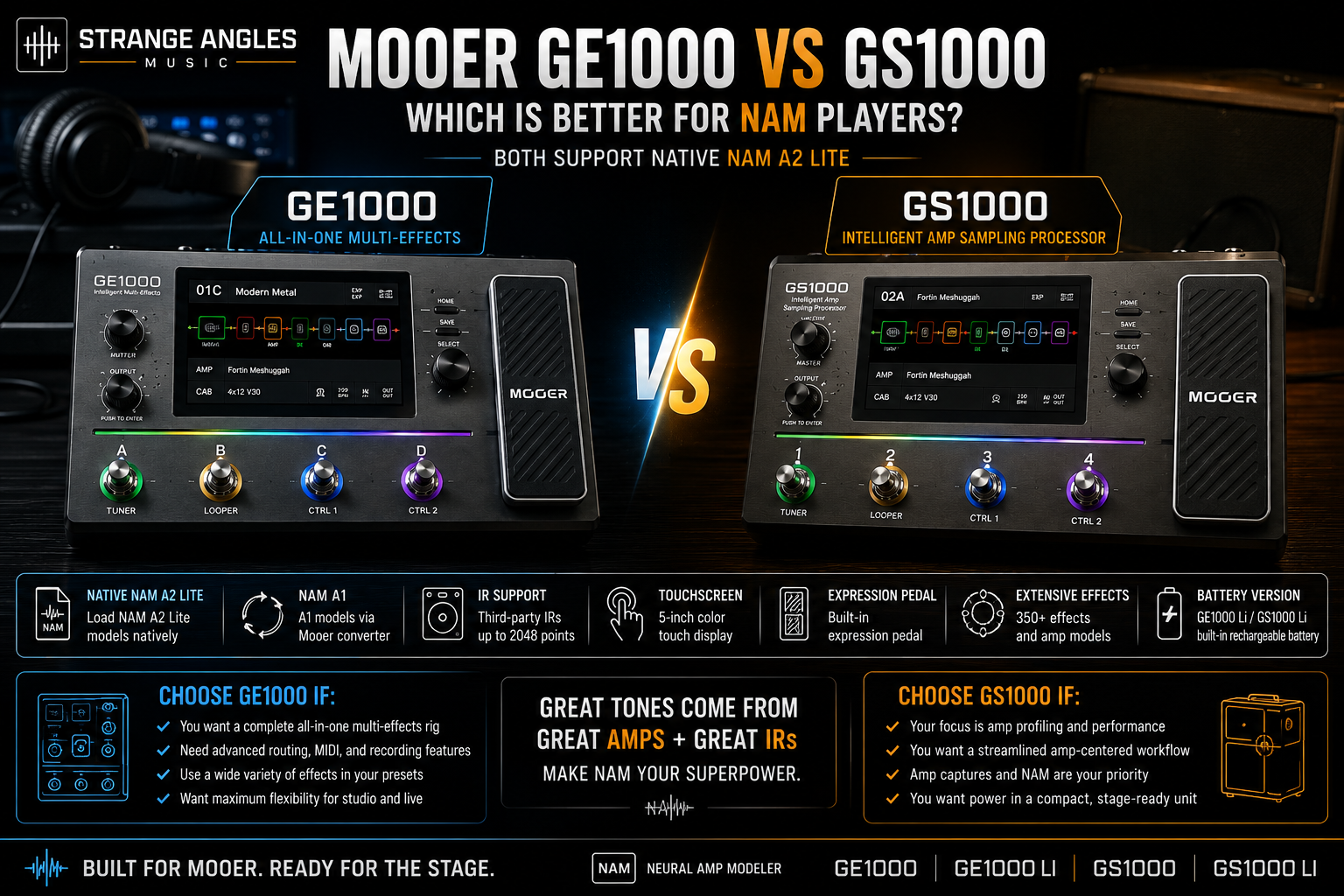
Both units now support native NAM A2 Lite models with current firmware, while NAM A1 models are handled through Mooer's converter.
So which one makes more sense for a NAM user?
Let's break it down.
Looking for Great Tones?
Whether you choose the GE1000 or GS1000, start with professionally captured NAM profiles built around great amps and quality IRs.
🎸 Browse Premium NAM Profiles →
GE1000 vs GS1000 at a Glance
FeatureGE1000GS1000Native NAM A2 Lite✅✅NAM A1ConverterConverterThird-Party IRs✅ Up to 2048 points✅ Up to 2048 pointsTouchscreen5-inch5-inchExpression PedalBuilt inBuilt inEffectsExtensiveExtensiveBattery VersionGE1000 LiGS1000 LiPrimary FocusMulti-effects / complete rigAmp profiling / performanceNAM SupportExcellentExcellent
Mooer's current firmware documentation confirms native NAM A2 Lite loading on both platforms.
Mooer GE1000
The GE1000 is the more traditional all-in-one multi-effects approach.
It's designed around a large collection of effects, amp models, routing options, presets, MIDI, USB audio, and third-party IR support. Mooer lists 255 preset slots and 2048-point third-party IR support.
For someone who wants NAM to become one part of a larger effects rig, the GE1000 makes a lot of sense.
Great for:
Recording
Complex signal chains
Live rigs
Multiple effects
MIDI setups
NAM + IR combinations
Mooer GS1000
The GS1000 takes a slightly different approach.
Mooer positions it as an intelligent amp sampling processor, and it was designed heavily around amp profiling and performance. It also provides 350+ effects modules and supports third-party IRs up to 2048 points.
For guitarists who are particularly interested in amp captures, NAM, and building a compact performance rig, the GS1000 is extremely compelling.
NAM Support Is Very Similar
This is important.
Both devices currently support:
NAM A2 Lite
Loaded natively.
NAM A1
Converted using Mooer's converter.
Mooer also specifies that NAM models are imported into the AMP module. Pedal and amp-head captures are recommended for the PREAMP SAMPLE, while integrated amp + cabinet captures are recommended for the ENTIRE SAMPLE.
So from a pure NAM compatibility standpoint, neither device has a huge advantage.
Which One Is Better for Modern Metal?
Both can be excellent.
The bigger difference comes down to the type of rig you're building.
For modern metal, I'd start with NAM profiles based on amps such as:
Fortin Meshuggah
Extremely tight and precise for djent, progressive metal, and low tunings.
Fortin Evil Pumpkin
Aggressive and saturated for metalcore and deathcore.
Driftwood Purple Nightmare
Huge, thick rhythm tones with serious low-end authority.
Randall Satan
Tight and aggressive with excellent articulation.
Omega Ampworks Obsidian
Modern boutique high gain with excellent definition.
Granophyre
Punchy and aggressive for extreme and low-tuned metal.
MLC Subzero
Focused and fast for modern rhythm playing.
RedSeven Leviathan
Versatile high gain for rhythm and lead.
Carstens Empire
Excellent for progressive and technical metal.
And classics still have their place:
EVH 5150
Marshall JCM800
Marshall Plexi
Soldano SLO-100
Mesa/Boogie Rectifier Rev G
Don't Forget the IR
A great NAM profile can still sound wrong with a poor cabinet choice.
For modern metal, experiment with:
Vintage 30 — aggressive mids and strong mix presence.
DV-77 — tight and controlled.
G12T-75 — brighter and more aggressive.
Creamback — thicker and warmer.
Both the GE1000 and GS1000 support third-party IRs up to 2048 points.
Which Should You Buy?
Choose the GE1000 if:
You want a more traditional all-in-one multi-effects processor with NAM added to the equation.
It's especially attractive if you're building complex presets with lots of effects, MIDI, routing, and recording functionality.
Choose the GS1000 if:
Your priority is amp profiling and performance, and you want a compact platform built heavily around amp and cabinet technology.
The GS1000 is particularly interesting for players who want to explore both Mooer's own sampling ecosystem and NAM.
What About the GE1000 Li and GS1000 Li?
Both platforms are also available in versions with built-in rechargeable batteries.
The GE1000 Li includes a 7.4V 4750mAh lithium-ion battery, while the GS1000 Li uses the same 7.4V 4750mAh battery specification.
That can be useful for players who want a more portable setup.
The Bottom Line
If NAM is your primary reason for buying a Mooer, both the GE1000 and GS1000 are strong choices because both now support native NAM A2 Lite models.
The bigger question is what you want the rest of the unit to do.
GE1000: Better fit for the guitarist who wants a complete multi-effects and recording workstation.
GS1000: Better fit for the guitarist who puts amp profiling and performance at the center of the rig.
Either way, the combination of NAM + quality IRs + professionally captured amps gives Mooer users a huge amount of tonal flexibility.
Ready to Upgrade Your Tone?
Explore professionally captured NAM profiles featuring Fortin, Driftwood, Randall, Omega Ampworks, Granophyre, MLC, RedSeven, Carstens, and classic high-gain amplifiers.