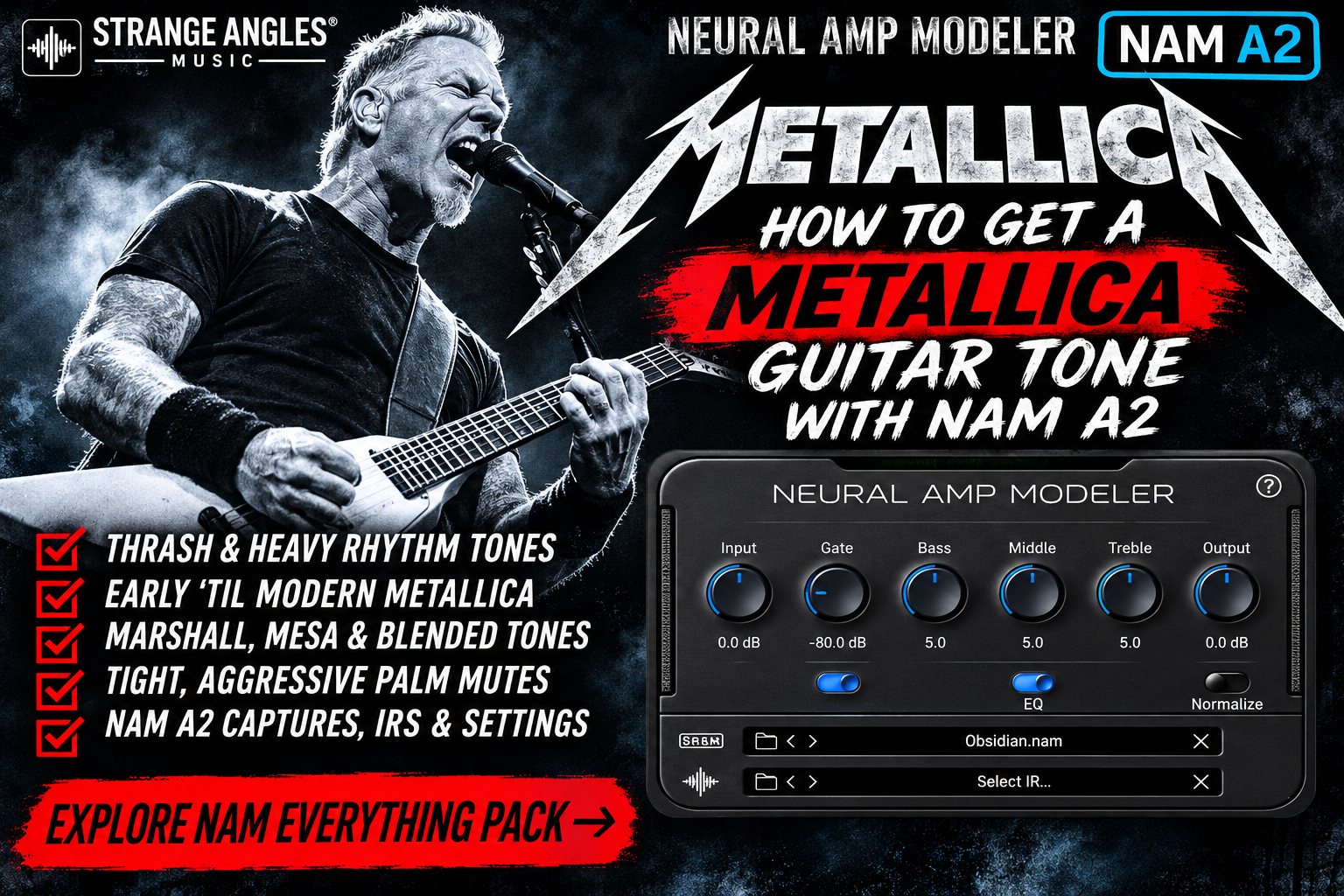
How to Get a Metallica Guitar Tone with NAM A2
Want to recreate the legendary guitar tones of Metallica using Neural Amp Modeler (NAM)?
Metallica has produced some of the most recognizable guitar sounds in heavy music history. From the raw thrash tones of Kill 'Em All and Ride the Lightning to the crushing rhythm guitars of Master of Puppets, ...And Justice for All, and The Black Album, James Hetfield's guitar sound has influenced generations of metal players.
The band's sound has evolved considerably over the years, but several characteristics remain consistent:
Tight, aggressive rhythm guitar
Powerful palm-muted riffs
Precise downpicking
Strong midrange definition
Controlled low frequencies
Thick, layered distortion
Clear articulation during fast riffs
With Neural Amp Modeler, you can explore different amplifier sounds and build your own Metallica-inspired tones using NAM captures, cabinet IRs, overdrives, and EQ.
In this guide, we'll look at the amplifiers behind Metallica's different album eras, how to build a similar sound using NAM, and which Strange Angles Music captures are worth exploring.
Looking for Great NAM Guitar Tones?
Spend less time searching for the right amplifier and more time playing.
Explore professionally captured boutique amplifiers, preamps, and overdrives designed for classic heavy metal, thrash metal, modern metal, and aggressive rhythm guitar.
What Makes the Metallica Guitar Tone So Distinctive?
James Hetfield's rhythm guitar sound is built around precision and consistency.
His aggressive downpicking technique, tight palm muting, and carefully controlled distortion create a powerful rhythm sound that remains clear even during extremely fast riffs.
Some of the defining characteristics include:
Tight, aggressive palm mutes
Strong pick attack
Powerful midrange
Controlled bass response
Clear note separation
High-gain amplifier tones
Carefully layered rhythm guitars
Precise playing and timing
One important thing to understand is that Metallica doesn't have just one guitar tone.
The band's sound changed significantly between albums, and different amplifier combinations were used throughout its recording history.
If you want to get closer to a particular Metallica sound, it's worth understanding the differences between the major album eras.
What Amplifiers Did Metallica Use?
Metallica has used a variety of amplifiers throughout its career, but several models are particularly important to understanding James Hetfield's signature rhythm sound.
1. Marshall Amplifiers – Kill 'Em All
The early Metallica sound was built around aggressive thrash metal riffs and British-style amplifier distortion.
James Hetfield used a modified Marshall amplifier during the recording of Kill 'Em All.
This produced a rawer, more aggressive guitar sound compared with the later Mesa/Boogie recordings.
For this style, focus on:
British-style distortion
Strong upper-midrange
Aggressive pick attack
Tight palm muting
Controlled low end
2. Marshall JCM800 – Ride the Lightning
The Marshall JCM800 2203 became an important part of James Hetfield's early amplifier history.
He used the amplifier with an Ibanez Tube Screamer and Marshall cabinets during the Ride the Lightning era.
This sound has a more traditional British high-gain character.
The combination of the amplifier, boost, and cabinet helped create the aggressive rhythm tones heard throughout the album.
3. Mesa/Boogie Mark IIC+ – Master of Puppets
The Mesa/Boogie Mark IIC+ is one of the most important amplifiers in Metallica's history.
James Hetfield has repeatedly discussed the amplifier's importance to his sound.
The Mark IIC+ became a major part of his tone during the recording of Master of Puppets and continued to influence his sound on later albums.
The original recording setup involved a more complex arrangement than simply plugging into the amplifier.
The Mesa preamp was combined with a Marshall power section and cabinet setup.
The result was an aggressive, articulate rhythm sound with powerful mids and tight low-end response.
For a similar tonal character, focus on:
Strong midrange
Tight palm-muted riffs
Controlled gain
Aggressive pick attack
Precise EQ
A focused 4x12 cabinet sound
Important: The Mesa/Boogie Mark IIC+ is not the same amplifier as a Dual Rectifier. If you're looking for an exact Mark IIC+ capture, make sure the NAM product specifically identifies that model.
4. Mesa/Boogie and Marshall – The Black Album
The Black Album introduced a much bigger and more polished guitar sound.
James continued using his Mesa/Boogie Mark-series amplifier, while producer Bob Rock brought additional amplifier combinations into the recording process.
A modified Marshall Super Lead was also an important part of the album's guitar production.
The guitars were layered and blended to create a massive sound without losing their definition.
For this style, experiment with:
Mesa-style high-gain tones
Marshall-style amplifier character
Thick 4x12 cabinet sounds
Strong low-midrange
Carefully balanced EQ
Multiple guitar performances
5. Modern Metallica – 72 Seasons
Metallica's more recent recordings continue to use a combination of amplifier tones.
During the recording of 72 Seasons, producer Greg Fidelman discussed the use of James' Mesa/Boogie Mark IIC++, a modified Marshall Super Lead, a Wizard amplifier, and a Diezel amplifier.
This demonstrates how different amplifier characteristics can be blended to create a more complex guitar sound.
With NAM, you can experiment with different captures and cabinet combinations to build your own interpretation.
How to Get a Metallica Guitar Tone Using NAM A2
You don't need the exact original amplifiers to start exploring Metallica-inspired tones.
The most important things are amplifier character, gain structure, cabinet choice, EQ, and playing technique.
Step 1: Choose Your Amplifier Character
Start by deciding which Metallica era you want to explore.
Desired SoundTonal DirectionKill 'Em AllBritish-style Marshall distortionRide the LightningJCM800-style high gainMaster of PuppetsMesa Mark-style preamp characterBlack AlbumMesa and modified Marshall-style blendModern MetallicaLayered high-gain amplifier tones
Your NAM capture won't automatically reproduce the exact original recording chain.
Think of these as tonal starting points.
Step 2: Start With a High-Gain NAM Capture
Load a suitable NAM amplifier capture into your compatible player.
For the aggressive rhythm sound, begin with a Fortin or Omega capture from the Strange Angles Music collection.
These aren't exact recreations of Hetfield's Mesa Mark IIC+ or modified Marshall, but they provide different high-gain amplifier characters to experiment with.
Start with the amplifier by itself.
Listen for:
Strong pick attack
Tight palm mutes
Defined low notes
Clear chord separation
Enough gain without excessive saturation
Step 3: Experiment With an Overdrive
A boost can help tighten the low end and improve the attack of a high-gain amplifier.
A Tube Screamer-style overdrive is a useful starting point.
Try these general settings:
Drive: Low
Tone: Around the middle
Level: Moderately high
You can experiment with the 808 and other overdrive captures included in the Strange Angles Music NAM collections.
The goal is to tighten the signal rather than simply add more distortion.
Step 4: Choose a Suitable Cabinet IR
The cabinet is an important part of the Metallica sound.
A 4x12 cabinet with Celestion-style speakers is a useful starting point.
Experiment with:
Mesa-style 4x12 cabinets
Marshall-style 4x12 cabinets
Vintage 30-style speakers
SM57-style microphone positions
Different microphone blends
If you're using a D.I. capture, add a cabinet IR to complete the guitar tone.
If you're using a full-rig capture, check whether cabinet and microphone coloration are already included.
Step 5: Control the Low End
One of the most important parts of a Metallica rhythm tone is keeping the low end controlled.
If palm mutes sound loose or muddy, try:
Reducing excessive bass before the amplifier
Adjusting the cabinet IR
Reducing unnecessary gain
Applying subtle post-capture EQ
Don't try to make the guitar produce all the low-frequency weight.
The bass guitar should provide much of the foundation.
Step 6: Find the Right Midrange Balance
Different Metallica albums have different midrange characteristics.
For a classic thrash sound, experiment with strong upper-midrange presence and controlled low end.
For a thicker Black Album-inspired sound, experiment with more low-midrange body while keeping the guitar articulate.
Avoid automatically scooping all the mids.
Step 7: Use a Noise Gate
A noise gate helps control unwanted noise between fast riffs and palm-muted stops.
Start with a moderate threshold.
Increase it until unwanted noise is controlled without cutting off sustained notes or natural decay.
How to Get the Tight Downpicked Metallica Rhythm Sound
A big part of James Hetfield's guitar tone comes from his playing technique.
The amplifier is important, but the way the riffs are played is just as important.
Focus on Consistent Downpicking
Hetfield's rhythm guitar sound is famous for its aggressive downpicking.
Practice playing riffs with consistent picking dynamics and timing.
The attack should remain controlled even when playing fast passages.
Keep Palm Muting Consistent
Experiment with the position of your picking hand.
Small changes in palm placement can dramatically affect how tight or open the low strings sound.
Don't Use Excessive Gain
Too much distortion can reduce note separation.
Try lowering the gain until the individual notes become clearer.
Double-Track Your Rhythm Guitars
Record two separate performances of the same rhythm part.
Pan one left and the other right.
This creates natural stereo width and makes the guitars sound much larger.
Avoid simply duplicating one performance.
Recommended NAM Signal Chains for Metallica-Inspired Tones
Here are some practical starting points.
Classic Thrash Rhythm
Noise Gate
Optional Overdrive / Boost
British-Style NAM Capture
4x12 Cabinet IR
Post-EQ
Output
Heavy Mesa-Inspired Rhythm
Noise Gate
Optional 808-Style Boost
High-Gain NAM Capture
4x12 Cabinet IR
Post-EQ
Output
Layered Black Album-Inspired Approach
Record Guitar Performance A
Process with a high-gain NAM capture
Record Guitar Performance B
Process with a different amplifier capture
Pan the performances left and right
Blend the tones to taste
These are starting points for your own Metallica-inspired sounds, not exact recreations of the original recording chains.
Best NAM Packs for Metallica-Inspired Guitar Tones
The right product depends on which amplifier character you're trying to explore.
Your NAM catalog offers several options, from individual amplifier captures to larger collections.
1. NAM Everything Pack
Best broad collection
The NAM Everything Pack is a good option if you want a larger selection of high-gain amplifier captures rather than one specific amp.
It includes nearly 100 D.I. and studio profiles.
Featured amplifiers include:
Fortin Evil Pumpkin
Fortin Meshuggah 2.0
Omega Granophyre
Omega Obsidian 1.5
Driftwood Purple Nightmare
Dover DA 50
RedSeven Leviathan
Dimebag Darrell Warhead Mini
MLC S_ZERO 93 Silenoz
MLC S_ZERO 100
It also includes:
EVH 2x12 cabinet
Recto 4x12 OS cabinet
Fortin Natas preamp
Airis Effects Nemesis preamp
Solar Chug preamp
Fortin Hexdrive
Horizon Precision Drive
808
Additional overdrive captures
This gives you a variety of amplifier and boost combinations to experiment with.
It does not include a listed Mesa Mark IIC+ capture, so consider it a broad collection of high-gain alternatives rather than an exact Metallica rig recreation.
Best for: Guitarists who want a wide selection of high-gain NAM captures for thrash metal, modern metal, and heavy rhythm guitar.
2. Fortin – NAM Amp Bundle
The Fortin NAM Amp Bundle is worth exploring if you're looking for aggressive amplifier tones.
Fortin amplifier designs are known for their high-gain character and tight response.
This is a more focused option if you want to experiment with a particular amplifier family rather than purchase a large collection.
Best for: Aggressive rhythm guitar, modern metal, and high-gain tones.
Explore Fortin NAM Amp Bundle →
3. Omega – NAM Amp Bundle
The Omega NAM Amp Bundle gives you another option for exploring modern high-gain amplifier designs.
Omega amplifiers offer a different tonal direction from the Fortin models and are worth experimenting with for thick, aggressive rhythm guitar.
Best for: Modern high-gain tones, heavy rhythm guitar, and players who want to explore Omega amplifiers.
Explore Omega NAM Amp Bundle →
4. Individual NAM Amplifier Captures
If you don't need a large collection, Strange Angles Music also offers individual NAM amplifier packs.
You can explore options such as:
Omega Obsidian NAM Captures
Omega Granophyre NAM
Fortin Evil Pumpkin NAM Captures
Driftwood Nightmare NAM
RedSeven Leviathan NAM
SHUGGA NAM
These provide a more focused way to explore individual amplifier sounds.
Best for: Guitarists who already know the kind of amplifier character they're looking for.
Browse Individual NAM Amplifier Packs →
How to Make Your Metallica-Inspired Guitar Tone Sound Better in a Mix
Double-Track Your Rhythm Guitars
Record two separate performances of the same guitar part.
Pan one left and the other right.
This creates natural stereo width and helps the guitars sound much bigger.
Don't Overdo the Gain
A clear, articulate guitar tone will usually sound heavier in a mix than one with excessive distortion.
Start with enough gain to achieve the aggression you want, then adjust based on how the guitars work with the bass and drums.
Keep the Low End Controlled
Let the bass guitar provide much of the low-frequency weight.
The guitars should focus on attack, definition, and midrange.
Use Consistent Picking Technique
A great amplifier capture cannot replace consistent playing.
Focus on tight downpicking, palm muting, and accurate timing.
Experiment With Different Amplifier Combinations
Try recording separate guitar tracks with different NAM captures.
For example, use one amplifier capture on the left and another on the right.
This can create a wider, more complex rhythm guitar sound.
Frequently Asked Questions
What amplifier does James Hetfield use?
James Hetfield has used a wide range of amplifiers throughout his career, including modified Marshall amplifiers, Mesa/Boogie Mark IIC+ and IIC++ models, and other amplifier combinations.
What amplifier was used on Master of Puppets?
The main rhythm guitar sound is associated with Mesa/Boogie Mark IIC+ amplification, with a modified signal path involving a Marshall power section and 4x12 cabinets.
What amplifier was used on the Black Album?
The Black Album featured multiple amplifier combinations. James Hetfield has identified his Mesa/Boogie Mark IIC++ as a central part of his sound, while modified Marshall amplifiers also contributed to the album's guitar production.
Can I get a Metallica guitar tone with NAM A2?
Yes. You can use high-gain amplifier captures, cabinet IRs, overdrives, and EQ to build your own Metallica-inspired guitar tones.
What is the best NAM capture for Metallica?
There isn't one exact capture that recreates every Metallica album.
For a broader selection of high-gain alternatives, explore the NAM Everything Pack and the individual Fortin and Omega amplifier collections.
What pickups does James Hetfield use?
James Hetfield is strongly associated with active EMG pickups, including his signature Het Set.
Do I need an overdrive?
Not necessarily. An overdrive can help tighten the low end, but start with the amplifier capture by itself before adding additional processing.
Can I use these captures for other thrash metal bands?
Absolutely. These amplifiers can also be useful for tones inspired by Megadeth, Slayer, Testament, Anthrax, and other classic thrash metal bands.
Final Thoughts
Metallica's guitar tones have evolved across decades, but the fundamentals remain the same: aggressive amplification, precise rhythm playing, powerful palm mutes, and carefully controlled distortion.
The early Marshall sounds, the Mesa Mark IIC+ era, and the layered Black Album production all offer different directions to explore.
Start with an amplifier capture that matches the character you're after, choose a suitable cabinet IR, keep the low end controlled, and focus on consistent picking technique.
The NAM Everything Pack provides a broad selection of high-gain alternatives, while the individual Fortin and Omega collections offer more focused ways to explore different amplifier characters.
With the right captures and signal chain, you can build your own Metallica-inspired tones using Neural Amp Modeler.
Find Your Next NAM Guitar Tone
Explore the Strange Angles Music NAM collection and discover professionally captured amplifiers, preamps, and overdrives for thrash metal, modern metal, and more.