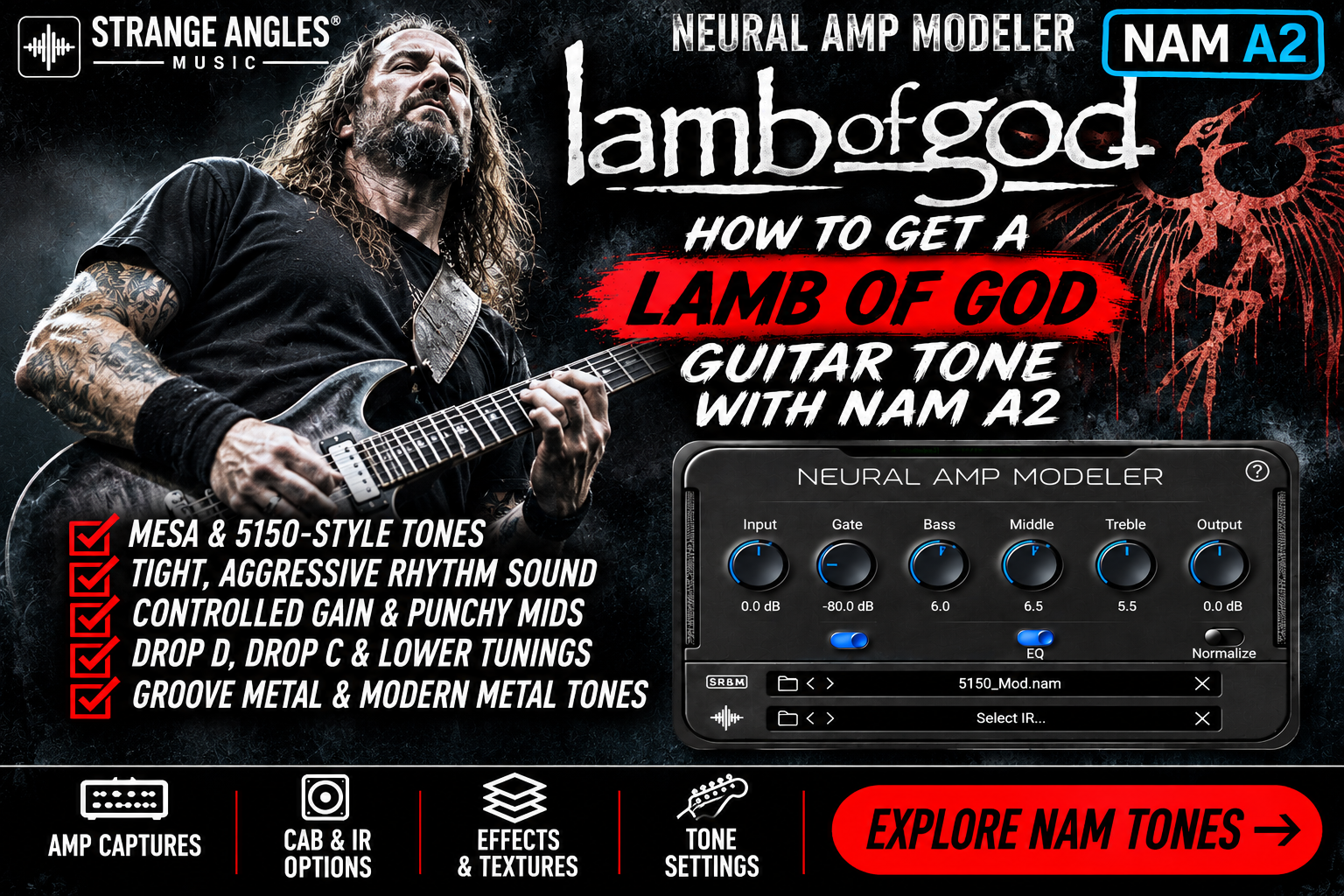
How to Get a Lamb of God Guitar Tone with NAM A2
Want to recreate the crushing, aggressive guitar tones of Lamb of God using Neural Amp Modeler (NAM)?
Lamb of God helped define modern American groove metal with powerful riffs, aggressive palm muting, intricate rhythms, and guitar tones that are heavy without sacrificing clarity.
From Ashes of the Wake and Sacrament to Wrath and Omens, Mark Morton and Willie Adler have developed a distinctive sound built around powerful Mesa/Boogie amplifiers, aggressive playing, and carefully controlled distortion.
Their sound isn't simply about using maximum gain. It's about tight low frequencies, strong midrange, precise picking, and two guitar tones that complement each other.
With Neural Amp Modeler, you can explore similar amplifier characteristics using professionally captured amplifiers, cabinet IRs, and overdrives.
In this guide, we'll look at the amplifiers behind Lamb of God's sound, how to build a Lamb of God-inspired NAM A2 signal chain, and which Strange Angles Music products are worth exploring.
Looking for Great NAM A2 Tones?
Spend less time tweaking and more time playing.
Explore professionally captured amplifiers, preamps, and overdrives designed for groove metal, thrash metal, modern metal, and aggressive rhythm guitar.
What Makes the Lamb of God Guitar Tone So Distinctive?
Lamb of God's guitar sound combines aggression, precision, and powerful rhythmic playing.
Mark Morton and Willie Adler have different approaches to their guitar tones, but together they create the band's massive signature sound.
Some of the defining characteristics include:
Tight, aggressive palm mutes
Strong midrange presence
Controlled low frequencies
Clear pick attack
Powerful amplifier distortion
Precise alternate picking
Complex rhythmic patterns
Heavy down-tuned riffs
Two complementary guitar tones
One important detail is that Lamb of God doesn't rely on excessive gain to create its heavy sound.
Mark Morton has discussed deliberately keeping gain under control when recording because too much saturation can make guitar tracks lose clarity.
That is an important lesson when building your own Lamb of God-inspired tone.
What Amplifiers Do Lamb of God Use?
Lamb of God has used several amplifiers throughout its career, but Mesa/Boogie has been particularly important to the band's sound.
Mark Morton and Willie Adler have both used Mesa/Boogie Mark-series amplifiers.
Their exact setups have changed between recording sessions and tours.
1. Mesa/Boogie Mark IV
The Mesa/Boogie Mark IV is one of the most important amplifiers associated with Mark Morton.
He has used it extensively for recording and live performances.
The Mark IV provides a powerful, focused midrange and tight high-gain response.
It is particularly useful for aggressive rhythm guitar that needs to remain clear during fast riffs.
2. Mesa/Boogie Mark V
The Mesa/Boogie Mark V has also been an important part of the band's amplifier setup.
Willie Adler has used the Mark V alongside the Mark IV.
Mark Morton has also used Mark-series amplifiers throughout his career.
The Mark V offers additional tonal flexibility and is worth exploring for players looking to create a similar high-gain sound.
3. Mesa/Boogie Royal Atlantic
Mark Morton has also used the Mesa/Boogie Royal Atlantic RA-100.
He described its combination of smooth saturation and tight low-end response as particularly appealing.
It became part of his recording and live amplifier setup during the Resolution era.
4. Mesa/Boogie Badlander 100
Mark Morton's more recent amplifier setup includes the Mesa/Boogie Badlander 100 alongside the Mark V.
In a 2026 interview, he highlighted the Badlander's strong, usable low end and present midrange as important characteristics for Lamb of God's heavy riffing style.
He also described using a Tube Screamer with its drive rolled down to tighten the bottom end rather than add substantial distortion.
5. Mesa/Boogie Rectifier
Mesa/Boogie Rectifier amplifiers have also appeared in Lamb of God's broader amplifier history.
The Rectifier provides a different high-gain character from the Mark-series amplifiers.
It is worth experimenting with if you want a thicker, more saturated alternative.
Important: The Mark IV, Mark V, Badlander, and Dual Rectifier are different amplifier designs. They should not be treated as interchangeable or exact recreations of one another.
What Guitars and Tunings Does Lamb of God Use?
Mark Morton and Willie Adler have used different guitars throughout their careers.
Mark is associated with his signature Jackson Dominion and Gibson Les Paul models.
Willie Adler is closely associated with his ESP Warbird signature guitars.
Both guitarists use humbucker-equipped instruments designed for aggressive rhythm playing.
Lamb of God Tunings
Lamb of God uses different tunings depending on the song.
Some of the commonly encountered tunings include:
Drop D
Drop C
Drop C#
Standard tuning
Other alternate tunings
Mark Morton has discussed using different string gauges depending on the tuning.
For example, his 2026 touring setup included different string sets for Drop D, Drop C#, and Drop C.
If you're recreating a particular Lamb of God song, check its specific tuning rather than assuming every riff uses the same setup.
Best NAM Amplifiers for Lamb of God-Inspired Guitar Tones
The original Mesa/Boogie Mark IV and Badlander are important reference points for Lamb of God's sound.
However, you don't need those exact amplifiers to start exploring similar high-gain characteristics.
Here are several Strange Angles Music NAM captures worth experimenting with.
1. Peavey 5150 Block Letter
The original Peavey 5150 is an excellent starting point for aggressive groove metal.
It provides a powerful high-gain character with plenty of attack and a focused response.
It isn't a Mesa Mark IV recreation, but it offers a different high-gain alternative for tight, aggressive rhythm guitar.
2. Mesa/Boogie Dual Rectifier
The Dual Rectifier is particularly interesting because it gives you access to a genuine Mesa/Boogie amplifier character.
It is not the same as the Mark IV or Badlander used by Mark Morton, but it provides another Mesa high-gain sound to explore.
Try it for:
Heavy rhythm guitar
Aggressive palm mutes
Thick low-midrange
Modern metal riffs
Powerful lead tones
3. Randall Satan
The Randall Satan is another option worth exploring for aggressive groove metal.
Its high-gain character makes it interesting for heavy, punchy rhythm tones.
Experiment with the gain and cabinet combinations to find a sound that works with your guitar and tuning.
4. Fortin Evil Pumpkin
The Fortin Evil Pumpkin offers a more modern high-gain alternative.
It is worth exploring if you want aggressive rhythm guitar with a tight, focused response.
5. Omega Obsidian
The Omega Obsidian is another option for thick, aggressive modern metal tones.
It offers a different character from the 5150 and Mesa Rectifier and can be useful for creating your own interpretation of Lamb of God's sound.
These are alternative amplifier choices, not claims that Lamb of God used these particular Strange Angles captures.
How to Get a Lamb of God Guitar Tone Using NAM A2
Let's build a practical signal chain.
Step 1: Start With a High-Gain NAM Capture
Begin with a Peavey 5150, Mesa Dual Rectifier, Randall Satan, or another suitable high-gain capture.
Start with the amplifier by itself before adding additional processing.
Listen for:
Tight palm mutes
Strong pick attack
Defined low notes
Clear chord separation
Powerful midrange
Enough gain without excessive saturation
The goal is a heavy, aggressive sound that remains articulate.
Step 2: Add an Overdrive to Tighten the Low End
A Tube Screamer-style overdrive is a useful starting point.
Try these general settings:
Drive: Very low
Tone: Adjust to your pickups and cabinet
Level: Moderately high
The idea is to tighten the signal entering the amplifier rather than add another layer of distortion.
Mark Morton has discussed using an original Tube Screamer with its drive rolled all the way down in front of his Mesa/Boogie Badlander.
This is a particularly useful technique to experiment with.
Step 3: Choose the Right Cabinet IR
The cabinet is a major part of the final sound.
A 4x12 cabinet is a great starting point for Lamb of God-inspired rhythm tones.
Experiment with:
Mesa-style 4x12 cabinets
Marshall-style 4x12 cabinets
Vintage 30 speakers
G12T-75 speakers
SM57 microphone positions
Different microphone blends
If you're using a D.I. capture, add a suitable cabinet IR.
If you're using a full-rig capture, check whether the cabinet and microphone coloration are already included.
Step 4: Keep the Gain Under Control
This is one of the most important parts of the Lamb of God sound.
More distortion doesn't automatically mean a heavier guitar tone.
Too much gain can reduce note separation and make fast riffs sound less precise.
Try reducing the gain until the guitar becomes clearer.
You may find that a slightly cleaner tone sounds much heavier once the bass and drums are added.
Step 5: Find the Right Midrange Balance
A strong midrange helps the guitar remain present in the mix.
Avoid automatically scooping the mids.
Experiment with:
Strong upper mids for attack
Enough low mids for body
Controlled bass
Smooth high frequencies
The goal is a powerful guitar tone that doesn't disappear behind the bass or drums.
Step 6: Experiment With Two Different Amplifier Characters
One of the interesting aspects of Lamb of God's guitar sound is how Mark Morton and Willie Adler complement each other.
Rather than making two guitar tracks sound identical, experiment with different amplifier characters.
For example:
Guitar A: Mesa-style or Marshall-style midrange character.
Guitar B: Peavey 5150 or modern high-gain character.
Record separate performances and pan them left and right.
This creates natural stereo width while allowing each guitar to contribute something different.
How to Get the Tight Lamb of God Rhythm Sound
The amplifier is only part of the equation.
The playing technique is just as important.
Focus on Precise Palm Muting
Lamb of God riffs often combine fast palm-muted passages with open chords and rhythmic accents.
Keep your picking hand controlled and avoid allowing unwanted strings to ring.
Practice Alternate Picking
Many of the band's riffs rely on consistent alternate picking and precise rhythmic execution.
Focus on clean transitions between notes.
Keep Your Picking Dynamics Consistent
The amplifier should respond to your playing rather than flattening every note with excessive distortion.
Try slightly reducing the gain and paying attention to how hard you're picking.
Don't Let the Bass and Guitar Fight
The guitar should provide aggression and midrange definition.
The bass guitar should provide much of the low-frequency foundation.
Avoid adding excessive bass to the guitar signal simply because you're playing in a lower tuning.
Recommended NAM Signal Chains for Lamb of God-Inspired Tones
Here are three practical starting points.
Classic Groove Metal Rhythm
Noise Gate
Tube Screamer-Style Boost
Peavey 5150 NAM Capture
4x12 Cabinet IR
Subtle Post-EQ
Output
Thick Mesa-Inspired Rhythm
Noise Gate
Optional Overdrive
Mesa Dual Rectifier NAM Capture
4x12 Cabinet IR
Post-EQ
Output
Layered Two-Guitar Approach
Record Guitar Performance A
Process with one amplifier capture
Record Guitar Performance B
Process with a different amplifier capture
Pan performances left and right
Blend levels to taste
These are starting points for your own Lamb of God-inspired tones, not exact recreations of the band's recording chains.
Best NAM Packs for Lamb of God-Inspired Guitar Tones
Here are the Strange Angles Music products I would explore for this particular sound.
1. Euge Valovirta – Hard Hitters Vol. 2 NAM
Best for classic high-gain amplifier options
This collection is particularly useful if you want to experiment with different high-gain amplifier characters.
It includes:
24 A2 D.I. amp captures
24 A2 full-rig studio captures
3 A2 D.I. overdrive captures
Featured amplifiers include:
Peavey 5150 II
Peavey 5150 Block Letter
Mesa/Boogie Dual Rectifier
Soldano SLO-100
Marshall 1959HW Jose Mod Plexi
Marshall JCM800 2203 The Bad Boy
Marshall JCM800 2203 The Little Brother
ADA MP-1 preamp into Fryette PS-100 power amp
It also includes Maxon OD808, BOSS SD-1, and MXR Custom Badass Modified overdrive captures.
The Mesa Dual Rectifier and Peavey 5150 captures make this a strong collection for exploring different groove-metal and thrash-metal tones.
It does not list the Mesa Mark IV or Badlander, so these are alternative amplifier choices rather than exact recreations of Mark Morton's rig.
Best for: Groove metal, thrash metal, aggressive rhythm guitar, and players who want multiple high-gain amplifier options.
Explore Euge Valovirta – Hard Hitters Vol. 2 NAM →
2. NAM Everything Pack
Best for a broad selection of modern high-gain tones
The NAM Everything Pack includes a large selection of D.I. and studio profiles.
Featured amplifiers include:
Fortin Evil Pumpkin
Fortin Meshuggah 2.0
Omega Granophyre
Omega Obsidian 1.5
Driftwood Purple Nightmare
Dover DA 50
RedSeven Leviathan
Dimebag Darrell Warhead Mini
MLC S_ZERO 93 Silenoz
MLC S_ZERO 100
It also includes cabinet captures, preamps, and overdrives.
This is a good choice if you want a broader selection of amplifier sounds for different metal styles.
Best for: Guitarists who want a larger collection of modern high-gain NAM captures.
3. Metal Heads – NAM A2
Best for a dedicated modern metal collection
The Metal Heads NAM A2 collection includes:
54 D.I. captures
3 full-rig captures
Featured amplifier options include:
Fortin Evil Pumpkin
Fortin Meshuggah 2.0
Omega Granophyre
Omega Obsidian 1.5
Driftwood Purple Nightmare
Dover DA 50
RedSeven Leviathan
MLC S_ZERO 93 Silenoz
It also includes preamp and overdrive captures.
This collection is worth exploring if you want multiple aggressive amplifier characters in one package.
Best for: Modern metal, groove metal, and aggressive high-gain rhythm guitar.
Explore Metal Heads – NAM A2 →
4. Individual NAM Amplifier Packs
If you already know which amplifier character you want, individual packs can be a better option.
Explore the available Strange Angles Music individual amplifier captures and choose the one that best fits your preferred sound.
Best for: Guitarists who want a specific amplifier rather than a large collection.
Browse Individual NAM Amplifier Packs →
How to Make Your Lamb of God Guitar Tone Sound Better in a Mix
Double-Track Your Rhythm Guitars
Record two separate performances of the same guitar part.
Pan one left and the other right.
This creates natural stereo width and helps the guitars sound much larger.
Don't Overdo the Gain
A clear, articulate guitar tone will usually sound heavier in a mix than one with excessive distortion.
Keep the Low End Controlled
Let the bass guitar provide much of the low-frequency weight.
The guitars should focus on attack, aggression, and midrange definition.
Leave Space for the Vocals
Lamb of God's guitar arrangements often leave room for Randy Blythe's vocal rhythms.
Avoid excessive midrange buildup that makes the guitars compete with the vocal.
Use Different Guitar Tones
Try blending different amplifier characters rather than making every guitar track sound identical.
This can create a larger, more interesting sound without excessive gain.
Frequently Asked Questions
What amplifiers does Mark Morton use?
Mark Morton has used several Mesa/Boogie amplifiers, including the Mark IV, Mark V, Royal Atlantic, and Badlander 100.
His more recent setup includes the Badlander 100 and Mark V.
What amplifiers does Willie Adler use?
Willie Adler has used Mesa/Boogie Mark IV and Mark V amplifiers, along with other Mesa models throughout his career.
What is the best NAM capture for Lamb of God?
There isn't one exact capture that recreates the band's entire sound.
The Peavey 5150 Block Letter and Mesa/Boogie Dual Rectifier captures in Euge Valovirta Hard Hitters Vol. 2 NAM are excellent starting points.
Can I get a Lamb of God guitar tone with NAM A2?
Yes. You can use high-gain NAM captures, cabinet IRs, overdrives, and EQ to build your own Lamb of God-inspired guitar tones.
What tuning does Lamb of God use?
Lamb of God uses different tunings depending on the song, including Drop D, Drop C, and Drop C#.
Should I use a Tube Screamer?
A Tube Screamer-style overdrive is a useful option for tightening the low end.
Try using very little drive and increasing the output level to push the amplifier.
Should I double-track my guitars?
Yes. Recording two separate performances and panning them left and right is a great way to create a wide rhythm guitar sound.
Do I need a cabinet IR with NAM?
It depends on the capture.
D.I. amplifier captures generally need a cabinet IR or another cabinet stage. Full-rig captures may already include the cabinet and microphone response.
Can I use these captures for other groove metal bands?
Absolutely. These amplifier captures can also be useful for exploring tones inspired by Pantera, Machine Head, Sepultura, and other aggressive metal bands.
Final Thoughts
Lamb of God's guitar sound is built around powerful amplification, tight low-end response, strong midrange, and precise rhythmic playing.
The Mesa/Boogie Mark IV, Mark V, and Badlander are important reference points for understanding Mark Morton's approach to guitar tone.
While the Strange Angles Music NAM catalog doesn't list exact captures of those particular amplifiers, the Peavey 5150 and Mesa Dual Rectifier captures in Euge Valovirta Hard Hitters Vol. 2 NAM provide excellent alternative starting points.
Experiment with different amplifier characters, cabinet IRs, and overdrives.
Keep the gain controlled, focus on picking precision, and let the bass guitar provide much of the low-frequency foundation.
With the right captures and playing technique, you can build a powerful Lamb of God-inspired guitar setup using Neural Amp Modeler.
Find Your Next NAM Guitar Tone
Explore the Strange Angles Music NAM collection and discover professionally captured amplifiers, preamps, and overdrives for groove metal, thrash metal, modern metal, and more.