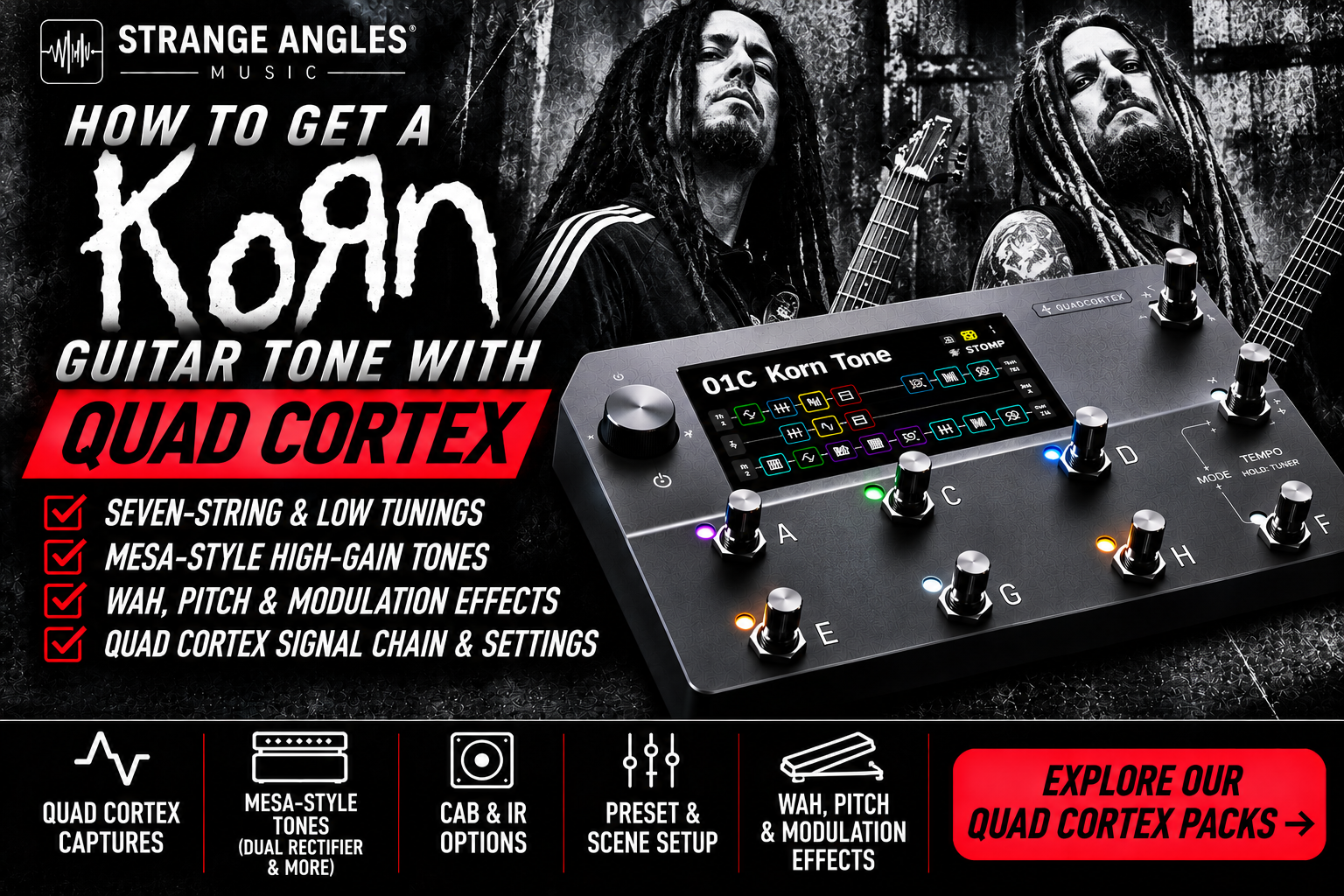
How to Get a Korn Guitar Tone with Quad Cortex
Want to get the heavy, gritty guitar tones of Korn using the Neural DSP Quad Cortex?
Korn helped define the sound of nu metal with a guitar style that completely changed the way heavy music was played.
James "Munky" Shaffer and Brian "Head" Welch built a distinctive sound around seven-string guitars, low tunings, aggressive distortion, unusual effects, and dark, dissonant riffs.
From the raw sound of Korn and Life Is Peachy to the massive production of Follow the Leader and Issues, their guitar tones have remained instantly recognizable.
The good news is that you can explore this sound using the Quad Cortex and a combination of high-gain amplifier captures, cabinet simulations, pitch effects, wah, and modulation.
In this guide, we'll look at what makes Korn's guitar tone unique, how to build your own Korn-inspired Quad Cortex preset, and which Strange Angles Music captures are worth trying.
Looking for Great Quad Cortex Tones?
Explore professionally captured amplifiers designed for nu metal, alternative metal, modern metal, and aggressive rhythm guitar.
From Mesa/Boogie and EVH to Omega, Fortin, Randall, and more, Strange Angles Music offers professionally captured tones for your Quad Cortex.
🎸 Browse Quad Cortex Captures →
What Makes the Korn Guitar Tone So Distinctive?
Korn's guitar sound is different from traditional heavy metal.
Instead of relying on extremely tight, polished distortion, their sound often features a gritty, thick, and almost industrial character.
Some of the defining characteristics include:
Seven-string guitars
Low tunings
Thick, aggressive distortion
Strong low-midrange presence
Dark, dissonant riffs
Unusual rhythmic patterns
Wah and pitch-shifting effects
Chorus and modulation
A combination of heavy and atmospheric guitar sounds
One of the most important parts of the Korn sound is the way the guitar interacts with the bass.
The guitars don't always need to sound extremely tight or heavily scooped. Their distinctive low-midrange character is a major part of what makes the riffs recognizable.
If you're trying to recreate this style, don't automatically approach it like a modern djent or metalcore tone.
What Guitars Do Munky and Head Use?
One of the biggest parts of Korn's signature sound is the seven-string guitar.
Munky and Head helped popularize the seven-string guitar in mainstream heavy music during the 1990s.
Both guitarists have been closely associated with Ibanez seven-string guitars, including their signature K7 models.
The additional low string allows them to create riffs and chord voicings that aren't possible in the same way on a conventional six-string guitar.
For a Korn-inspired setup, consider:
A seven-string guitar
A suitable low string gauge
Humbucker pickups
Proper intonation
A guitar setup appropriate for your tuning
You don't necessarily need an expensive signature guitar. A properly set up seven-string with suitable pickups is a great starting point.
What Tuning Does Korn Use?
Korn is strongly associated with seven-string guitars tuned down a whole step from standard seven-string tuning.
A common tuning is:
Low to high: A – D – G – C – F – A – D
This low A tuning is one of the defining characteristics of their early sound.
Different songs and recording eras can use different tunings, so always check the specific song you're learning.
The important thing is maintaining enough string tension to keep the low notes clear and controlled.
If the strings feel too loose, experiment with heavier gauges and make sure your guitar is properly set up.
What Amplifiers Have Korn Used?
Korn's guitarists have experimented with several different amplifier setups throughout their career.
Their sound has included Mesa/Boogie, Bogner, Diezel, and other high-gain amplifier systems.
The Mesa/Boogie Triple Rectifier is particularly associated with their live guitar setups.
Their studio tones have also involved different combinations of amplifiers, effects, and recording techniques.
For Quad Cortex users, there are several high-gain amplifier captures worth exploring.
Best Amplifiers for a Korn-Inspired Quad Cortex Tone
1. Mesa/Boogie Dual Rectifier
The Mesa/Boogie Dual Rectifier is a great starting point for exploring the thick, aggressive character associated with classic nu metal.
Korn's documented use of Triple Rectifier amplifiers makes the Rectifier family particularly relevant.
Your Quad Cortex setup can use a Dual Rectifier capture as an alternative tonal starting point.
Try it for:
Thick rhythm guitar
Low-tuned riffs
Aggressive distortion
Heavy alternative metal
Dark, powerful chord sounds
The Dual Rectifier isn't the same amplifier as the Triple Rectifier, but it offers a useful way to explore a related tonal character.
2. EVH 5150 III
The EVH 5150 III is another option for aggressive high-gain guitar tones.
It offers a more focused and aggressive response that can work well for heavier modern nu metal sounds.
Try it if you want more attack and definition than a looser, darker amplifier setting.
3. Omega Obsidian
The Omega Obsidian is worth exploring if you want a more modern, aggressive high-gain sound.
Its thick distortion character makes it useful for heavy rhythm guitar and low-tuned riffs.
4. Fortin Evil Pumpkin
The Fortin Evil Pumpkin is another strong option for aggressive high-gain tones.
Try it for heavier modern interpretations of the Korn sound.
5. Randall Satan
The Randall Satan is worth experimenting with if you want a darker, aggressive amplifier character.
It offers another direction for building thick, heavy rhythm guitar sounds.
These are recommended alternatives for building your own Korn-inspired tone, not a claim that Korn used these exact amplifiers.
How to Get a Korn Guitar Tone Using Quad Cortex
The goal is to build a thick, aggressive sound without making everything overly compressed or excessively modern.
1. Start With a High-Gain Amp Capture
Begin with a Mesa/Boogie Dual Rectifier capture or another high-gain amplifier.
Start with moderate-to-high gain and experiment with the amplifier's bass and midrange response.
Listen for:
Thick low-midrange
Aggressive distortion
Dark but clear chords
Strong note definition
Enough saturation for heavy riffs
Don't immediately add multiple effects.
Get the amplifier sound right first.
2. Experiment With the Gain
Korn's classic sound isn't necessarily about using the highest possible gain setting.
Try adjusting the gain until the guitar has enough aggression without becoming overly compressed.
You want the riffs to retain their dynamics and character.
3. Choose a Suitable Cabinet
A 4x12 cabinet is a useful starting point.
Experiment with different speaker types and microphone positions to find a sound that has enough body without becoming muddy.
For a D.I. capture, add a cabinet IR or Quad Cortex cabinet block.
If you're using a full-rig capture, it may already contain cabinet and microphone coloration.
4. Don't Automatically Scoop the Mids
This is particularly important.
Korn's guitar sound has a distinctive midrange and low-midrange character.
Removing too much midrange can make the guitar sound thin and take away some of the aggression.
Instead, experiment with small EQ adjustments until the guitar sounds thick without becoming muddy.
5. Control the Low End
Seven-string guitars produce substantial low-frequency energy.
If the low notes sound loose or muddy, try:
Reducing excessive bass before the amplifier
Adjusting the cabinet IR
Reducing unnecessary gain
Applying subtle post-capture EQ
Checking your guitar's string tension and setup
The goal is to maintain a thick sound while keeping individual notes clear.
How to Get the Classic Korn Effects
The amplifier is only part of the sound.
Munky and Head have used effects such as wah, pitch shifting, chorus, and other processing to create some of Korn's most recognizable guitar parts.
The Quad Cortex gives you plenty of options for experimenting with these sounds.
1. Add a Wah Effect
Wah is an important part of the Korn guitar vocabulary.
Experiment with a traditional wah effect and use an expression pedal to control it.
Try it on riffs where you want a more vocal, aggressive character.
2. Experiment With Pitch Shifting
Pitch effects can create unusual guitar sounds and help reproduce the character of certain Korn riffs.
Try experimenting with:
Whammy-style pitch shifting
Octave effects
Momentary pitch changes
Different intervals
Use the expression pedal to control the pitch movement where appropriate.
3. Add Chorus
Chorus can help create wider, more unusual guitar textures.
Try subtle settings for clean sounds and more exaggerated settings for atmospheric or experimental sections.
4. Experiment With Flanger and Phaser
Modulation effects can create movement and unusual textures.
Try these effects on individual scenes rather than leaving them active on every rhythm tone.
5. Create Separate Scenes
One of the best ways to organize a Korn-inspired Quad Cortex setup is to create different scenes.
SceneSoundAMain heavy rhythmBHeavy rhythm with wahCPitch-shifted effectDChorus guitarEClean / atmospheric
This allows you to switch between different sounds without building an entirely new preset for every song.
Recommended Quad Cortex Signal Chain for Korn-Inspired Tones
Here's a practical starting point.
Heavy Rhythm Chain
Noise Gate
Optional Overdrive / Boost
Mesa/Boogie Dual Rectifier Capture
4x12 Cabinet IR
Subtle Post-EQ
Output
Experimental Guitar Chain
Noise Gate
Wah / Pitch Effect
High-Gain Amp Capture
Cabinet IR
Chorus / Modulation
Output
The effects can be moved around depending on the sound you're trying to achieve.
Best Quad Cortex Packs for Korn-Inspired Guitar Tones
If you're looking for high-gain amplifier captures, these Strange Angles Music collections are worth exploring.
1. Metal Essential – Quad Cortex Pack
The Metal Essential Quad Cortex Pack is a great starting point for aggressive nu metal and alternative metal tones.
It includes:
15 D.I. amp captures
6 amp and cabinet captures
Approximately 12 D.I. overdrive captures
Featured amplifiers include:
EVH 5150 III
ENGL Savage
ENGL Powerball
Marshall JVM
Mesa/Boogie Dual Rectifier
The collection also includes overdrive captures from Horizon Devices, Maxon, and Fortin.
The Mesa/Boogie Dual Rectifier makes this pack particularly interesting for guitarists exploring classic nu metal and aggressive alternative metal tones.
Best for: Nu metal, alternative metal, metalcore, and aggressive rhythm guitar.
Explore Metal Essential – Quad Cortex Pack →
2. Quad Cortex – Everything Pack
If you want a much larger selection of amplifiers, the Quad Cortex Everything Pack includes over 150 D.I. and studio captures.
Featured amplifiers include:
Fortin Evil Pumpkin
Fortin Meshuggah 2.0
Omega Ampworks Obsidian 1.5
Omega Ampworks Granophyre
RedSeven Duality
RedSeven Leviathan
Dover DA 50
Driftwood Purple Nightmare
Randall Satan
Science Hellhawk
Science Mother
Fryette Deliverance
EVH 5150 III
ENGL Savage
ENGL Powerball
Marshall JVM
It also includes preamp captures, overdrives, and cabinet options.
Best for: Guitarists who want a large selection of modern and classic high-gain amplifier tones in one collection.
Explore Quad Cortex Everything Pack →
3. Obsidian – Quad Cortex Pack
The Omega Obsidian Quad Cortex Pack includes:
15 D.I. captures
3 full-rig studio captures
The Obsidian is a great option for players who want an aggressive, modern high-gain sound.
Although it isn't a recreation of Korn's original amplifier setup, it can be used to create your own heavy nu metal-inspired tones.
Best for: Aggressive modern metal, heavy rhythm guitar, and high-gain alternative metal.
Explore Obsidian – Quad Cortex Pack →
How to Make Your Korn-Inspired Guitar Tone Sound Better in a Mix
Double-Track Your Rhythm Guitars
Record two separate performances of the same guitar part.
Pan one left and the other right.
This creates natural stereo width and helps the guitars sound much larger.
Don't Remove Too Much Midrange
The midrange is an important part of the Korn sound.
Avoid excessive EQ scooping, especially when playing low-tuned riffs.
Use Effects Creatively
Wah, pitch shifting, chorus, and modulation can add character to the guitar sound.
Use these effects to complement the riff rather than overwhelm it.
Keep the Bass and Guitar Working Together
Korn's sound relies heavily on the relationship between guitar and bass.
Avoid excessive low-frequency buildup in the guitar signal.
The bass should provide much of the deepest weight while the guitars provide the aggression and harmonic character.
Experiment With Different Gain Levels
Not every riff needs maximum distortion.
Try different gain settings for different songs and sections.
Sometimes a slightly less saturated sound produces a more recognizable result.
Frequently Asked Questions
What guitar does Munky from Korn use?
Munky has been closely associated with Ibanez seven-string guitars, including the signature K7 series.
What guitar does Head from Korn use?
Head has also used Ibanez seven-string guitars, including signature models. His equipment has changed throughout his career.
What tuning does Korn use?
Korn is strongly associated with seven-string guitars tuned A–D–G–C–F–A–D, although tunings vary between songs.
What amplifier does Korn use?
Korn's guitarists have used different amplifiers throughout their career, including Mesa/Boogie Triple Rectifiers and other high-gain systems.
Can I get a Korn guitar tone with Quad Cortex?
Yes. You can use high-gain Neural Captures, cabinet IRs, wah, pitch shifting, and modulation effects to create your own Korn-inspired guitar sounds.
Do I need a seven-string guitar?
A seven-string is ideal for reproducing many of Korn's classic riffs and tunings. However, you can experiment with pitch shifting and other approaches using a six-string guitar.
Should I use a Mesa Dual Rectifier capture?
It's a useful starting point because of its relationship to the Rectifier amplifier family, although it isn't the same model as Korn's documented Triple Rectifier setups.
Can I use these captures for other nu metal bands?
Absolutely. These high-gain captures can also be useful for exploring tones inspired by Slipknot, Deftones, Mudvayne, and other heavy alternative metal bands.
Final Thoughts
Korn's guitar tone is built around low-tuned seven-string guitars, thick distortion, aggressive riffs, and creative effects.
The key to getting a similar sound with Quad Cortex is to avoid treating it like a conventional modern metal tone.
Start with a high-gain amplifier capture, preserve the low-midrange character, experiment with wah and pitch effects, and create separate scenes for different sounds.
With the right captures and effects, you can build a powerful Korn-inspired setup using your Quad Cortex.
Find Your Next Quad Cortex Guitar Tone
Explore the Strange Angles Music Quad Cortex collection and discover professionally captured amplifiers for nu metal, alternative metal, modern metal, and more.