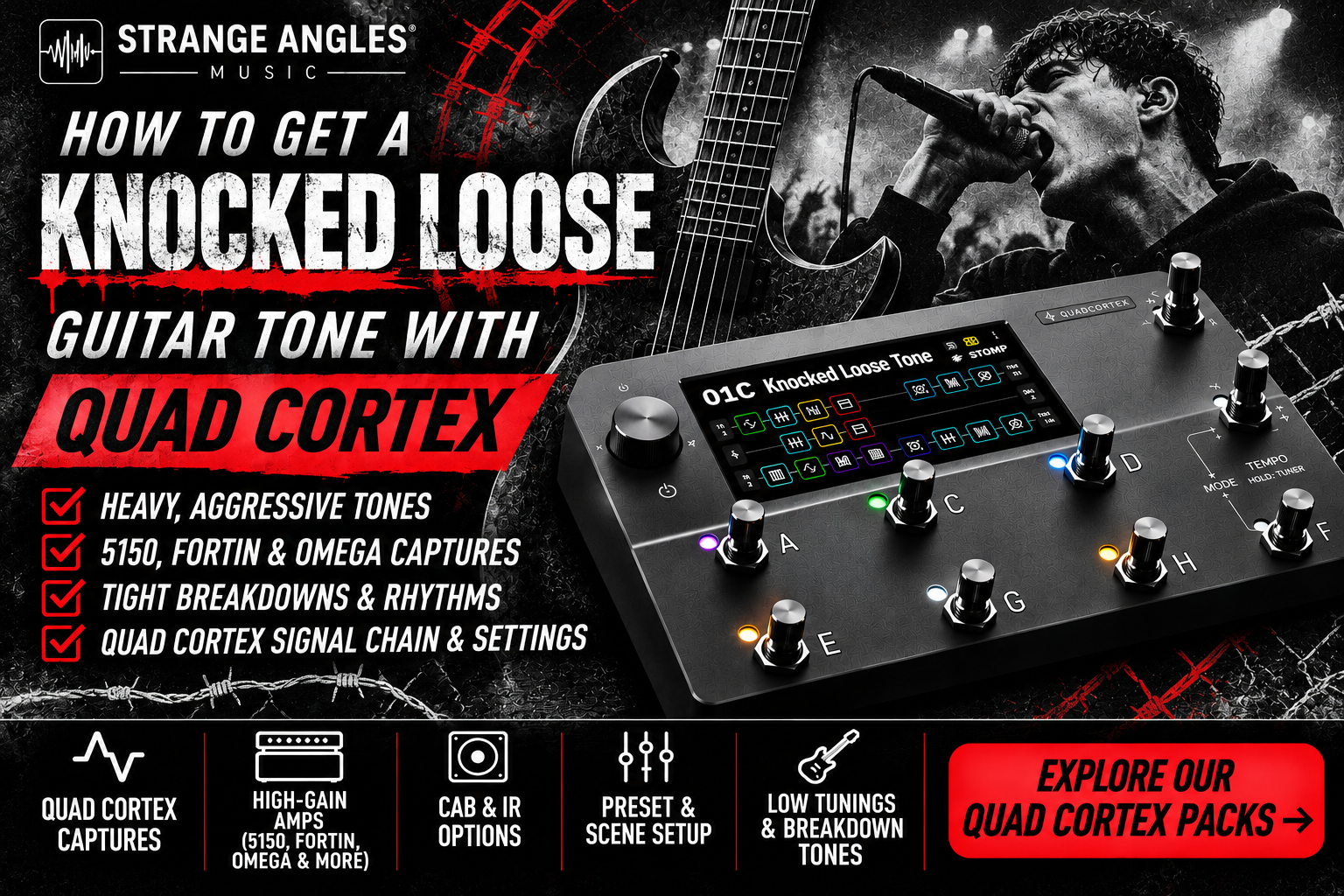
How to Get a Knocked Loose Guitar Tone with Quad Cortex
Want to get the crushing, aggressive guitar tones of Knocked Loose using the Neural DSP Quad Cortex?
Knocked Loose has become one of the most recognizable names in modern heavy music, combining metallic hardcore, metalcore, chaotic rhythms, and brutally heavy breakdowns.
Their guitar sound is raw, aggressive, and extremely percussive. Unlike the highly polished djent tones associated with some progressive metal bands, Knocked Loose's sound emphasizes attack, urgency, and impact.
With the right Neural Captures, cabinet IRs, and signal-chain settings, you can build your own Knocked Loose-inspired guitar tone using the Quad Cortex.
In this guide, we'll explore the amplifiers worth trying, how to create tight breakdown tones, and which Strange Angles Music captures can help you get started.
Looking for Great Quad Cortex Tones?
Explore professionally captured high-gain amplifiers designed for metalcore, hardcore, modern metal, and aggressive rhythm guitar.
From EVH 5150 III and Fortin to Omega Granophyre, Randall, and more, Strange Angles Music offers a wide range of high-gain Neural Captures.
🎸 Browse Quad Cortex Captures →
What Makes the Knocked Loose Guitar Tone So Distinctive?
Knocked Loose's guitar tone is built around aggression, precision, and a powerful midrange.
Their riffs often feature abrupt rhythmic stops, dissonant chords, palm-muted low notes, and explosive breakdowns.
The defining characteristics include:
Aggressive high-gain distortion
Tight, punchy palm mutes
Strong midrange and pick attack
Low-tuned rhythm guitars
Abrasive, dissonant chords
Controlled low-frequency response
Precise rhythmic stops
Raw, powerful guitar production
The goal isn't to create the smoothest or most saturated distortion possible.
Instead, you want a guitar tone that sounds aggressive and immediate, with enough clarity to make every rhythmic hit stand out.
Best Amplifiers for a Knocked Loose-Inspired Tone
You don't need to duplicate the band's exact recording equipment to explore this style.
Several high-gain amplifier designs are particularly useful for creating aggressive hardcore and metalcore tones.
EVH 5150 III
The EVH 5150 III is an excellent starting point.
Its aggressive gain structure, strong midrange, and tight response make it useful for heavy rhythm guitar.
Try it for:
Metallic hardcore
Metalcore
Heavy breakdowns
Aggressive palm-muted riffs
Low-tuned rhythm guitar
A 5150-style capture can provide the aggression and punch needed for this style.
Fortin Evil Pumpkin
The Fortin Evil Pumpkin is another strong option.
Its aggressive high-gain character makes it useful for tight, saturated rhythm guitar and modern heavy music.
Try it when you want a more intense, modern distortion character.
Omega Granophyre
The Omega Granophyre is worth exploring for aggressive modern metal and metalcore.
It can deliver a tight, articulate response that works well with low-tuned riffs and fast rhythmic patterns.
Randall Satan
The Randall Satan is another interesting amplifier for aggressive, down-tuned rhythm guitar.
Experiment with its high-gain character when building heavier hardcore-inspired sounds.
Mesa/Boogie Dual Rectifier
A Dual Rectifier-style tone can provide a thick, aggressive distortion character with substantial low-midrange weight.
Try it when you want a more traditional heavy amplifier sound.
These are recommended alternatives for creating a Knocked Loose-inspired tone, not a claim that the band used each amplifier on its recordings.
How to Get a Knocked Loose Guitar Tone Using Quad Cortex
Once you've selected your amplifier capture, you can build a signal chain around it.
1. Start With a High-Gain Neural Capture
Begin with an EVH 5150 III or another aggressive high-gain amplifier capture.
Listen for tight palm mutes, strong attack, and enough midrange to keep the guitar audible.
Don't immediately add more gain.
A capture with controlled distortion can sound heavier than an overly saturated one, especially during fast breakdowns.
2. Add an Overdrive or Boost
A boost can help tighten the low end and increase pick attack.
Try a Tube Screamer-style overdrive with these starting settings:
Drive: 0–2 out of 10
Level: 7–9 out of 10
Tone: 5 out of 10
These are starting points, not exact settings used by the band.
The goal is to reduce loose low-frequency distortion and emphasize the attack of each note.
If your capture already sounds tight, you may not need a boost.
3. Choose an Aggressive Cabinet IR
The cabinet plays a major role in your guitar tone.
A 4x12 cabinet with Vintage 30-style speakers is a useful starting point.
Experiment with an SM57-style microphone position for an aggressive, mid-forward sound.
If the tone becomes too harsh, adjust the microphone position or blend it with a darker microphone sound.
If you're using a D.I. capture, add a cabinet IR or Quad Cortex cab block.
A full-rig capture may already include the cabinet and microphone sound.
4. Control the Low Frequencies
Breakdowns need low-end impact, but too much bass can make them sound muddy.
Try a high-pass filter around 70–100 Hz as a starting point, adjusting for your tuning and mix.
Reduce excessive low-mid buildup only where necessary.
The bass guitar should provide much of the sub-bass weight.
5. Preserve the Midrange
One of the most important parts of this style is keeping the guitars aggressive and present.
Avoid scooping too much midrange.
The guitar needs enough midrange to make dissonant chords, pick attack, and breakdowns cut through the drums.
6. Use a Noise Gate
A noise gate is particularly useful for tight hardcore riffs.
The short stops between notes need to sound controlled.
Start with a moderate gate threshold and increase it until unwanted noise is reduced.
Avoid settings that cut off natural note decay or sustain.
Recommended Quad Cortex Signal Chain
Here's a practical starting point for a Knocked Loose-inspired rhythm preset.
Heavy Hardcore Rhythm Chain
Noise Gate
Overdrive / Boost
EVH 5150 III Neural Capture
4x12 Cabinet IR
Post-EQ
Output
You can substitute the EVH capture with a Fortin Evil Pumpkin, Omega Granophyre, or Mesa Dual Rectifier capture to experiment with different amplifier characteristics.
For a more raw sound, start with fewer effects and let the amplifier and playing technique do most of the work.
How to Get Heavy Knocked Loose-Style Breakdowns
A big part of the band's sound comes from the relationship between guitar, bass, drums, and rhythmic arrangement.
Focus on Pick Attack
Play with a consistent, aggressive pick attack.
Strong picking and controlled palm muting help create the percussive character associated with metallic hardcore.
Don't Use Excessive Gain
Too much distortion can blur the attack of individual notes.
Reduce gain until the rhythmic details become more obvious.
Keep the Gate Tight but Natural
A noise gate can make rhythmic stops more precise, but excessive gating can remove the natural character of the performance.
Use enough gating to control unwanted noise without making the guitar sound artificial.
Experiment With Dissonant Chords
Knocked Loose's sound isn't only about low single-note riffs.
Dissonant chords, unusual intervals, and abrupt rhythmic changes contribute heavily to the aggression.
Experiment with these techniques alongside your amplifier settings.
Test Your Tone With Drums
A breakdown that sounds huge on guitar alone may not have the same impact in a mix.
Listen to how your guitar works alongside the kick drum and bass.
The instruments should reinforce one another rather than compete for the same frequencies.
Best Quad Cortex Packs for Knocked Loose-Inspired Tones
Strange Angles Music offers several collections worth exploring for aggressive hardcore and metalcore.
1. Metal Essential – Quad Cortex Pack
The Metal Essential Quad Cortex Pack is a strong starting point for this style.
It includes captures of:
EVH 5150 III
ENGL Savage
ENGL Powerball
Marshall JVM
Mesa/Boogie Dual Rectifier
The collection also features overdrive captures, giving you options for experimenting with boosted high-gain tones.
Best for: Metallic hardcore, metalcore, heavy breakdowns, and aggressive rhythm guitar.
2. Grannyphyre – Quad Cortex Pack
The Grannyphyre Quad Cortex Pack features 15 D.I. and full-rig studio captures of the Omega Ampworks Granophyre.
It's worth exploring if you want an aggressive modern high-gain sound with strong articulation.
Best for: Modern metalcore, low-tuned guitar, and tight rhythm tones.
Explore Grannyphyre – Quad Cortex Pack →
3. Quad Cortex – Everything Pack
For players who want a larger selection of amplifier tones, the Quad Cortex Everything Pack includes over 150 D.I. and studio captures.
Featured amplifiers include:
EVH 5150 III
Fortin Evil Pumpkin
Fortin Meshuggah 2.0
Omega Granophyre
Omega Obsidian 1.5
Driftwood Purple Nightmare
Randall Satan
ENGL Savage
ENGL Powerball
Marshall JVM
RedSeven Leviathan
Fryette Deliverance
This gives you plenty of options for experimenting with different hardcore and modern metal tones.
Explore Quad Cortex Everything Pack →
Frequently Asked Questions
What amplifier does Knocked Loose use?
Knocked Loose has used different guitar equipment across its live performances and recordings. The exact equipment depends on the era and production.
For a similar aggressive character, 5150-style and other high-gain amplifiers are useful starting points.
Can I get a Knocked Loose guitar tone with Quad Cortex?
Yes. You can use high-gain Neural Captures, cabinet IRs, and EQ to create a Knocked Loose-inspired guitar tone.
What tuning does Knocked Loose use?
Knocked Loose uses low tunings, with Drop A commonly associated with some of their material. Check the tuning for the specific song you're learning rather than assuming every song uses the same tuning.
Should I use an overdrive?
An overdrive can help tighten the low end and improve pick attack, but it isn't always necessary.
Do I need a cabinet IR?
D.I. amp captures generally need a cabinet IR or cab block. Full-rig captures may already include cabinet and microphone coloration.
How much gain should I use?
Use enough gain for aggressive distortion while maintaining note definition. Excessive gain can make breakdowns less punchy.
Can these captures work for other hardcore and metalcore bands?
Yes. Similar high-gain approaches can be useful for exploring tones inspired by bands such as Kublai Khan TX, Boundaries, and other modern metallic hardcore acts.
Final Thoughts
Knocked Loose's guitar tone is built around aggression, rhythmic precision, and powerful midrange.
With the Quad Cortex, you can experiment with high-gain captures of the EVH 5150 III, Fortin Evil Pumpkin, Omega Granophyre, and other amplifiers to build your own version of this sound.
Start with a tight amplifier capture, choose an aggressive cabinet, control the low frequencies, and focus on pick attack rather than excessive distortion.
The result can be a crushing, articulate guitar tone suited for metallic hardcore, metalcore, and heavy breakdowns.
Find Your Next Quad Cortex Guitar Tone
Explore professionally captured amplifiers for hardcore, metalcore, modern metal, and more.