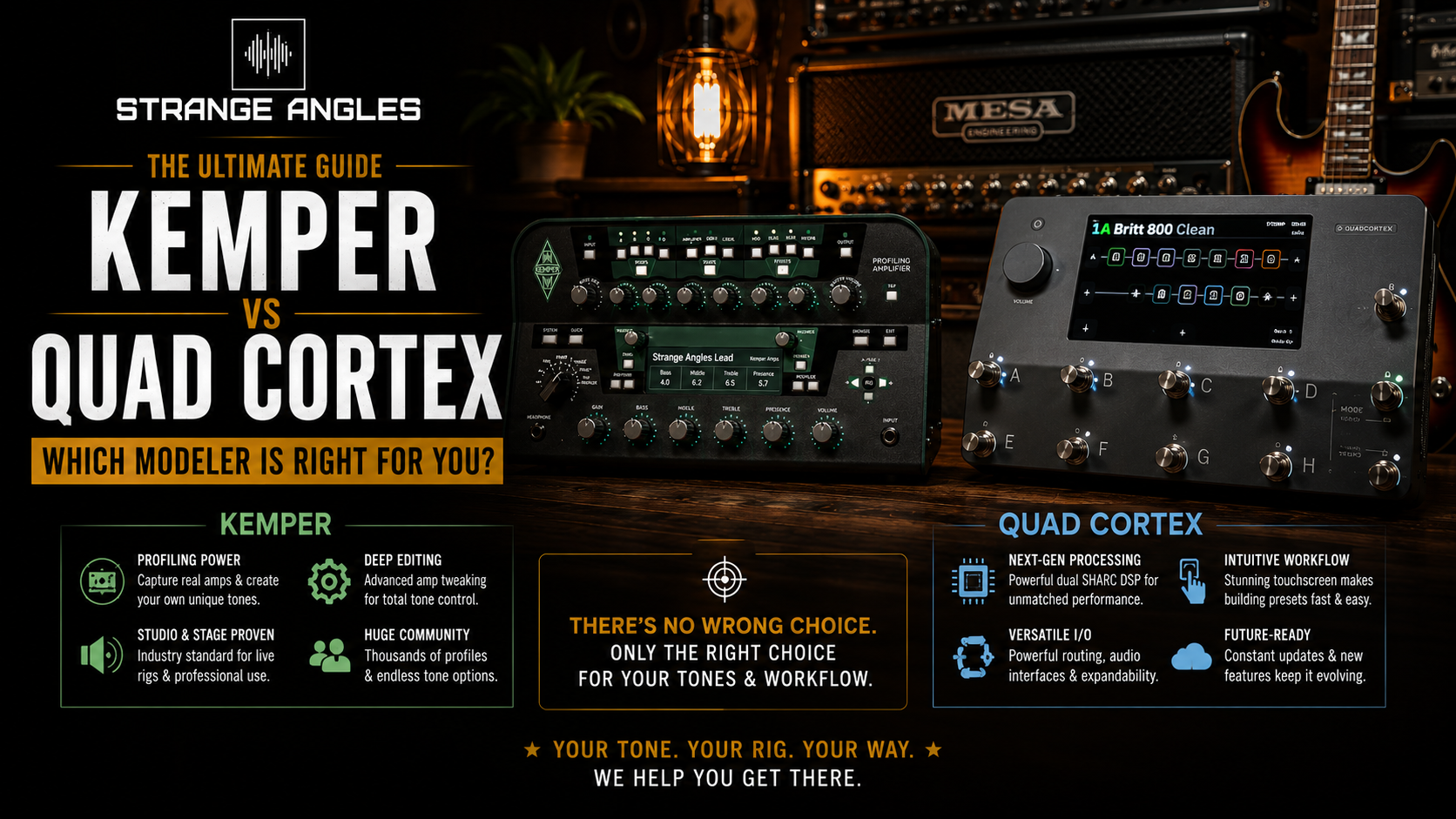
Kemper vs Quad Cortex: Which Guitar Modeler Is Right for You?
The Kemper Profiler and Neural DSP Quad Cortex are two of the most popular guitar modelers available today. Both are capable of producing incredible guitar tones for recording, rehearsals, and live performance, but they approach amp recreation in different ways.
If you're trying to decide which one is right for you, understanding the strengths of each platform will help you make a more informed decision.
What Is the Kemper Profiler?
The Kemper Profiler introduced many guitarists to the world of digital amp profiling.
Rather than relying solely on traditional amp modeling, the Kemper creates digital profiles of real amplifiers, allowing players to capture the sound and feel of their favorite rigs.
Over the years, it has become a trusted tool for countless professional musicians and recording engineers thanks to its reliability, sound quality, and enormous library of available profiles.
What Is the Quad Cortex?
The Neural DSP Quad Cortex combines amp modeling, Neural Captures, impulse responses, and powerful effects into a compact floor unit.
Its modern touchscreen interface, flexible signal routing, and capture technology have made it one of the most popular choices for players who want an all-in-one solution for recording and live performance.
The Quad Cortex is designed to provide both excellent tones and an intuitive user experience.
Sound Quality
Both units are capable of producing professional-quality guitar tones.
The Kemper is known for accurately reproducing profiled amplifiers, while the Quad Cortex combines modeled amplifiers with Neural Captures that recreate the sound of real gear.
When paired with quality impulse responses or cabinets, either platform is capable of delivering tones suitable for professional recordings and live performances.
For most players, the difference in sound quality is less important than finding the platform whose workflow best suits their needs.
Ease of Use
The Quad Cortex features a large touchscreen that makes creating presets, rearranging signal chains, and editing effects fast and intuitive.
The Kemper uses a more traditional interface with dedicated knobs and buttons that many players appreciate once they become familiar with the layout.
Neither approach is inherently better. It simply depends on whether you prefer a touchscreen workflow or a more traditional hardware interface.
Effects
Both platforms include a wide variety of effects, including:
• Reverbs
• Delays
• Modulation
• Compression
• Overdrives
• Pitch effects
• EQ
Each platform continues to receive firmware updates that expand its capabilities.
Captures and Profiles
One of the biggest differences between the two platforms is how they recreate amplifiers.
The Kemper uses Profiles.
The Quad Cortex uses Neural Captures alongside modeled amplifiers.
Both technologies have earned strong reputations among guitar players and producers, and both offer access to large libraries of commercial and community-created content.
Which Is Better for Live Performance?
Both units are widely used on professional stages around the world.
Players often choose based on factors such as:
• Workflow
• Effects
• Size
• Routing flexibility
• Existing preset libraries
Reliability has made both platforms popular with touring musicians.
Which Is Better for Recording?
For recording, either platform is capable of producing studio-quality guitar tones.
Many producers use both depending on the project, while others simply stick with the platform they know best.
The most important factor is choosing high-quality captures, profiles, and impulse responses that complement your playing style.
Best For
Kemper
• Players with large profile collections
• Traditional workflows
• Recording
• Live performance
• Studio use
Quad Cortex
• Modern touchscreen workflow
• Flexible routing
• Neural Captures
• Compact pedalboard rigs
• Recording
• Touring
Great For These Genres
Both platforms excel at:
• Modern Metal
• Metalcore
• Deathcore
• Progressive Metal
• Hard Rock
• Alternative Rock
• Blues
• Classic Rock
• Ambient
• Worship
Frequently Asked Questions
Does the Quad Cortex sound better than the Kemper?
Both platforms are capable of producing outstanding tones. The better choice often depends on the captures, profiles, impulse responses, and workflow that best fit your needs.
Can both use impulse responses?
Yes.
Both the Kemper and Quad Cortex support third-party impulse responses, allowing players to experiment with different speaker cabinets and microphones.
Which one is easier to use?
Many players find the Quad Cortex easier to learn because of its touchscreen interface, while others appreciate the dedicated controls and workflow offered by the Kemper.
Which one is better for modern metal?
Both platforms are excellent choices for modern metal when paired with quality captures, profiles, and impulse responses.
The quality of the content you load into the device often has a greater impact than the hardware itself.
Final Thoughts
The Kemper Profiler and Neural DSP Quad Cortex are both outstanding guitar modelers capable of delivering professional-quality tones.
Rather than asking which unit is objectively better, consider which workflow, features, and ecosystem best match the way you play, record, and perform.
Whichever platform you choose, pairing it with high-quality captures, profiles, and impulse responses will help you get the very best from your rig.
Ready to Upgrade Your Tone?
Explore Strange Angles Music's collection of professionally crafted Kemper profiles, Quad Cortex captures, impulse responses, and presets designed for today's most popular guitar modelers.