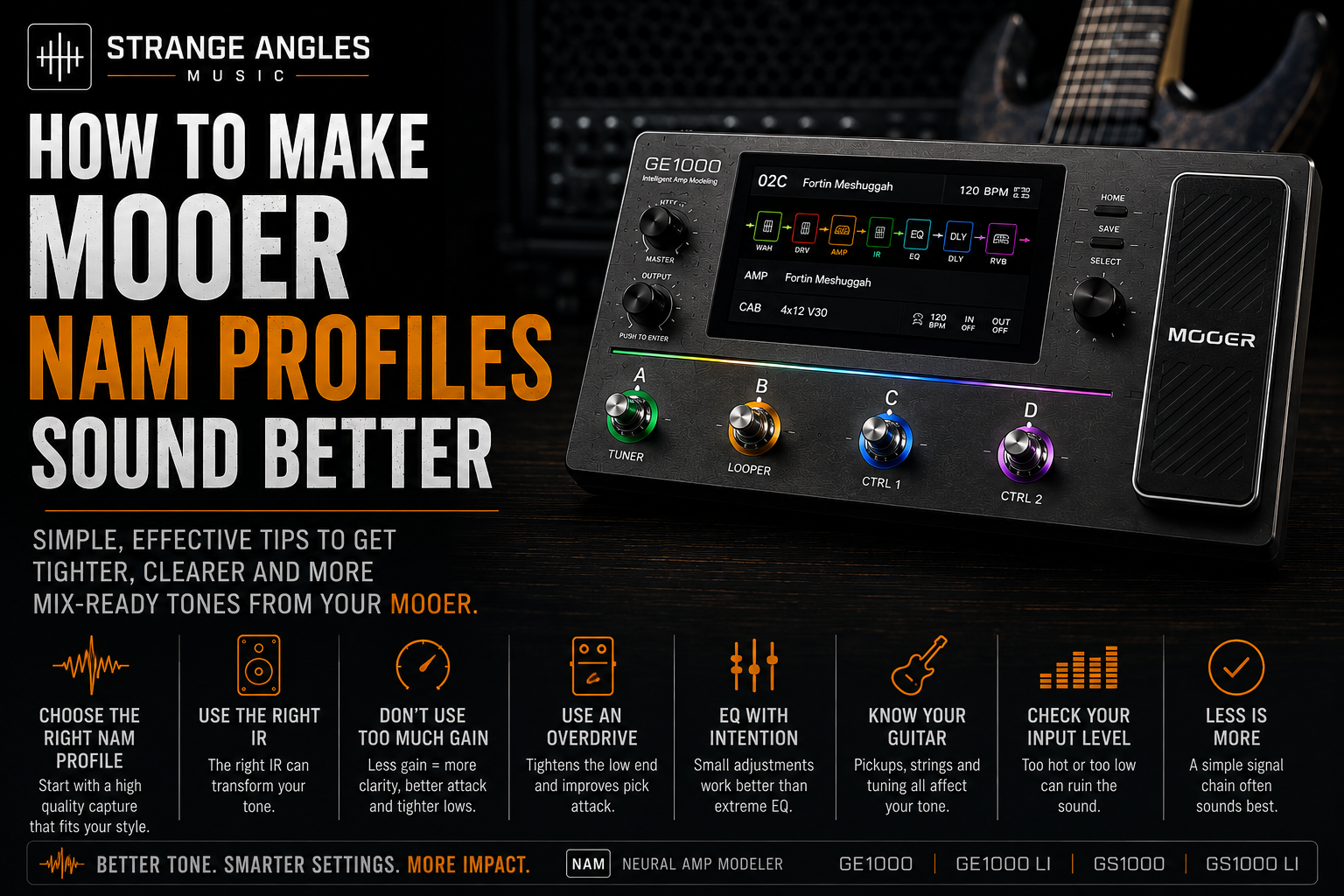
How to Make Mooer NAM Profiles Sound Better
NAM profiles can sound incredible on a Mooer, but the profile itself is only part of the equation. Your guitar, tuning, IR, input level, gain staging, and EQ all have a major impact on the final tone.
This article gives Mooer users a practical starting point for getting tighter, clearer, and more mix-ready NAM tones—especially for modern metal.
Looking for Great Tones?
Skip the endless tweaking and start with professionally captured NAM Profiles featuring boutique high-gain amps and classic tones.
🎸 Browse Premium NAM Profiles →
1. Start With a Good NAM Profile
No amount of EQ can completely fix a poor amp capture.
For modern metal, start with profiles based on amps that already have the characteristics you need.
Some excellent choices include:
Fortin Meshuggah — extremely tight and precise
Fortin Evil Pumpkin — aggressive and saturated
Driftwood Purple Nightmare — huge and thick
Randall Satan — tight and aggressive
Omega Ampworks Obsidian — modern and articulate
Granophyre — aggressive and punchy
MLC Subzero — focused and fast
RedSeven Leviathan — versatile modern high gain
RedSeven Duality — progressive and flexible
Carstens Empire — dynamic and articulate
Fryette Deliverance — aggressive with more dynamics
You can also get excellent results from classics like the 5150, JCM800, Plexi, Soldano SLO-100, and Mesa Rectifier Rev G.
2. Choose the Right IR
This is one of the biggest factors in your final tone.
Two NAM profiles of the exact same amplifier can sound completely different when paired with different IRs.
For modern metal, try:
Vintage 30
Strong mids and excellent cut.
DV-77
Tight and controlled with a modern character.
G12T-75
Brighter and more aggressive.
Creamback
Thicker and warmer.
Don't immediately start changing amp EQ when a profile doesn't sound right.
Try another IR first.
3. Don't Use Too Much Gain
This is one of the most common problems with digital guitar tones.
More gain can actually make your guitar sound smaller in a mix.
Too much gain creates:
Less note separation
Softer pick attack
More low-end buildup
Less room for bass guitar
Muddy chords
Try backing the gain down until individual notes become easier to hear.
Then turn the overall volume up.
4. Tighten the Low End
If you're playing a 7-string or Drop A, Drop B, or Drop C, this becomes even more important.
Avoid simply increasing the bass control.
Instead, try:
Less bass → tighter amp → appropriate IR
You want the guitar to have enough low end to sound powerful without competing with the bass guitar and kick drum.
5. Use an Overdrive
A Tube Screamer-style overdrive before the NAM amp can dramatically tighten a high-gain profile.
A good starting point is:
Drive: Low
Tone: Moderate
Level: High
The goal isn't to add another layer of distortion.
The goal is to tighten what hits the amp.
This is particularly effective with profiles such as:
Fortin Meshuggah
Fortin Evil Pumpkin
Randall Satan
Granophyre
MLC Subzero
6. Don't Over-EQ the NAM
If you're making huge EQ adjustments just to make the profile usable, consider trying a different profile.
Start with the amp relatively flat.
Then make small adjustments.
For example:
Too muddy?
Reduce bass or low mids.
Too harsh?
Try reducing upper mids or treble.
Too dark?
Try a brighter IR before boosting treble.
Too thin?
Try a different IR or add some low-mid body.
Small changes usually work better than extreme EQ.
7. Pay Attention to Your Guitar
Your NAM profile doesn't exist in isolation.
The guitar itself has a huge effect on the result.
Things such as:
Pickup output
Pickup type
Scale length
String gauge
Tuning
Playing technique
can all change how the profile responds.
A profile that sounds incredible with one guitar may need adjustment with another.
8. Check Your Input Level
If your Mooer's input level is too high, you're effectively pushing the NAM profile harder than intended.
If it's too low, the profile may feel weak or less responsive.
Start with a healthy signal without clipping the input.
This is particularly important with high-output active pickups.
9. Use Less Processing
It's easy to build a giant signal chain when you have hundreds of effects available.
But a great NAM profile often doesn't need much.
For a modern metal rhythm tone, try starting with:
Gate → Overdrive → NAM → IR → EQ
That's it.
Get that sounding great before adding delay, reverb, chorus, compression, or other effects.
10. Build Your Tone at Realistic Volume
A tone that sounds amazing through headphones at low volume may sound completely different through an FRFR speaker or PA.
Speakers and rooms affect what you hear.
When possible, check your tone at the volume you'll actually use.
And remember:
The best solo tone isn't always the best mix tone.
A guitar can sound somewhat thin by itself and still sound enormous once bass, drums, and vocals are added.
Great Starting Points for Different Styles
StyleNAM Profiles to TryDjentFortin MeshuggahMetalcoreFortin Evil PumpkinDeathcoreGranophyre / Evil PumpkinProgressive MetalOmega Obsidian / Carstens EmpireGroove MetalRandall Satan / Purple NightmareModern MetalMLC Subzero / RedSeven LeviathanTechnical MetalFortin Meshuggah / RedSeven DualityNu MetalMesa Rectifier Rev GClassic Metal5150 / JCM800 / Soldano
A Simple Mooer NAM Signal Chain
For a tight modern metal tone, start here:
Guitar
↓
Noise Gate
↓
Overdrive
↓
NAM Amp Profile
↓
IR
↓
Parametric EQ
↓
Delay/Reverb
You can then build from there.
The important thing is getting the NAM + IR combination right before adding additional processing.
The Biggest Mistakes to Avoid
❌ Too much gain
Use less than you think you need.
❌ Too much bass
Especially with 7-string and low-tuned guitars.
❌ Using the wrong IR
The IR can completely change the character of the amp.
❌ Excessive EQ
If you're cutting or boosting everything, try another profile.
❌ Too many effects
Start with the core amp tone.
❌ Judging the tone only in isolation
Always check how it works with the rest of the mix.
Final Thoughts
Getting great NAM tones from a Mooer isn't about endlessly turning knobs.
Start with a great capture, pair it with the right IR, keep the gain and low end under control, and make small adjustments from there.
For modern metal, profiles based on amps like the Fortin Meshuggah, Evil Pumpkin, Driftwood Purple Nightmare, Randall Satan, Omega Obsidian, Granophyre, MLC Subzero, RedSeven Leviathan, RedSeven Duality, and Carstens Empire give you excellent foundations.
And if you're after classic tones, the 5150, JCM800, Plexi, Soldano, and Rectifier Rev G remain extremely effective.
The goal isn't to make the guitar sound as huge as possible by itself.
The goal is to make it sound huge when it matters—in the mix.
Ready to Upgrade Your Tone?
Explore professionally captured NAM Profiles featuring boutique modern metal amplifiers and classic high-gain amps for Mooer and other compatible modelers.