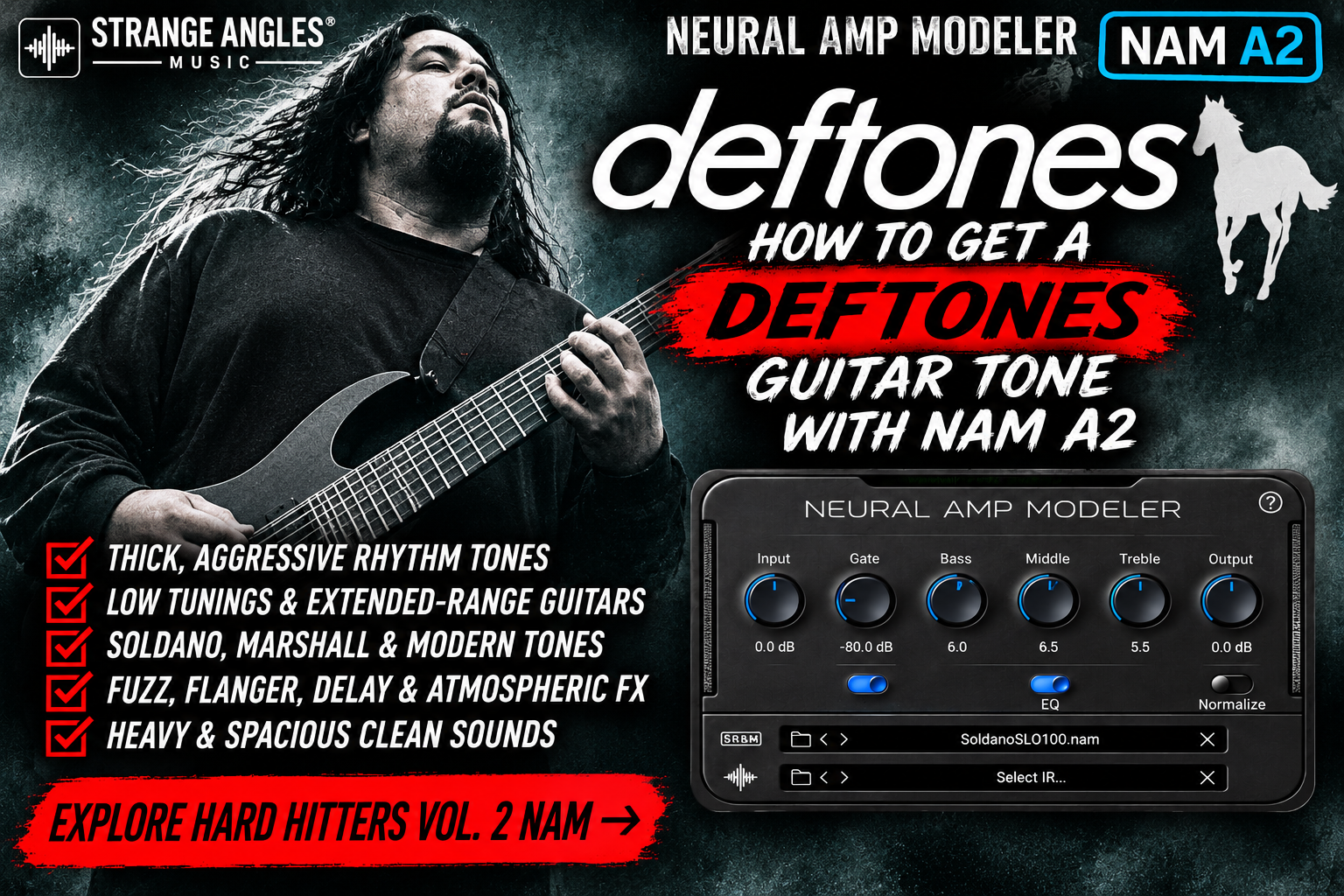
How to Get a Deftones Guitar Tone with NAM A2
Want to recreate the thick, atmospheric, and aggressive guitar tones of Deftones using Neural Amp Modeler (NAM)?
Deftones have one of the most recognizable guitar sounds in alternative metal. Stephen Carpenter combines extended-range guitars, low tunings, powerful amplifier distortion, unusual chord voicings, and atmospheric effects to create a sound that is both crushing and spacious.
From the raw aggression of Adrenaline and Around the Fur to the atmospheric heaviness of White Pony, Diamond Eyes, Koi No Yokan, and Ohms, Deftones have continually evolved their guitar sound.
Unlike many modern metal bands, Deftones don't rely exclusively on extremely tight, heavily gated rhythm guitars. Their sound often combines thick distortion, fuzzy textures, open chords, unusual harmonies, and effects that create a sense of space.
With Neural Amp Modeler, you can explore similar amplifier characteristics using professionally captured amplifiers, cabinet IRs, and additional effects.
In this guide, we'll look at Stephen Carpenter's amplifier history, how to build a Deftones-inspired NAM A2 signal chain, and which Strange Angles Music captures are worth exploring.
Looking for Great NAM A2 Tones?
Spend less time searching for the right amplifier and more time creating.
Explore professionally captured amplifiers, preamps, and overdrives designed for alternative metal, nu metal, progressive metal, and heavy rhythm guitar.
What Makes the Deftones Guitar Tone So Distinctive?
Deftones have a very different approach to heavy guitar tones compared with many traditional metal bands.
Stephen Carpenter's guitar sound combines enormous low-end weight with aggressive distortion, unusual chord voicings, and atmospheric textures.
Some of the defining characteristics include:
Extended-range guitars
Low tunings
Thick, aggressive distortion
Strong midrange presence
Fuzzy and saturated guitar textures
Open, dissonant chord voicings
Wide atmospheric effects
Flanger, chorus, delay, and pitch effects
Multiple amplifier and cabinet combinations
One of the most important things to understand is that Deftones' guitar sound isn't simply about using more gain.
The relationship between the guitar, bass, drums, and effects creates much of the band's distinctive atmosphere.
Sometimes the guitar needs to sound enormous and aggressive. Other times, it needs to be spacious, clean, and almost dreamlike.
A good Deftones-inspired setup should be capable of both.
What Amplifiers Does Stephen Carpenter Use?
Stephen Carpenter has experimented with a wide range of amplifiers throughout his career.
His documented amplifier history includes:
Bogner Uberschall
Soldano SLO-100
Diezel amplifiers
Rivera amplifiers
Marshall JMP-1 preamp
Marshall power amplifiers
Mesa/Boogie amplifiers
Fryette amplifiers
His setup has changed considerably over the years, including periods when he relied heavily on digital modelers.
1. Bogner Uberschall
The Bogner Uberschall is one of the most important amplifiers in Stephen Carpenter's current rig.
In a 2025 Premier Guitar Rig Rundown, Carpenter demonstrated his return to tube amplifiers, with Bogner Uberschall Uber Ultra heads at the center of his live setup.
The amplifiers were connected to Bogner UberKabs loaded with Celestion Vintage 30 and G12T-75 speakers.
The Uberschall is known for its powerful low end and aggressive high-gain character.
It is a particularly interesting amplifier to explore if you want a thick, modern Deftones-inspired rhythm sound.
2. Soldano SLO-100
The Soldano SLO-100 is another amplifier Stephen Carpenter has used.
In a 2026 Premier Guitar interview, he specifically praised the SLO-100 and discussed using it during the recording of Private Music.
This is an interesting connection because Strange Angles Music offers Soldano SLO-100 NAM captures.
The SLO-100 provides a different character from the Bogner Uberschall, with a rich midrange and expressive high-gain response.
3. Marshall JMP-1
The Marshall JMP-1 preamp was an important part of Carpenter's earlier rig.
During the Diamond Eyes era, he discussed using the JMP-1 preamp with a Marshall EL34 100/100 power amplifier and Marshall 4x12 cabinets.
This setup contributed to the aggressive Marshall character heard during that period.
4. Diezel Amplifiers
Carpenter has also used Diezel amplifiers during recording sessions.
Different amplifier combinations have been used across Deftones' albums, and the Diezel is another example of how his sound extends beyond one particular amplifier design.
5. Rivera and Fryette Amplifiers
Rivera and Fryette amplifiers have also appeared in Carpenter's recording and live setups.
His approach has often involved experimenting with different amplifier designs to find the right sound for each song.
This is why exploring different NAM captures can be particularly useful when trying to create Deftones-inspired tones.
What Guitar and Tuning Does Stephen Carpenter Use?
Stephen Carpenter is closely associated with extended-range guitars.
He has used seven-string and eight-string guitars throughout his career, including ESP signature models.
His more recent setup includes extended-range and baritone guitars from ESP and Kiesel.
The additional low strings allow him to create the enormous low-tuned riffs that are such an important part of Deftones' sound.
Deftones Tunings
Deftones use different tunings depending on the song and album.
There isn't one universal Deftones tuning.
Stephen Carpenter has used several different tunings across six-, seven-, and eight-string guitars.
If you're trying to recreate a particular song, always check its specific tuning rather than assuming every Deftones riff uses the same setup.
For a similar playing experience, consider:
A seven- or eight-string guitar
Appropriate string gauges
Humbucker pickups
Proper intonation
A setup designed for your preferred low tuning
You don't necessarily need an expensive signature guitar. A properly set up extended-range guitar is a great starting point.
Best NAM Amplifiers for Deftones-Inspired Guitar Tones
You don't need the exact Bogner Uberschall or Diezel amplifier to explore the character of Deftones' guitar sound.
Several Strange Angles Music NAM captures offer interesting alternatives.
1. Soldano SLO-100
The Soldano SLO-100 is one of the strongest product matches for this article.
Stephen Carpenter has specifically discussed using the SLO-100 during the recording of Private Music.
The amplifier provides a powerful, harmonically rich high-gain character that works well for aggressive rhythm guitar and expressive lead sounds.
Try it for:
Heavy alternative metal
Thick rhythm guitar
Aggressive lead tones
Midrange-focused distortion
Atmospheric heavy sections
2. Marshall JCM800 2203
The Marshall JCM800 is another interesting option.
Carpenter's earlier Marshall-based setups provide a useful tonal direction to explore.
The JCM800 offers a more traditional British amplifier character, with strong midrange and aggressive distortion.
Experiment with different overdrive settings and cabinet IRs to create your own interpretation.
3. Peavey 5150 Block Letter
The original Peavey 5150 is a great alternative if you want a powerful high-gain sound.
It offers a different character from the Soldano and Marshall captures and can work well for heavier Deftones-inspired rhythm parts.
4. Fortin Evil Pumpkin
The Fortin Evil Pumpkin provides a more modern high-gain alternative.
Try it when you want a heavier, more aggressive sound while maintaining strong note definition.
5. Omega Obsidian
The Omega Obsidian is another option for thick, aggressive rhythm guitar.
It offers a different tonal character from the Soldano and Marshall amplifiers and is worth experimenting with for heavier interpretations of Deftones' sound.
These are recommended alternatives and starting points. They are not claims that Deftones used these particular Strange Angles captures.
How to Get a Deftones Guitar Tone Using NAM A2
Let's build a practical signal chain.
Step 1: Choose Your Amplifier
Start with a Soldano SLO-100, Marshall JCM800, or another suitable high-gain capture.
For a thick Deftones-inspired rhythm sound, begin with the amplifier itself before adding additional processing.
Listen for:
Thick low-midrange
Aggressive distortion
Strong midrange presence
Clear chord definition
Enough saturation without excessive compression
Don't immediately add multiple boosts or EQ adjustments.
Get the amplifier sound right first.
Step 2: Experiment With Gain
Deftones use a variety of guitar tones, and not every part requires maximum distortion.
Try creating several different sounds:
Heavy saturated rhythm
Thick, fuzzy distortion
Crunchy mid-gain rhythm
Clean atmospheric guitar
Having different tones available is more useful than trying to force one amplifier setting to do everything.
Step 3: Choose the Right Cabinet IR
The cabinet plays a major role in the final sound.
A 4x12 cabinet is a useful starting point for aggressive rhythm guitar.
Experiment with:
Vintage 30-style speakers
G12T-75 speakers
Mesa-style 4x12 cabinets
Marshall-style 4x12 cabinets
SM57 microphone positions
Different microphone blends
Stephen Carpenter's current Bogner cabinets use a combination of Vintage 30 and G12T-75 speakers.
Experimenting with these speaker characteristics is a useful way to explore similar tonal territory.
If you're using a D.I. capture, add a suitable cabinet IR.
If you're using a full-rig capture, check whether the cabinet and microphone coloration are already included.
Step 4: Don't Remove Too Much Low-Midrange
A thick low-midrange is an important part of the Deftones sound.
If you remove too much, the guitar can become thin and lose its weight.
Instead, experiment with small adjustments to keep the guitar powerful without becoming muddy.
Step 5: Add Fuzz for Extra Texture
Fuzz is an interesting way to create some of the more aggressive and unusual guitar textures associated with Deftones.
Stephen Carpenter has used fuzz effects, including the Z.Vex Fuzz Factory and Boss FZ-1W.
You can experiment with a separate fuzz plugin or pedal before or after your NAM amplifier stage.
Try different combinations of fuzz and high-gain amplification.
Sometimes a slightly less conventional distortion sound works better than a perfectly polished modern metal tone.
Step 6: Experiment With Parallel Guitar Tones
One of the most useful recording techniques is blending different amplifier sounds.
Try recording one guitar performance through a Soldano capture and another through a Marshall capture.
You can also experiment with parallel processing of one performance, using different amplifier and cabinet combinations.
Adjust the levels until the two sounds complement each other.
How to Create Deftones-Style Atmospheric Guitar Effects
The amplifier is only part of the sound.
Stephen Carpenter uses a range of effects to create the textures that make Deftones so distinctive.
NAM captures the amplifier, but you can use separate plugins or hardware effects to recreate these additional sounds.
1. Flanger
Flanger is useful for creating moving, metallic guitar textures.
Experiment with:
Slow modulation
Deeper feedback
Different rate settings
Flanger before distortion
Flanger after distortion
Try using it on individual guitar parts rather than leaving it active on everything.
2. Chorus
Chorus can make clean guitar sounds wider and more atmospheric.
Try subtle settings for clean sections and more exaggerated modulation for experimental textures.
3. Delay
Delay is particularly useful for creating the spacious guitar sounds heard throughout Deftones' catalog.
Experiment with:
Short delays for thickness
Quarter-note delays
Longer atmospheric repeats
Modulated delay
Different delay levels
4. Pitch Shifting
Carpenter has used pitch-shifting effects, including DigiTech Whammy-style processing.
Try using pitch shifting for unusual intervals, octave changes, and expressive movement.
An expression pedal can make this particularly effective.
5. Reverb
Reverb is useful for the more atmospheric side of Deftones.
Try combining a clean or lightly distorted amplifier sound with delay and reverb.
This can create a completely different guitar character from the heavy rhythm tones.
6. Volume Swells
Volume swells are another useful technique for creating atmospheric guitar parts.
Try placing a volume pedal before delay and reverb.
Slowly increase the volume to create sustained, evolving textures.
Recommended NAM Signal Chains for Deftones-Inspired Tones
Here are three practical starting points.
Heavy Deftones Rhythm
Noise Gate
Optional Overdrive
Soldano SLO-100 NAM Capture
4x12 Cabinet IR
Subtle Post-EQ
Output
Thick Alternative Metal
Noise Gate
Marshall JCM800 NAM Capture
Fuzz or Distortion Effect
Cabinet IR
Post-EQ
Output
Atmospheric Deftones Guitar
Clean or Crunch Amp Capture
Chorus or Flanger
Delay
Reverb
Output
These are suggested starting points. Experiment with different effects and amplifier combinations to create your own sound.
Best NAM Packs for Deftones-Inspired Guitar Tones
Here are the Strange Angles Music products I would explore for this particular sound.
1. Euge Valovirta – Hard Hitters Vol. 2 NAM
Best match for the Soldano and Marshall amplifier character
This is my first recommendation for Deftones-inspired NAM tones.
It includes:
24 A2 D.I. amplifier captures
24 A2 full-rig studio captures
3 A2 D.I. overdrive captures
Featured amplifiers include:
Soldano SLO-100
Marshall 1959HW Jose Mod Plexi
Marshall JCM800 2203 The Bad Boy
Marshall JCM800 2203 The Little Brother
Peavey 5150 II
Peavey 5150 Block Letter
ADA MP-1 preamp into Fryette PS-100 power amp
The overdrive captures include:
Maxon OD808
BOSS SD-1
MXR Custom Badass Modified
The full-rig captures use a Marshall JCM800 1980s 4x12 cabinet loaded with Celestion G12-65 speakers.
The Soldano SLO-100 and Marshall JCM800 captures make this collection particularly interesting for exploring Stephen Carpenter-inspired amplifier tones.
It doesn't include his exact Bogner Uberschall or Diezel setup, but it gives you several useful amplifier alternatives.
Best for: Alternative metal, heavy rock, aggressive rhythm guitar, and players looking for Marshall and Soldano amplifier tones.
Explore Euge Valovirta – Hard Hitters Vol. 2 NAM →
2. NAM Everything Pack
Best for a broader selection of modern high-gain amplifiers
The NAM Everything Pack includes nearly 100 D.I. and studio profiles.
Featured amplifiers include:
Fortin Evil Pumpkin
Fortin Meshuggah 2.0
Omega Granophyre
Omega Obsidian 1.5
Driftwood Purple Nightmare
Dover DA 50
RedSeven Leviathan
Dimebag Darrell Warhead Mini
MLC S_ZERO 93 Silenoz
MLC S_ZERO 100
It also includes cabinet captures, preamps, and overdrives.
This is a good choice if you want to experiment with a much wider range of high-gain amplifier characters.
Best for: Players who want a large NAM collection covering modern metal and aggressive rhythm guitar.
3. Fortin – NAM Amp Bundle
The Fortin NAM Amp Bundle is another option for players who want aggressive high-gain amplifier tones.
Fortin designs offer a different character from the Soldano and Marshall amplifiers.
Experiment with the captures for heavier Deftones-inspired rhythm sounds.
Best for: Aggressive modern metal and players who want a focused collection of Fortin amplifier tones.
Explore Fortin – NAM Amp Bundle →
4. Individual IR Packs
Don't overlook the cabinet.
The right impulse response can make a major difference when creating thick, aggressive guitar tones.
Strange Angles Music offers several IR collections worth exploring:
Euge Valovirta IR packs
Everything IR Pack
V30 IR Pack
Creamback IR Pack
Try different speaker and microphone combinations to find the right balance of low-end weight, midrange aggression, and high-frequency detail.
Best for: Guitarists who want more control over their NAM cabinet sound.
How to Make Your Deftones Guitar Tone Sound Better in a Mix
Don't Make Every Guitar Track Sound the Same
Deftones use a variety of guitar textures.
Try combining different amplifier tones and effects rather than making every track sound identical.
Experiment With Different Guitar Performances
Record separate performances for your left and right rhythm tracks.
You can also experiment with different amplifier captures on each side.
Keep the Low End Under Control
The guitar needs to sound thick, but excessive bass can make the entire mix muddy.
Let the bass guitar provide much of the deepest low-frequency weight.
Use Effects Creatively
Don't limit yourself to traditional metal guitar processing.
Flanger, chorus, delay, pitch shifting, fuzz, and reverb can all contribute to the distinctive Deftones sound.
Create Contrast
One of the most important characteristics of Deftones is the contrast between heavy and atmospheric sections.
A clean, spacious guitar part can make the next distorted riff sound even heavier.
Frequently Asked Questions
What amplifier does Stephen Carpenter use?
Stephen Carpenter has used different amplifiers throughout his career, including Bogner Uberschall, Soldano SLO-100, Diezel, Rivera, and Marshall equipment.
His more recent live rig is centered around Bogner Uberschall Uber Ultra amplifiers.
What guitar does Stephen Carpenter use?
Stephen Carpenter is closely associated with ESP extended-range guitars, including seven-string and eight-string signature models. He has also used Kiesel guitars.
What tuning does Deftones use?
Deftones use different tunings depending on the song. Stephen Carpenter is particularly associated with extended-range guitars and low tunings. Always check the specific song's tuning.
Can I get a Deftones guitar tone with NAM A2?
Yes. You can use high-gain NAM captures, cabinet IRs, fuzz, modulation, delay, and reverb to build your own Deftones-inspired guitar tones.
What is the best NAM capture for Deftones?
There isn't one exact capture that recreates every Deftones album.
The Soldano SLO-100 and Marshall JCM800 captures in the Euge Valovirta Hard Hitters Vol. 2 NAM collection are excellent starting points.
Do I need an eight-string guitar?
No. An eight-string can help reproduce some of Stephen Carpenter's lower-register parts, but a properly set up six- or seven-string guitar can also work for many Deftones-inspired riffs.
Can I use NAM for clean Deftones tones?
Yes. You can use clean or lower-gain amplifier captures and add chorus, delay, reverb, and other effects to create atmospheric guitar sounds.
Can I use these captures for other alternative metal bands?
Absolutely. These amplifier captures can also be useful for exploring sounds inspired by bands such as Korn, Tool, Alice in Chains, and other heavy alternative rock and metal bands.
Final Thoughts
Deftones' guitar sound is built around contrast.
The heavy sections combine thick amplifier distortion, low tunings, and aggressive riffs, while the atmospheric sections use unusual effects, spacious delays, and expressive guitar textures.
The Soldano SLO-100 and Marshall JCM800 captures in the Euge Valovirta Hard Hitters Vol. 2 NAM collection are excellent starting points for exploring this style.
For a broader selection of modern high-gain amplifiers, the NAM Everything Pack gives you plenty of additional options.
Experiment with different amplifier combinations, cabinet IRs, fuzz, modulation, and delay.
The goal isn't to recreate one exact recording chain. It's to build your own Deftones-inspired guitar sound using Neural Amp Modeler.
Find Your Next NAM Guitar Tone
Explore the Strange Angles Music NAM collection and discover professionally captured amplifiers, preamps, and overdrives for alternative metal, nu metal, progressive metal, and more.