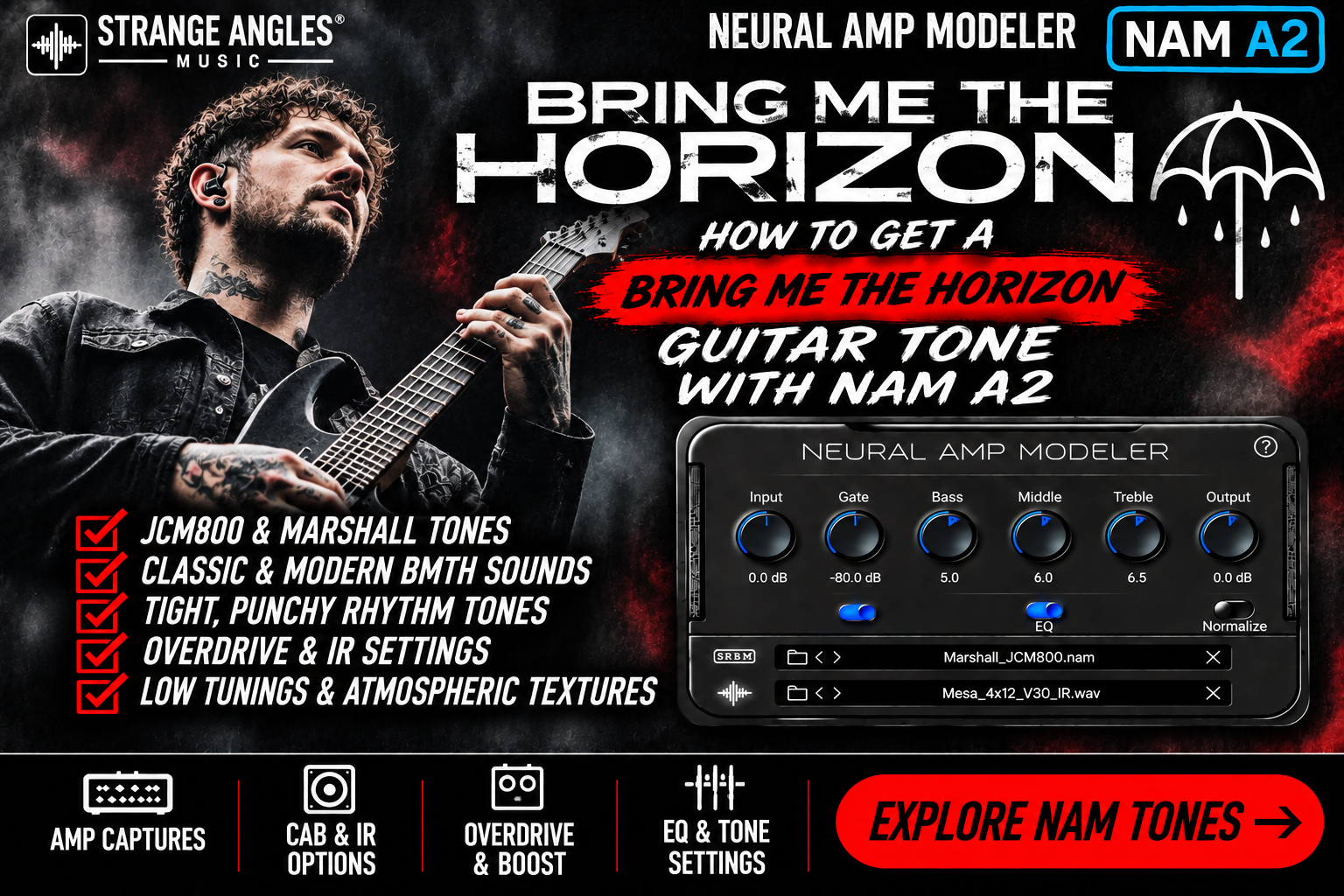
How to Get a Bring Me the Horizon Guitar Tone with NAM A2
Bring Me the Horizon have never been a band that sticks to one guitar sound. Their music has moved from aggressive metalcore to more melodic, electronic, and heavily produced alternative metal, with each era bringing a different approach to guitar tone.
But there are some recurring ingredients: powerful riffs, focused midrange, tight low end, and guitar sounds that work alongside electronic layers and atmospheric production.
In this guide, we'll look at guitarist Lee Malia's documented gear and explore how to build a Bring Me the Horizon-inspired sound using Neural Amp Modeler A2 profiles.
Looking for Great Tones?
🎸 Explore professionally captured NAM A2 profiles for aggressive metal, modern metalcore, and classic British amplifier tones.
What Makes the Bring Me the Horizon Guitar Tone?
The band's sound has changed considerably over the years, so it helps to think about different tonal eras rather than trying to recreate one universal BMTH tone.
Some important characteristics include:
Aggressive British amp character: Especially in the Sempiternal era, Marshall-style tones played an important role.
Strong midrange: The guitars need to cut through dense arrangements without becoming harsh.
Controlled gain: More distortion doesn't necessarily mean a heavier sound.
Low-tuned guitars: Heavy strings and lower tunings contribute to the band's weightier riffs.
Atmospheric effects: Delays, reverbs, pitch effects, and electronic textures help create the band's wider sound.
For a classic BMTH-inspired rhythm tone, a Marshall JCM800-style amplifier is a particularly useful starting point.
What Amps Has Lee Malia Used?
Lee Malia's documented equipment provides some excellent clues about how to approach the band's guitar sound.
Marshall JCM800
The Marshall JCM800 has been one of Lee Malia's most important amplifiers.
During the Sempiternal era, he used Marshall amplifiers for the aggressive guitar tones heard on songs such as "Shadow Moses."
In a 2025 interview with MusicRadar, Malia explained that the "Shadow Moses" tone came from a Marshall JCM800 boosted with a Klon-style overdrive.
His preferred setup was surprisingly simple: a JCM800, a 4x12 cabinet loaded with Celestion Vintage 30 speakers, and an overdrive.
He also emphasized that he doesn't like excessive gain. He wants the amplifier to retain its sharp attack and direct response.
Marshall JTM45
Malia has also used a Marshall JTM45 for clean tones.
This is a useful reminder that the band's sound isn't built entirely around high-gain amplifiers. Clean and atmospheric sections are an important part of many BMTH arrangements.
Wizard Modern Classic
During the recording of amo, Malia used a variety of amplifiers, including the Wizard Modern Classic.
He described using it when he wanted more gain and bite than the Marshall JCM800 provided.
This is an example of how the band has experimented with different amplifier characters depending on the song.
Neural DSP Quad Cortex
Malia's more recent live setup has moved toward digital modeling.
Premier Guitar's 2026 Rig Rundown documents his Neural DSP Quad Cortex configured for a modified Marshall-style tone. Most of his live effects are also handled through the Quad Cortex.
This is particularly interesting if you're building a modern digital guitar setup. The goal is still to preserve the response and character of the amplifier sound.
Best NAM A2 Profiles to Explore for a Bring Me the Horizon-Inspired Tone
You don't need the exact original equipment to explore these tones. The following Strange Angles Music collections provide useful starting points.
1. Euge Valovirta Hard Hitters Vol. 2 NAM
This is my first recommendation if you're chasing the aggressive British amplifier character associated with Lee Malia's JCM800 tones.
The collection includes:
Marshall 1959HW Jose Mod Plexi
Marshall JCM800 2203 The Bad Boy
Marshall JCM800 2203 The Little Brother
Soldano SLO-100
Peavey 5150 II
Peavey 5150 Block Letter
ADA MP-1 preamp into a Fryette PS-100 power amp
The two JCM800 captures are especially relevant for exploring the sharp, direct, aggressive response associated with Malia's classic rhythm sound.
Explore Euge Valovirta Hard Hitters Vol. 2 NAM →
2. NAM Everything Pack
If you want to explore more modern high-gain tones, the NAM Everything Pack gives you a much wider selection of amplifiers.
It includes captures of:
Fortin Evil Pumpkin
Fortin Meshuggah 2.0
Omega Granophyre
Omega Obsidian
Driftwood Purple Nightmare
Dover DA 50
RedSeven Leviathan
MLC S_ZERO 93 Silenoz
These amps provide different approaches to aggressive modern metal tones. They're worth exploring if you're looking for something heavier or more saturated than the traditional Marshall sound.
Explore the NAM Everything Pack →
3. The Chuggernaut NAM Pack
The Chuggernaut includes captures from the EVH 5150 III Mod, KSR Orthos, and ENGL Savage, along with custom IRs.
The EVH 5150 III Mod is a useful starting point for a tighter, more modern high-gain sound.
The additional amp captures and cabinet options give you room to experiment with different approaches to modern metalcore rhythm tones.
Explore The Chuggernaut NAM Pack →
How to Dial In a Bring Me the Horizon-Inspired Tone
If you're chasing the Sempiternal era, start with a JCM800-style capture. If you're after a more modern, saturated metalcore sound, compare it with a 5150-style or modern high-gain profile.
1. Start with a JCM800-Style Capture
Choose a JCM800-style NAM profile and begin with moderate gain.
Don't expect the amp to sound extremely saturated on its own. Malia's approach relies on the amplifier's attack and response rather than simply turning the gain all the way up.
2. Add an Overdrive Boost
A Klon-style overdrive is a useful reference for the "Shadow Moses" approach.
Try these general starting points:
Drive: Low
Tone: Around the middle
Level: Higher than unity
The purpose is to tighten the signal and push the amplifier, not to add a huge amount of additional distortion.
3. Choose a Vintage 30-Style IR
A 4x12 cabinet with Celestion Vintage 30 speakers is a particularly relevant starting point.
Try different IR microphone positions and blends. A Shure SM57-style capture can provide a focused upper-midrange attack, while a second microphone can add body and depth.
4. Keep the Gain Controlled
One of the most interesting things about Malia's approach is how little gain he uses compared with what people might expect.
If your tone sounds soft or loses its attack, try reducing the gain rather than adding more.
A tighter sound can often feel heavier in a mix.
5. Add Effects for the Wider BMTH Sound
For atmospheric sections, experiment with:
Stereo delay
Reverb
Octave or pitch effects
Modulation
Synth-style textures
These effects are part of what makes the band's arrangements distinctive. They don't need to be part of the core rhythm guitar signal all the time.
Guitar and Tuning Considerations
Lee Malia has used a variety of Gibson, Epiphone, and Jackson guitars throughout his career.
His more recent Jackson Pro Series Signature LM-87 is based on the Charvel Surfcaster design. Premier Guitar's 2026 Rig Rundown documents his use of a custom .080 low string, with tunings ranging from drop A to standard E.
That heavier string approach helps maintain tension when tuning down.
For lower-tuned BMTH-style riffs, consider:
Using strings appropriate for your tuning
Maintaining enough tension for accurate picking
Setting up your guitar's intonation correctly
Choosing pickups that provide the attack and output you want
Your guitar and playing technique will affect how a NAM profile responds, so don't assume the same settings will work identically with every instrument.
Can NAM A2 Recreate the Bring Me the Horizon Sound?
NAM A2 can provide the amplifier foundation for a Bring Me the Horizon-inspired tone.
However, the band's recorded sound is about more than the amplifier. Their music combines guitars with electronic production, effects, layered arrangements, and detailed mixing.
A single NAM capture won't automatically recreate a finished BMTH recording.
The best approach is to start with the right amp character, choose a suitable IR, and build the rest of the sound around the song you're trying to create.
Frequently Asked Questions
What amp does Lee Malia use?
Lee Malia has used Marshall JCM800 amplifiers extensively, along with other amplifiers such as the Wizard Modern Classic and Marshall JTM45. His more recent live setup uses a Neural DSP Quad Cortex configured for a modified Marshall tone.
What amp was used for the Shadow Moses guitar tone?
In a 2025 MusicRadar interview, Malia described the "Shadow Moses" tone as a Marshall JCM800 boosted with a Klon-style overdrive, through a 4x12 cabinet loaded with Vintage 30 speakers.
Does Bring Me the Horizon use digital amp modeling?
Yes. Malia's documented modern live setup includes the Neural DSP Quad Cortex, which handles his modified Marshall-style guitar tone and much of his effects processing.
What NAM profile should I use for a BMTH-style tone?
A JCM800-style capture is an excellent starting point for the classic aggressive rhythm sound. A 5150-style or modern high-gain capture can be useful for a heavier, more contemporary approach.
How much gain should I use?
Start with less gain than you think you need. Focus on attack, midrange, and low-end control. Add an overdrive boost if the sound needs more tightness.
Final Thoughts
Bring Me the Horizon's guitar sound has evolved across multiple eras, but Lee Malia's approach to tone offers a useful lesson: a great high-gain sound doesn't have to rely on excessive distortion.
Start with a JCM800-style NAM capture for the classic BMTH rhythm character, experiment with an overdrive boost, and find a Vintage 30-style IR that complements your guitar.
For a more modern direction, compare those tones with 5150-style and contemporary high-gain captures.