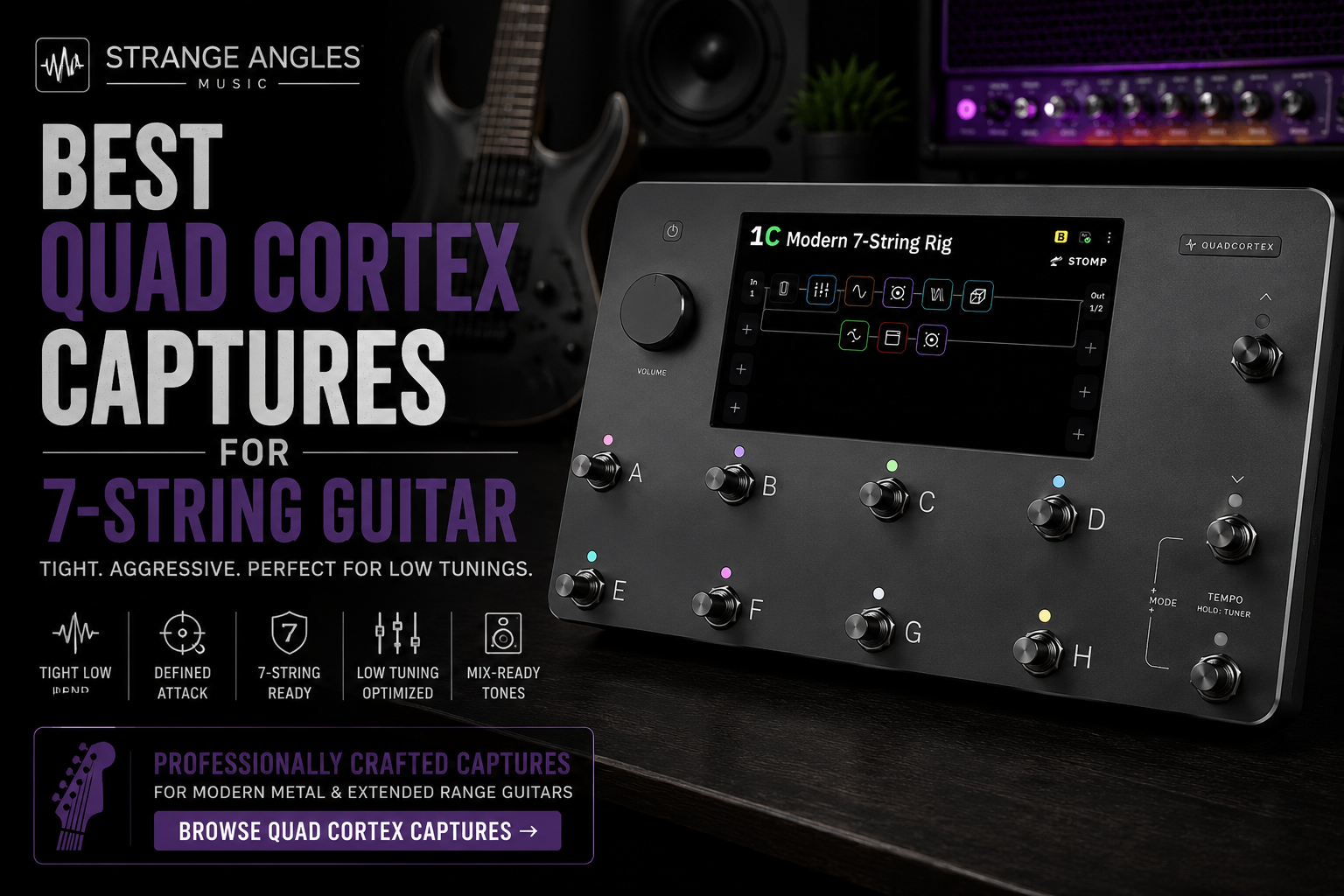
Best Quad Cortex Captures for 7-String Guitar
A 7-string guitar gives you access to massive low-end territory, but getting those low notes to sound tight, punchy, and defined can be challenging.
The right Quad Cortex capture can make a huge difference. A good high-gain capture should keep the low B string focused while still delivering the aggression, saturation, and pick attack needed for modern metal.
In this guide, we'll look at what makes a great Quad Cortex capture for 7-string guitar, which amp styles work particularly well, and how to get a huge low-tuned tone without sacrificing clarity.
Looking for Great Tones?
Spend less time tweaking and more time playing. Explore professionally crafted Quad Cortex captures designed for 7-string guitars, low tunings, modern metal, recording, and live performance.
🎸 Browse Premium Quad Cortex Captures →
Why 7-String Guitars Need the Right Capture
A 7-string isn't simply a 6-string with an extra note.
The additional low string creates significantly different demands on your entire signal chain.
A good capture needs to handle:
Extended low frequencies
Heavy palm muting
Fast pick attack
High-gain saturation
Complex chords
Low tunings
Dense mixes
If the amplifier has too much loose low end, the low B string can become muddy very quickly.
That's why tightness is one of the most important characteristics to look for.
What Makes a Great 7-String Quad Cortex Capture?
The best captures generally have:
Tight low end
Strong midrange
Fast transient response
Controlled gain
Clear note separation
Good palm-mute response
Enough saturation for modern metal
A cabinet that complements the amplifier
You don't necessarily need an extremely high-gain amp.
In many cases, a tighter, slightly less saturated capture will make a 7-string sound considerably heavier.
Best Amp Styles for 7-String Guitar
1. Fortin
Fortin-style amplifiers are an excellent starting point for 7-string guitars.
Their tight response works particularly well with low tunings and aggressive rhythm playing.
They're especially useful for:
Modern metal
Progressive metal
Djent
Metalcore
Low-tuned rhythm guitar
If you want extremely tight palm mutes, Fortin is one of the first amp families worth exploring.
2. 5150
The 5150 remains one of the most versatile choices for 7-string guitar.
It provides the combination of:
Aggressive mids
Tight response
Saturated gain
Strong pick attack
Excellent low-tuning performance
A 5150-style capture can work for almost anything from modern metal to progressive and alternative metal.
3. Omega
Omega amplifiers are particularly useful if you want a modern boutique high-gain sound.
The Omega Obsidian and Granophyre are both excellent choices for players who want:
Tight lows + aggressive mids + thick saturation.
They're especially effective with extended-range guitars.
4. Driftwood Purple Nightmare
The Driftwood Purple Nightmare is a great option when you want a larger, thicker sound.
Rather than sounding extremely clinical, it can provide a huge saturated character that works well for layered rhythm guitars.
It's particularly useful when you want the low end to feel massive without completely losing definition.
5. Randall Satan
The Randall Satan is another strong choice for 7-string guitar.
It's particularly effective for:
Tight riffs
Aggressive palm mutes
Low tunings
Modern high gain
Technical playing
Its aggressive response makes it a natural fit for extended-range guitars.
6. RedSeven Leviathan
The RedSeven Leviathan gives you another modern high-gain option.
It's useful when you want a slightly different character from the more familiar 5150 and Fortin approaches.
It can work particularly well for players who want a versatile 7-string rig capable of covering multiple modern heavy styles.
7. MLC Subzero
The MLC Subzero is another strong choice for low-tuned guitar.
Its focused response makes it useful for:
Low B
Drop A
Extended-range guitars
Tight rhythm parts
Modern metal
If your biggest problem is getting the low string to remain defined, this is the type of capture worth trying.
Don't Ignore Classic Amps
Modern boutique amplifiers aren't your only option.
Classic high-gain platforms can work extremely well with a 7-string.
Mesa/Boogie Rectifier
Great when you want a huge, saturated rhythm sound.
Soldano
Excellent when you want stronger midrange character and articulation.
ENGL
A strong option for aggressive upper mids and precise note definition.
JCM800
A boosted JCM800 can provide excellent attack and midrange aggression, particularly when you want something less compressed than a modern high-gain amplifier.
Use an Overdrive to Tighten the Low String
One of the easiest ways to improve a 7-string tone is using an overdrive before the amplifier.
A common setup is:
Overdrive → High-Gain Amp → Cab
Try using:
Low Drive + High Level
The purpose isn't necessarily to add distortion.
Instead, it helps control excessive low-frequency energy before it hits the amplifier.
The result can be:
Tighter palm mutes
Faster attack
Cleaner low B string
Less flub
Better note separation
Don't Add More Bass to Fix a Weak Low End
This is a common mistake.
If your 7-string sounds thin, your first instinct might be to add bass.
But a better solution may be:
A tighter amp
A different capture
A different cabinet
An overdrive
Less gain
Better EQ
The deepest part of the frequency spectrum is usually better handled by the bass guitar.
Your guitar needs to provide punch and definition.
Control the Gain
A 7-string can quickly become muddy when combined with excessive gain.
Try backing the gain down until:
Chords become clearer
Palm mutes become more defined
Picking becomes more responsive
Individual notes separate
Then listen to the guitar with drums and bass.
You may discover that the lower-gain setting actually sounds much heavier.
Cabinet Choice Matters
The cabinet can dramatically change how a Quad Cortex capture responds to a 7-string.
V30-style cabinets are an excellent starting point because their midrange helps guitars cut through dense productions.
But other speakers can work extremely well too.
Different cabinets can change:
Low-end response
Midrange aggression
Pick attack
High-frequency fizz
Overall thickness
If the amp feels right but the tone doesn't, try another cabinet before completely changing the amplifier.
7-String Pickups Matter Too
Your pickup choice has a major effect on the final tone.
High-output bridge pickups can provide the tight response needed for modern high-gain guitar.
But don't assume that the highest-output pickup will automatically sound best.
A pickup with strong articulation and controlled low end can sometimes work better than an extremely hot pickup.
The goal is to send the Quad Cortex a clear, controlled signal.
Best Tunings for 7-String Guitar
A 7-string gives you plenty of options.
Common choices include:
Standard 7-String
B–E–A–D–G–B–E
Excellent for modern metal and progressive playing.
Drop A
A–E–A–D–G–B–E
Extremely useful for heavy rhythm guitar and modern metal.
Lower Tunings
You can go even lower, but the further you push the tuning, the more important string gauge, setup, pickups, and low-end control become.
A good Quad Cortex capture can help, but the entire guitar setup matters.
Recording 7-String Guitar
When recording, don't judge your tone only by itself.
A guitar tone that sounds huge in isolation may completely overwhelm the bass guitar.
Instead, listen to:
Guitar + bass + kick + drums + vocals
The guitar should occupy its own space.
This is especially important when recording doubled or quad-tracked 7-string guitars.
One Great Capture Can Be Better Than 100 Average Ones
The Quad Cortex makes it easy to collect enormous numbers of captures.
But more captures don't necessarily mean better tones.
A handful of carefully selected captures can be much more useful than hundreds of similar high-gain options.
Look for captures that give you clearly different characteristics:
Tight and aggressive
Thick and saturated
Mid-focused
Raw and dynamic
Modern and polished
That gives you a useful tonal palette without overwhelming yourself with choices.
Best Quad Cortex Captures for 7-String: Quick Guide
Amp / Capture StyleBest ForFortinUltra-tight modern metal5150Versatile high gainOmega ObsidianModern boutique tonesOmega GranophyreAggressive rhythmDriftwood Purple NightmareThick, saturated tonesRandall SatanTight low-tuned riffsRedSeven LeviathanModern high gainMLC SubzeroFocused low-end responseMesa RectifierHuge saturated rhythmsSoldanoMid-focused articulationENGLTechnical precisionJCM800Raw boosted aggression
Frequently Asked Questions
What are the best Quad Cortex captures for 7-string guitar?
Fortin, 5150, Omega, Randall, Driftwood, RedSeven, MLC, Mesa, and ENGL-style high-gain captures are all excellent starting points.
Is Quad Cortex good for 7-string guitar?
Absolutely. Its high-gain captures, cabinet options, effects, EQ, and flexible signal routing make it particularly well suited to extended-range guitars.
What is the best amp for a 7-string?
There isn't one universal answer. Fortin and 5150-style amps are excellent starting points, while Omega, Randall, Driftwood, RedSeven, Mesa, and ENGL offer different tonal characteristics.
Is Drop A good for a 7-string?
Yes. Drop A is one of the most useful low tunings for a 7-string, particularly for modern metal and heavy rhythm guitar.
Should I use an overdrive?
An overdrive can be extremely useful for tightening the low end and improving pick attack. Start with low drive and higher level.
Why does my low B string sound muddy?
Excessive gain, bass, or loose low-end response are common causes. Try reducing gain, tightening the amp with an overdrive, changing the cabinet, or trying a different capture.
Do I need a special IR for a 7-string?
Not necessarily. A good cabinet or IR can certainly help, but the amplifier, capture, guitar, pickups, tuning, and playing technique all contribute to the final result.
Final Thoughts
A great 7-string tone isn't about making the low B string as huge as possible.
It's about making it tight, powerful, and clearly defined.
Start with a strong high-gain capture, tighten it with an overdrive, choose the right cabinet, control the bass and gain, and let the guitar's natural low end do the work.
Whether you prefer Fortin, 5150, Omega, Driftwood, Randall, RedSeven, MLC, Mesa, or ENGL, the Quad Cortex gives you plenty of options for building a massive 7-string rig.
Ready to Upgrade Your Tone?
Skip the endless tweaking and start with professionally crafted Quad Cortex captures designed for modern metal, extended-range guitars, low tunings, and recording.