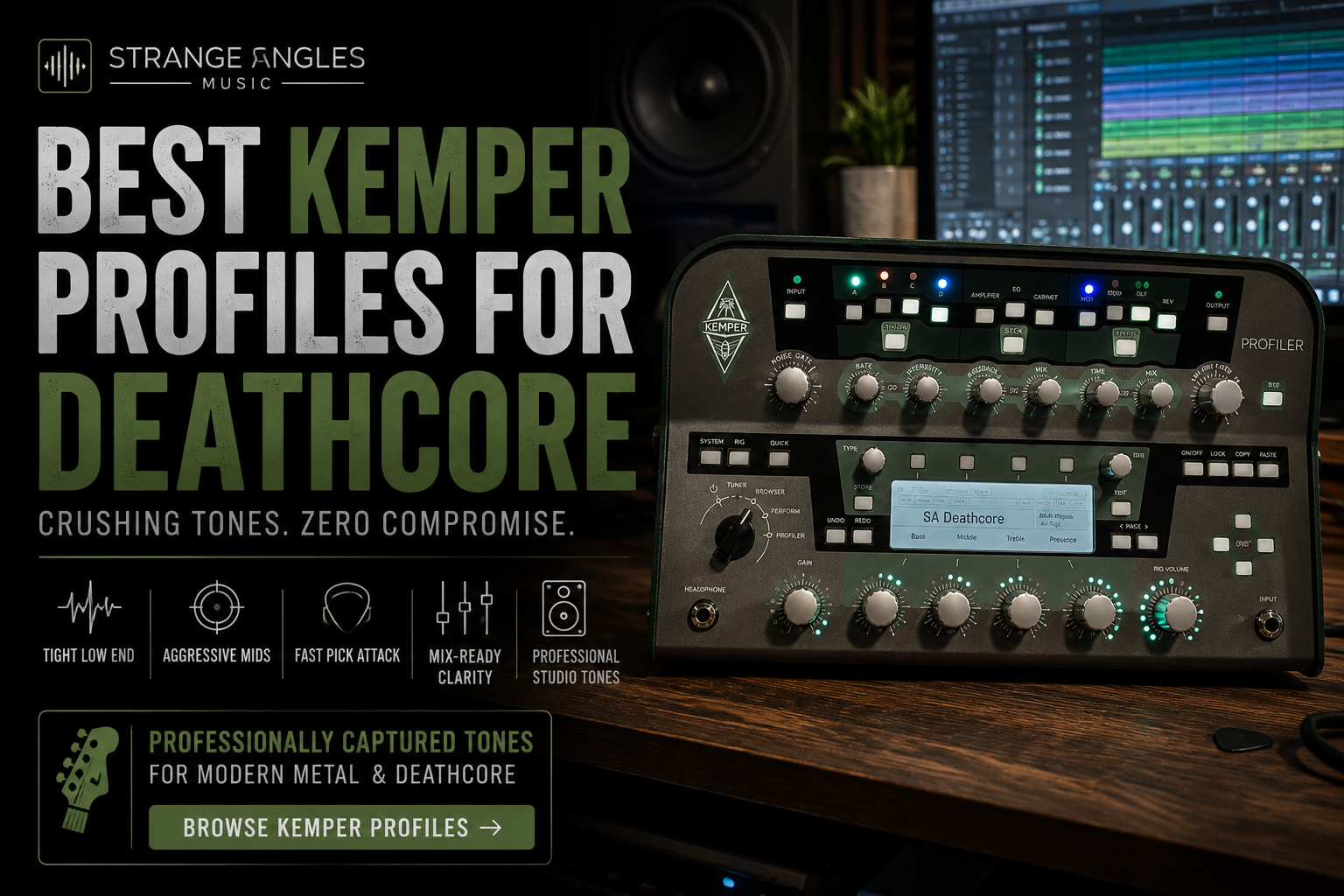
Best Kemper Profiles for Deathcore
Deathcore demands a very specific kind of guitar tone: massive low end, aggressive mids, tight palm mutes, fast pick attack, and enough clarity to keep complex riffs from turning into a wall of noise.
The challenge is finding Kemper profiles that deliver that aggression without becoming muddy or overly fizzy.
In this guide, we'll look at some of the best types of Kemper profiles for deathcore, what makes them work, and which amplifier styles are worth exploring if you're chasing crushing modern deathcore tones.
Looking for Great Tones?
Spend less time tweaking and more time playing. Explore professionally crafted Kemper profiles built around aggressive high-gain amplifiers and designed for modern metal, deathcore, low tunings, and recording.
What Makes a Great Deathcore Kemper Profile?
A great deathcore profile needs to do more than simply have a lot of gain.
The best tones typically have:
Extremely tight low end
Fast pick attack
Strong midrange presence
Excellent note separation
Controlled saturation
Aggressive palm mutes
Enough gain without excessive fizz
Clarity in low tunings
Deathcore guitars are often tuned extremely low, so excessive bass or gain can quickly make a profile sound loose and muddy.
The goal is heavy without losing definition.
Best Kemper Profiles for Deathcore
1. Chris Storey – All Shall Perish
If you're specifically looking for a deathcore-oriented Kemper pack, the Chris Storey – All Shall Perish pack is one of the most obvious places to start.
Chris Storey was a founding member of All Shall Perish, one of the pioneering bands of the deathcore movement, making this particularly relevant for players looking for authentic early-to-modern deathcore-inspired tones.
The pack includes 5 D.I. amp captures and 33 full-rig studio captures, covering a wide range of high-gain amplifiers.
The collection includes amps such as:
Splawn QuickRod 100
Original block-letter 5150 with upgraded transformer
RedSeven Leviathan
Driftwood Purple Nightmare
Engl Victor Smolski Ltd. E646
EVH 5150 III
Mesa Boogie Dual Rectifier
Engl Savage
Omega Granophyre
Rocktron Prophesy II + VHT 2/90/2
The full-rig captures also include Mesa, Marshall, and Engl cabinets along with several high-quality overdrive options.
This makes it particularly useful if you want a ready-to-play deathcore rig rather than starting from a completely raw amplifier capture.
The Chris Storey pack is currently available for Kemper for $44.99.
🎸 Browse Chris Storey – All Shall Perish Kemper →
2. Fortin Evil Pumpkin
The Fortin Evil Pumpkin is an excellent choice for players who want an extremely aggressive modern rhythm tone.
Its strengths include:
Tight low end
Aggressive attack
Saturated distortion
Strong upper-mid presence
Excellent response to low tunings
It's particularly well suited to:
Deathcore
Metalcore
Modern Metal
Drop tunings
For extremely tight rhythm guitar, this is one of the profiles I'd look toward first.
3. Fortin Meshuggah
If your idea of deathcore leans toward technical, precise, and brutally tight, the Fortin Meshuggah is another excellent option.
This type of voicing excels at:
Fast riffs
Low tunings
Palm-muted patterns
Technical playing
Extended-range guitars
The key characteristic is precision.
Instead of relying on huge amounts of distortion, the amp's tight response allows the picking attack and individual notes to remain extremely clear.
4. Driftwood Purple Nightmare
For players who want something bigger, thicker, and more aggressive, the Driftwood Purple Nightmare is worth trying.
It delivers a huge high-gain sound with:
Massive low end
Thick saturation
Aggressive mids
Strong punch
Excellent rhythm-guitar authority
It's especially effective when you want the guitars to sound enormous while still retaining enough definition for dense deathcore arrangements.
5. Randall Satan
The Randall Satan is another excellent choice for modern heavy music.
It's particularly strong when you want:
Tight palm mutes
Aggressive mids
Fast attack
Articulation
Controlled low end
It works particularly well with lower tunings and extended-range guitars where keeping the low strings defined is critical.
6. Omega Ampworks Obsidian
The Omega Obsidian is a great choice if you want a modern boutique high-gain sound rather than another traditional 5150-style tone.
Its combination of gain, articulation, and controlled low end makes it useful for:
Deathcore
Modern Metal
Progressive Metal
Low-tuned guitars
Recording
It's a particularly good option when you want a polished modern sound without sacrificing aggression.
7. Omega Granophyre
The Granophyre is another excellent deathcore choice.
It's capable of producing extremely aggressive rhythm tones while maintaining enough clarity for complicated riffs.
Expect:
Punchy low end
Aggressive mids
Fast response
Tight palm mutes
Heavy saturation
It's particularly well suited to deathcore, hardcore, and modern metal.
8. RedSeven Leviathan
The RedSeven Leviathan offers a slightly different flavor of high gain.
It's capable of producing extremely heavy rhythm tones while remaining versatile enough for leads and other applications.
It's a good option if you don't want your Kemper library completely dominated by one particular amp voicing.
9. MLC Subzero
The MLC Subzero is another strong choice for modern heavy guitar.
Its strengths include:
Tight response
Focused mids
Fast attack
Controlled low end
Strong note definition
For deathcore players using very low tunings, that controlled response can be extremely useful.
Don't Ignore the Classics
Modern boutique amps aren't the only way to get an incredible deathcore tone.
Some classic high-gain amplifiers remain extremely effective for the genre.
5150
The 5150 family remains one of the most useful starting points for aggressive metal rhythm tones.
Its combination of:
Tight response
Aggressive mids
Saturated gain
Strong attack
makes it extremely adaptable to modern deathcore.
Mesa/Boogie Dual Rectifier
The Dual Rectifier brings a different character, with a huge low end and unmistakable aggressive character.
It's particularly useful when you want the guitars to sound massive rather than ultra-clinical.
Engl
Engl amplifiers are another excellent option when articulation and aggressive upper mids are important.
They're particularly effective for technical and progressive styles of deathcore.
D.I. Profiles vs Full-Rig Profiles
When shopping for deathcore Kemper profiles, pay attention to whether you're getting a D.I. profile or a complete studio/full-rig profile.
D.I. Profiles
D.I. profiles capture the amplifier without committing you to a particular microphone-and-cabinet sound.
They're great if you want to:
Use your own cabinet
Experiment with IRs
Build your own complete rig
Fine-tune the final sound
Full-Rig / Studio Profiles
These are closer to a finished recording tone.
The amplifier, cabinet, microphone placement, and other parts of the signal chain have already been captured.
They're ideal if you want to:
Load the profile → plug in → play.
For recording and getting a great sound quickly, full-rig profiles can be incredibly convenient.
The Cabinet Still Matters
Even an excellent amplifier profile can sound wrong if you're pairing it with the wrong cabinet.
For deathcore, speakers such as the Celestion Vintage 30 are popular because they provide strong midrange presence and help guitars cut through dense mixes. Other speakers can produce thicker or smoother results depending on the sound you're after.
If you're using D.I. profiles, experimenting with different IRs can completely change the final character of the amp.
That's one of the biggest advantages of using D.I. profiles.
How Much Gain Should You Use?
Probably less than you think.
One of the biggest mistakes when building a deathcore tone is turning the gain up until the guitar sounds enormous by itself.
In a mix, excessive gain can actually make the guitars sound:
Smaller
Less defined
Muddy
Fuzzy
Less aggressive
A tighter profile with slightly less gain will often produce a much heavier recorded guitar tone.
Let the pick attack, low-end control, and midrange create the aggression.
What About Boosting?
A good overdrive in front of a high-gain amplifier can dramatically tighten the response.
A common approach is:
High-gain amp → overdrive with low drive → strong level boost → tight low end
The goal isn't necessarily to add more distortion.
Instead, the boost can help remove excessive low-end before the amplifier and make the attack more focused.
This is particularly useful for:
Drop A
Drop B
7-string guitars
8-string guitars
Fast palm-muted riffs
Best Deathcore Kemper Profiles: Quick Guide
Profile / AmpBest ForChris Storey – All Shall PerishDeathcore / complete rigsFortin Evil PumpkinModern deathcoreFortin MeshuggahTechnical / tight deathcoreDriftwood Purple NightmareHuge rhythm tonesRandall SatanTight modern metalOmega ObsidianModern boutique tonesOmega GranophyreAggressive deathcoreRedSeven LeviathanVersatile high gainMLC SubzeroTight low-tuned riffs5150Classic modern metal foundationMesa Dual RectifierHuge, aggressive rhythm tonesEnglArticulate technical tones
Strange Angles currently offers many of these amplifier families in its Kemper collection, including Fortin, Omega, RedSeven, Driftwood, Randall, Fryette, EVH, Engl, Mesa, MLC and others.
Frequently Asked Questions
What are the best Kemper profiles for deathcore?
There isn't one profile that works for everyone, but high-gain profiles based on amps such as the Fortin Evil Pumpkin, Fortin Meshuggah, Driftwood Purple Nightmare, Randall Satan, Omega Granophyre, 5150, and Mesa Dual Rectifier are excellent starting points.
For a deathcore-specific collection, the Chris Storey – All Shall Perish Kemper pack is particularly relevant.
Are 5150 profiles good for deathcore?
Absolutely. The 5150's tight response, aggressive mids, and saturated gain make it one of the most versatile starting points for modern heavy guitar.
Should I use a D.I. profile or a studio profile?
Use a D.I. profile if you want maximum flexibility with your own cabinet or IR. Choose a studio/full-rig profile if you want a more finished tone immediately.
How much gain should I use for deathcore?
Start lower than you think. Too much gain can reduce clarity and make low-tuned guitars sound loose. A tighter profile with controlled gain will usually work better in a mix.
What tuning works best with these profiles?
These profiles can work with everything from standard tuning to extremely low extended-range tunings. The lower you tune, the more important tight low-end response becomes.
Do I need an IR with a Kemper profile?
Not always. It depends on the type of profile you're using. D.I. profiles can be paired with your own cabinet or IR, while full-rig/studio profiles already include the cabinet character captured as part of the rig.
Final Thoughts
The best deathcore Kemper tone isn't necessarily the amp with the most gain.
It's the profile that gives you tight low end, aggressive attack, strong mids, and enough clarity to make every riff hit hard.
Start with the right profile, keep the gain under control, use an appropriate cabinet, and let your guitar and picking dynamics do the rest.
If you want a ready-made deathcore collection, the Chris Storey – All Shall Perish Kemper pack is an especially strong starting point. If you'd rather build your own rigs, amps like the Fortin Evil Pumpkin, Fortin Meshuggah, Driftwood Purple Nightmare, Omega Granophyre, Obsidian, Randall Satan, and RedSeven Leviathan give you plenty of different flavors to work with.
Ready to Upgrade Your Tone?
Skip the endless tweaking and start with professionally captured Kemper profiles designed for modern metal, deathcore, low tunings, and recording.