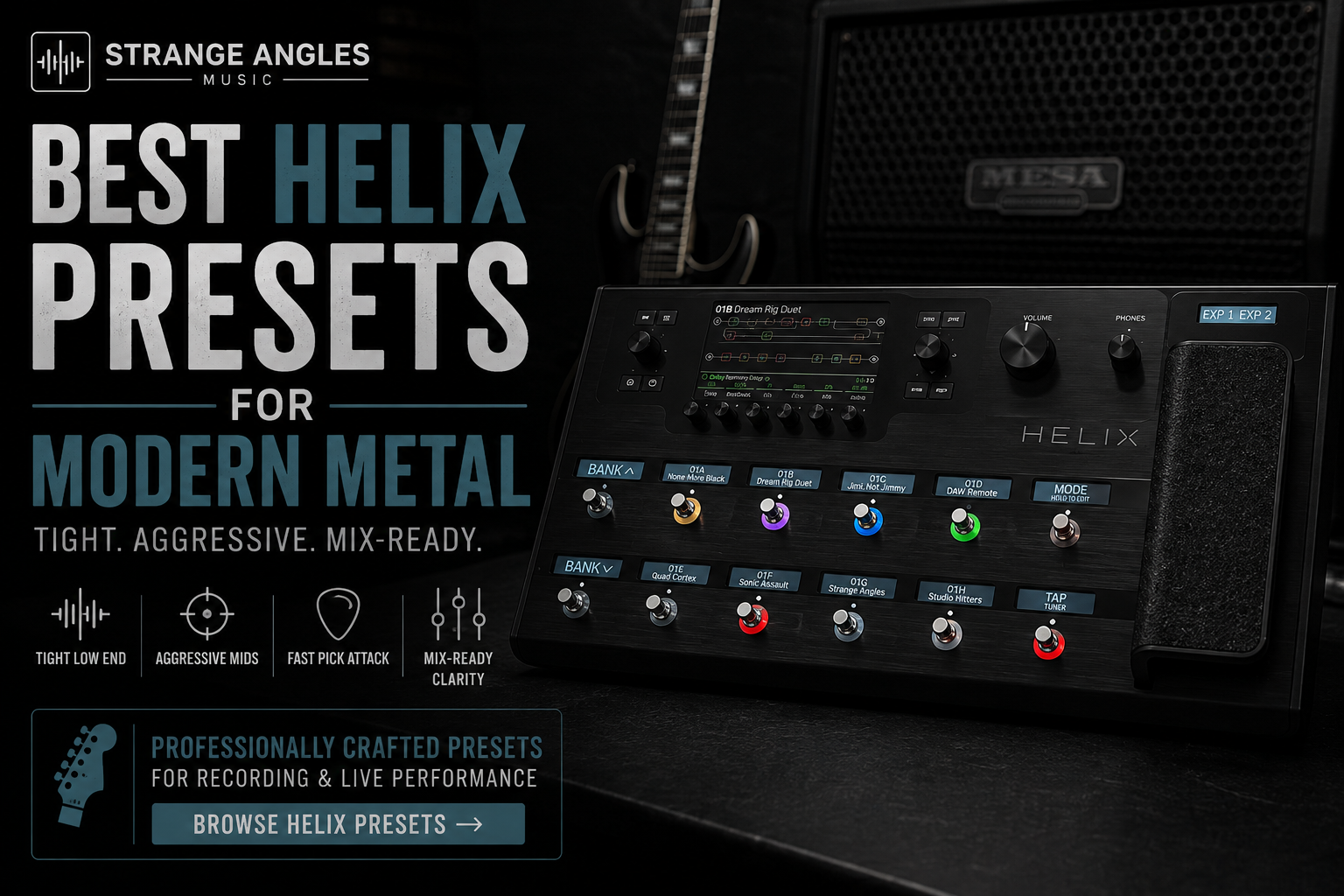
Best Helix Presets for Modern Metal
Getting a great modern metal tone from the Helix doesn't have to mean spending hours tweaking every parameter.
Modern metal guitar tones need tight low end, aggressive mids, fast pick attack, controlled gain, and enough clarity to work in a dense mix. The right preset can get you much closer to that sound without endless experimentation.
In this guide, we'll look at what makes a great Helix preset for modern metal, which amp styles work best, and how to build a tone that works for everything from tight rhythm guitar to huge lead tones.
Looking for Great Tones?
Spend less time tweaking and more time playing. Explore professionally crafted Helix presets designed for modern metal, high-gain rhythm guitar, recording, and live performance.
🎸 Browse Premium Helix Presets →
What Makes a Great Helix Preset for Modern Metal?
A modern metal preset needs more than a high-gain amplifier.
The best presets typically combine:
Tight low end
Aggressive midrange
Fast pick attack
Controlled high-gain saturation
A suitable cabinet or IR
An effective overdrive
Careful EQ
Proper gain staging
Useful snapshots for different sounds
The goal is to create a guitar tone that sounds huge without becoming muddy.
That's especially important with 7-string guitars, lower tunings, and heavily layered rhythm tracks.
Best Amp Styles for Modern Metal on Helix
1. 5150-Style Amps
If you're looking for a dependable starting point, 5150-style amplifiers are hard to beat.
They're known for the characteristics modern metal players typically need:
Tight low end
Aggressive mids
Plenty of saturation
Strong pick attack
Excellent response to low tunings
A 5150-style Helix preset can work for everything from metalcore and modern metal to progressive metal.
It's also a great foundation if you're building your own preset from scratch.
2. Rectifier-Style Amps
Mesa-style Rectifier tones are excellent when you want something big, aggressive, and saturated.
Compared with a tighter 5150-style sound, a Rectifier can provide a larger and more expansive character.
They're particularly useful for:
Modern metal
Metalcore
Alternative metal
Drop tunings
Huge rhythm guitars
If you want the guitars to sound massive rather than ultra-clinical, this is an excellent direction.
3. Soldano-Style Amps
Soldano-style amps can be a great choice when you want more emphasis on midrange character and articulation.
They're useful for players who don't want their tone to sound exactly like every other modern metal preset.
A good Soldano-style preset can work particularly well for:
Modern rock
Progressive metal
Lead guitar
Melodic metal
High-gain rhythm
4. ENGL-Style Amps
ENGL-style tones are particularly useful when precision is important.
They can provide:
Aggressive upper mids
Fast attack
Strong articulation
Tight response
Excellent note separation
They're a particularly good choice for technical modern metal where complicated riffs need to remain clearly defined.
5. Boutique High-Gain Tones
Modern boutique high-gain amplifiers can take things even further.
Amplifiers in the Fortin, Omega, Driftwood, RedSeven, MLC, and Fryette families are particularly interesting for modern metal because they offer different combinations of saturation, aggression, tightness, and midrange character.
This is where third-party presets can be especially useful.
Instead of starting with a generic amp model and spending hours trying to make it work, you can begin with a professionally dialed tone.
The Overdrive Is Extremely Important
One of the easiest ways to tighten a Helix high-gain preset is to place an overdrive before the amplifier.
The classic approach is:
Low Drive → High Level → High-Gain Amp
The overdrive isn't necessarily there to create more distortion.
Instead, it can:
Tighten the low end
Increase pick attack
Push the amp
Reduce flubby palm mutes
Focus the midrange
This is especially useful with lower tunings.
Don't Max Out the Gain
More gain doesn't automatically mean more metal.
In fact, excessive gain can make a modern metal tone sound smaller.
Too much gain can cause:
Muddy chords
Less pick definition
Weak palm mutes
Excessive fizz
Poor note separation
Try using slightly less gain than you think you need.
Once the bass and drums are added, the guitar will often sound significantly heavier.
Your IR Can Make or Break the Preset
The cabinet or IR is one of the most important parts of a modern metal tone.
You can have an excellent amp model and still end up with a disappointing tone if the cabinet isn't right.
A good IR can help determine:
Overall brightness
Midrange character
Low-end tightness
Pick attack
Fizz
Perceived size
V30-style speakers are an obvious starting point for modern metal, but they're not the only option.
Different speakers can completely change the personality of the same amplifier.
Don't Add Too Much Bass
This is one of the most common problems with high-gain presets.
When you're playing by yourself, adding bass can make the guitar sound huge.
In a mix, however, that same bass can fight with:
Kick drum
Bass guitar
Low-tuned guitars
Sub frequencies
Instead, aim for controlled low end and strong punch.
The bass guitar can occupy the deepest part of the frequency spectrum while the guitar provides the attack and aggression.
Keep the Mids
A heavily scooped guitar tone might sound impressive when you're playing alone.
But modern metal guitars need to compete with a lot of other instruments.
Mids help the guitar remain audible alongside:
Bass
Drums
Vocals
Other guitars
Rather than completely scooping the mids, try finding the frequencies that make the guitar cut without becoming harsh.
High-Pass and Low-Pass Filtering
Filtering is another useful tool for getting a mix-ready Helix preset.
A reasonable starting point is:
High-pass: 70–100 Hz
Low-pass: 8–10 kHz
These aren't fixed rules.
Your guitar, pickups, tuning, amp, cabinet, and mix will determine the final settings.
The goal is simply to remove frequencies that aren't contributing anything useful.
Build Snapshots Into Your Preset
One of the biggest advantages of the Helix is its snapshot system.
Instead of creating a completely separate preset for every sound, you can build multiple sounds around the same core rig.
For example:
Snapshot 1 — Rhythm
Tight amp + overdrive + cab.
Snapshot 2 — Rhythm Wide
Same core tone with additional ambience.
Snapshot 3 — Lead
Volume boost + delay + additional saturation.
Snapshot 4 — Clean
Clean amp + modulation + reverb.
This makes one well-designed preset much more useful for an entire song or live set.
Recording Presets vs Live Presets
The best Helix preset for recording isn't necessarily the best one for playing live.
Recording
A recording preset can be heavily optimized for a specific mix.
You might use:
Aggressive EQ
Carefully selected IR
High-pass/low-pass filtering
Stereo effects
Additional compression
Mix-specific processing
Live
A live preset needs to translate through a PA, FRFR speaker, or other monitoring system.
It should also provide:
Consistent volume
Easy snapshot switching
Reliable effects
Simple routing
Predictable dynamics
A tone that sounds amazing through headphones may need adjustment before taking it to the stage.
7-String and Low-Tuned Guitars
Modern metal is increasingly associated with extended-range guitars and low tunings.
This places additional demands on your preset.
As you tune lower, pay particular attention to:
Low-end control → Pick attack → Gain → Cabinet choice
If your low strings sound loose or blurry, don't immediately add more EQ.
Instead, try:
Reducing amp gain.
Tightening the low end with an overdrive.
Reducing excessive bass.
Trying another cabinet or IR.
Checking your input gain.
Often the solution is somewhere in the signal chain rather than the EQ.
Why Third-Party Helix Presets Can Save Time
The Helix gives you an incredible amount of control.
That's also its biggest downside.
You can spend hours comparing:
Amps
Cabs
IRs
Overdrives
EQs
Gates
Compressors
Delays
Reverbs
A professionally created preset can give you a finished starting point instead.
Strange Angles offers Helix products including Metal Rhythm, Metal Heads, and the Euge Valovirta Studio Hitters Vol.2 collection, giving players different approaches to modern high-gain guitar tones.
Best Helix Preset Ingredients for Modern Metal
Part of PresetRecommended Starting PointAmp5150 / Rectifier / Soldano / ENGLBoostTube Screamer-styleCabV30 or other proven metal speakerLow Cut~70–100 HzHigh Cut~8–10 kHzGainModerate-highBassControlledMidsPresent and aggressiveSnapshotsRhythm / Lead / Clean
Frequently Asked Questions
What are the best Helix presets for modern metal?
The best modern metal presets typically combine a tight high-gain amp, an appropriate cabinet or IR, an overdrive boost, and carefully controlled EQ. 5150, Rectifier, Soldano, ENGL, and modern boutique-style tones are all excellent starting points.
Is Helix good for modern metal?
Absolutely. Helix can produce everything from classic high-gain tones to extremely modern metal sounds. Its snapshot system also makes it particularly useful for building complete live rigs.
What is the best Helix amp for metal?
There isn't one universal winner. 5150-style amps are an excellent starting point, while Rectifier, Soldano, ENGL, and boutique high-gain styles can provide different flavors.
Should I use an overdrive with a Helix metal preset?
Usually, yes. A low-drive, high-level overdrive can tighten the amplifier and improve pick attack without simply adding more distortion.
Do I need an IR with Helix?
Not necessarily. Helix includes cabinet models, but third-party IRs can provide additional speaker and microphone combinations that may get you closer to a particular recorded sound.
Why does my Helix metal tone sound muddy?
Excessive gain, bass, or low-end information are common causes. Try reducing gain, tightening the amp with an overdrive, changing the cabinet or IR, and applying a high-pass filter.
Should I scoop the mids?
Generally, no. Keeping enough midrange helps your guitar remain audible in a full mix.
Final Thoughts
A great modern metal Helix preset isn't about turning everything up.
It's about tightness, balance, and clarity.
Start with a strong high-gain amplifier, tighten it with an overdrive, choose the right cabinet or IR, control the low end, and keep enough mids for the guitar to cut through the mix.
Once the core tone is right, use Helix snapshots to build rhythm, lead, clean, and other sounds around it.
And if you'd rather skip the hours of experimentation, a professionally crafted preset can give you a much stronger starting point immediately.
Ready to Upgrade Your Tone?
Spend less time tweaking and more time playing. Explore professionally crafted Helix presets built for modern metal, high-gain guitar, recording, and live performance.