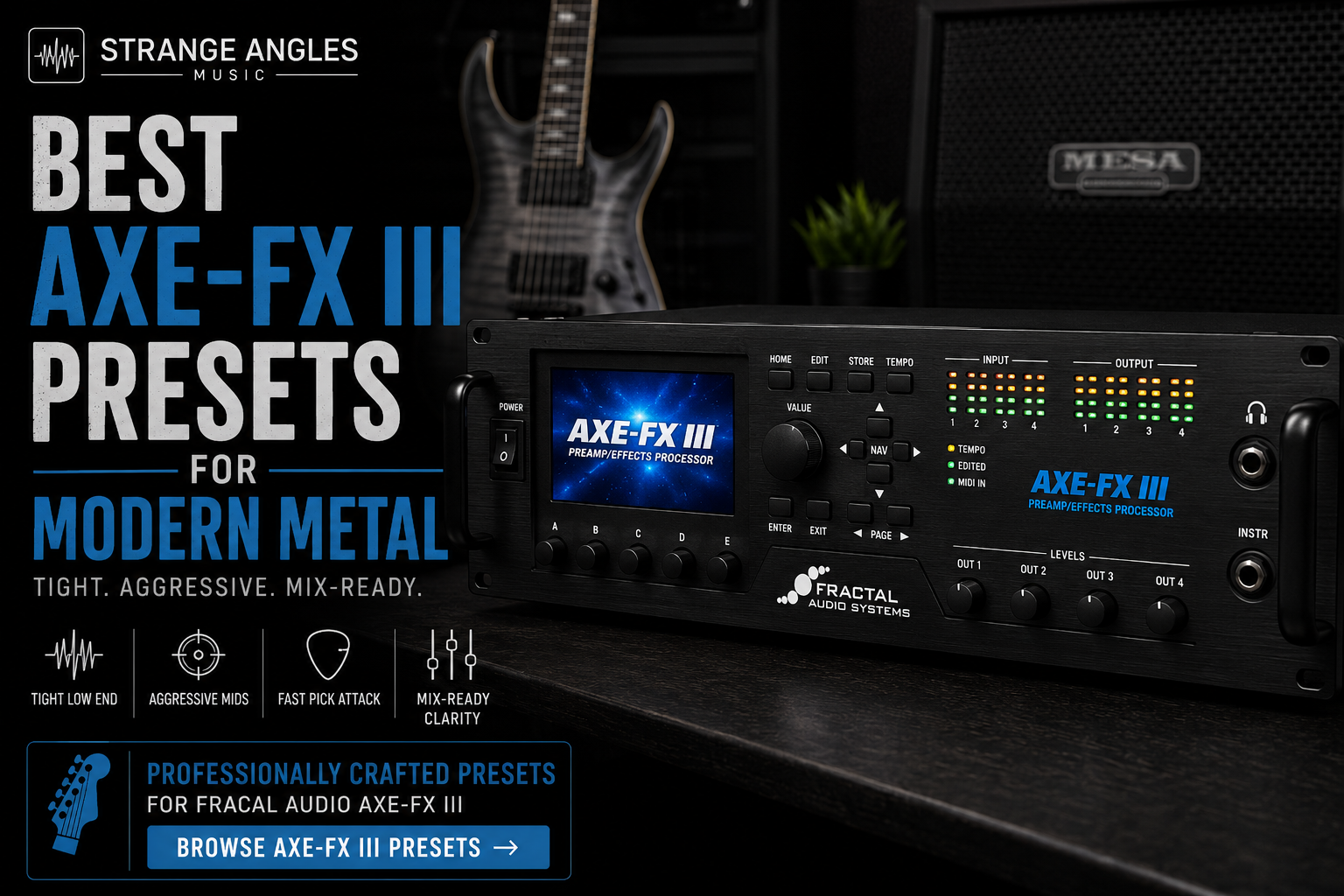
Best Axe-Fx III Presets for Modern Metal
The Axe-Fx III is one of the most powerful platforms available for modern metal guitar. With an enormous selection of amplifiers, cabinets, effects, routing options, and detailed tone controls, you can build practically any modern high-gain sound you can imagine.
But having thousands of options doesn't necessarily make finding the right tone easier.
A great modern metal preset needs tight low end, aggressive mids, fast pick attack, controlled gain, and a cabinet that keeps the guitar clear in a dense mix.
This guide covers what to look for in the best Axe-Fx III presets for modern metal and which amp styles are worth exploring.
Looking for Great Tones?
Spend less time tweaking and more time playing. Explore professionally crafted Axe-Fx III presets designed for modern metal, high-gain rhythm guitar, recording, and live performance.
🎸 Browse Premium Fractal Audio Presets →
What Makes a Great Modern Metal Axe-Fx III Preset?
A great metal preset isn't simply an amp with maximum gain.
The best presets usually combine:
Tight low end
Aggressive mids
Fast pick attack
Controlled saturation
A carefully selected cabinet
An effective boost
Useful EQ
Consistent gain staging
Scenes for different sounds
The objective is a guitar tone that sounds big, aggressive, and defined.
Best Amp Styles for Modern Metal
1. 5150-Style Amps
The 5150 remains one of the best foundations for modern metal.
Its combination of saturation, aggression, and tight response makes it extremely versatile.
A good 5150-style preset can cover:
Modern metal
Metalcore
Progressive metal
Heavy rhythm
Low tunings
7-string guitar
If you're building a modern metal preset from scratch, this is one of the easiest places to start.
2. Fortin-Style Amps
Fortin-style tones are excellent when you want maximum tightness and aggression.
They're particularly effective for:
Palm-muted riffs
Low tunings
7-string guitars
8-string guitars
Technical metal
Modern rhythm guitar
If your priority is an extremely controlled low end and sharp attack, Fortin-style tones are worth exploring.
3. Omega
Omega-style high-gain amps provide a more modern boutique approach.
The Omega Obsidian and Omega Granophyre are particularly useful when you want:
Tight lows + aggressive mids + thick saturation.
They can provide a distinctive alternative to the familiar 5150 sound while still delivering the characteristics needed for modern metal.
4. Driftwood Purple Nightmare
The Driftwood Purple Nightmare is an excellent option for players who prefer a thicker and more saturated modern metal sound.
It can provide a huge rhythm tone without necessarily becoming overly clinical.
This makes it particularly useful for:
Modern metal
Progressive metal
Metalcore
Low tunings
Layered rhythm guitars
5. RedSeven Leviathan
The RedSeven Leviathan provides another modern high-gain character.
It's a good choice when you want to move away from the most familiar 5150-style sound while retaining:
Tight response
Strong attack
Aggressive mids
Modern saturation
6. MLC Subzero
The MLC Subzero is particularly useful for players looking for a focused, aggressive rhythm sound.
It's well suited to:
Low tunings
7-string guitar
Tight palm mutes
Modern metal
Fast rhythm parts
7. Fryette Deliverance
The Fryette Deliverance provides a different approach to high gain.
Rather than relying entirely on massive saturation, it can offer a more dynamic and aggressive response.
This makes it useful when you want modern metal tones with more pick sensitivity and less compressed character.
Classic Amplifiers Still Work
Modern metal doesn't require a modern boutique amplifier.
Several classic platforms remain incredibly effective.
Mesa/Boogie Rectifier
Great for huge, saturated rhythm tones.
Soldano
Excellent for aggressive mids and articulate high gain.
JCM800
A boosted JCM800 can provide exceptional attack and a more raw character.
Plexi
A boosted Plexi can work surprisingly well when you want more dynamics and less compression.
5150
Still one of the most versatile modern metal choices.
The Overdrive Tightens Everything Up
A boost is one of the most useful tools for modern metal.
A common signal chain is:
Overdrive → Amp → Cab → EQ
The overdrive doesn't have to provide significant additional distortion.
Instead, it can:
Tighten the low end
Increase pick attack
Reduce flubby palm mutes
Push the amp
Focus the frequency response
A good starting point is:
Low Drive + High Level
Then adjust the tone to suit your guitar and amp.
Don't Max Out the Gain
One of the easiest ways to make a metal preset worse is using too much gain.
Excessive gain can create:
Muddy chords
Weak attack
Blurred palm mutes
Excessive fizz
Poor note separation
Try reducing the gain until the guitar becomes more open and responsive.
Then listen with drums and bass.
The tone will often sound heavier with less gain.
Cabinet Selection Is Just as Important as the Amp
The cabinet has an enormous influence on the final sound.
The same amp can sound completely different through different cabinets.
For modern metal, V30-style cabinets are an excellent starting point, but you don't have to stop there.
Other speakers can provide different combinations of:
Tightness
Thickness
Midrange aggression
Pick attack
High-frequency smoothness
If your amp sounds right but your preset doesn't, try changing the cabinet before replacing the amplifier.
Don't EQ Before Choosing the Right Amp and Cab
It's tempting to solve every problem with EQ.
But if you're constantly making huge EQ cuts and boosts, the underlying amp or cabinet may simply not be the right match.
A better process is:
Amp → Cab → Boost → Basic EQ → Fine tuning
Start with the right ingredients before trying to fix them with processing.
Control the Low End
Modern metal often involves Drop C, Drop B, Drop A, and even lower tunings.
The lower you tune, the easier it is for excessive low end to become a problem.
If your guitar sounds loose, try:
Reducing gain.
Tightening the amp with a boost.
Reducing excessive bass.
Trying another cabinet.
Checking your input level.
Don't automatically boost bass.
The biggest-sounding guitar in a mix is often the one with the most controlled low end.
Keep the Mids
A heavily scooped guitar can sound impressive alone.
But once you add drums, bass, vocals, and another guitar, that same tone can disappear.
Mids provide the guitar's identity.
For modern metal, focus on finding the frequencies that give you:
Aggression + attack + definition
without making the guitar harsh.
High-Pass and Low-Pass Filtering
Filtering can help remove frequencies that aren't contributing anything useful.
A reasonable starting point is:
High-pass: 70–100 Hz
Low-pass: 8–10 kHz
These are starting points, not universal rules.
Your guitar, pickups, tuning, amp, cabinet, and mix should determine the final settings.
Build Scenes Around the Core Tone
One of the biggest advantages of the Axe-Fx III is its scene system.
Instead of building an entirely separate preset for every sound, create multiple variations around the same core rig.
Scene 1 — Rhythm
High-gain amp + boost + cab.
Scene 2 — Rhythm Wide
Core rhythm tone with additional ambience.
Scene 3 — Lead
Volume boost + delay + reverb.
Scene 4 — Clean
Clean amp + modulation + reverb.
This lets one preset cover an entire song or performance.
Recording Modern Metal
A recording preset should be designed around the mix, not just the guitar.
Listen to the guitar alongside:
Bass
Kick
Snare
Vocals
Other guitars
A tone that sounds slightly thin when soloed may become enormous when doubled.
This is particularly important when recording multiple rhythm guitar tracks.
You don't want every guitar track occupying exactly the same frequencies.
Live Modern Metal Presets
Live presets have different requirements.
You need a tone that translates through your monitoring system and the PA.
Useful considerations include:
Consistent volume
Simple routing
Easy scene changes
Predictable dynamics
Appropriate effects levels
Build your preset so you can quickly switch between rhythm, lead, clean, and ambient sounds without disrupting the performance.
Axe-Fx III Presets vs Starting From Scratch
The Axe-Fx III gives you incredible control, but that can become a rabbit hole.
You can spend hours comparing:
Amp models
Cabs
Mic combinations
Boosts
EQ
Gates
Compressors
Delays
Reverbs
A professionally created preset gives you a strong starting point that's already been dialed in.
You can then make small adjustments for your guitar, pickups, tuning, and monitoring system rather than starting from zero.
Strange Angles Presets for Modern Metal
Strange Angles offers several Fractal Audio products aimed at modern high-gain guitar, including:
Metal Essential
Metal Rhythm
Metal Heads
Euge Valovirta Studio Hitters Vol.2
NRTHRN Guitar Presets
Sonic Assault Studios presets
Depending on the product, versions are available for Axe-Fx III, FM9, and FM3.
These provide different approaches to modern metal rather than forcing every player into the same amplifier sound.
Best Axe-Fx III Preset Ingredients
ComponentRecommended Starting PointAmp5150 / Fortin / Omega / MesaBoostTube Screamer-styleCabV30 or another proven metal cabGainModerate-highBassControlledMidsPresent and aggressiveLow Cut~70–100 HzHigh Cut~8–10 kHzScenesRhythm / Lead / Clean / Ambient
Frequently Asked Questions
What are the best Axe-Fx III presets for modern metal?
The best presets generally combine a tight high-gain amp, carefully selected cabinet, overdrive boost, and controlled EQ. 5150, Fortin, Omega, Mesa, ENGL, Soldano, and other high-gain platforms are excellent choices.
Is Axe-Fx III good for modern metal?
Absolutely. Its detailed amp models, extensive cabinet options, effects, routing, and scene system make it exceptionally capable for modern metal.
What is the best amp for modern metal on Axe-Fx III?
There isn't one universal answer. 5150-style amps are an excellent starting point, while Fortin, Omega, Mesa, Soldano, ENGL, and other platforms offer different tonal characteristics.
Should I use an overdrive?
Yes. An overdrive can tighten the low end and improve pick attack. Start with low drive and higher level rather than simply adding another layer of distortion.
How much gain should I use?
Usually less than you think. Excessive gain can reduce clarity and make rhythm guitar sound smaller in a mix.
What cabinet should I use?
V30-style cabinets are a great starting point, but other speakers can work extremely well. The cabinet should complement the amplifier and guitar rather than simply make the preset brighter.
Should I scoop the mids?
Generally, no. Controlled mids help modern metal guitars remain audible in a dense mix.
Do I need an IR with Axe-Fx III?
Not necessarily. The Axe-Fx III has extensive cabinet options built in, including the ability to use third-party IRs if desired.
Final Thoughts
The best Axe-Fx III preset for modern metal isn't the one with the most gain, bass, or processing.
It's the one that delivers tight low end, aggressive mids, fast attack, and enough saturation to sound huge while remaining clear.
Start with the right amplifier and cabinet, tighten the amp with an appropriate boost, control the low end, and build your scenes around a strong core rhythm tone.
Whether you prefer the precision of Fortin, the familiar aggression of a 5150, the modern boutique character of Omega, or the massive sound of a Mesa Rectifier, the Axe-Fx III gives you an enormous range of options.
And if you'd rather spend your time playing instead of endlessly tweaking, a professionally crafted preset can give you a much stronger starting point.
Ready to Upgrade Your Tone?
Spend less time tweaking and more time playing. Explore professionally crafted Fractal Audio presets designed for modern metal, high-gain guitar, recording, and live performance.